
The Society of Jesus (Jesuits) has been …
Years: 1692 - 1692
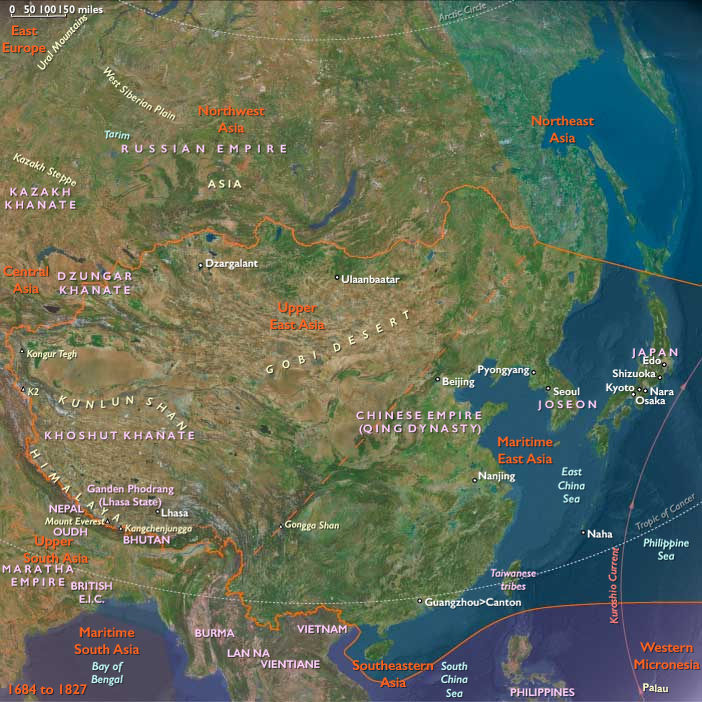
The Society of Jesus (Jesuits) has been successful in penetrating China and serving at the Imperial court.
They have impressed the Chinese with their knowledge of European astronomy and mechanics, and in fact run the Imperial Observatory.
Their accurate methods allow the Emperor to successfully predict eclipses, one of his ritual duties.
Other Jesuits function as court painters.
The Jesuits in turn are impressed by the Chinese Confucian elite, and adapt to that lifestyle.
The primary goal of the Jesuits is to spread Catholicism, but here they have a problem.
The Chinese elite are attached to Confucianism, while Buddhism and Taoism are mostly practiced by the common people and lower aristocracy of this period.
Despite this, all three provide the framework of both state and home life.
Part of Confucian and Taoist practices involve veneration of one's ancestors.
The Kangxi Emperor had at first been friendly to the Jesuit Missionaries working in China, as he is highly grateful for the services they have brought to him, in the areas of astronomy, diplomacy and gun manufacture.
The contribution of the Jesuits to artillery had allowed the Chinese Emperor to reconquer Taiwan.
Jesuit diplomacy, through the negotiations of Jean-François Gerbillon and Thomas Pereira, had allowed him to stop Russian expansionism in the East through the Treaty of Nerchinsk in 1689.
The Jesuits will also have made many converts by the end of the seventeenth century,.
The Kangxi Emperor on March 22 ssues the Edict of Toleration recognizing all the Roman Catholic Church, not just the Jesuits, and legalizing missions and their conversion of Chinese people.
Locations
People
Groups
- Confucianists
- Taoism
- Buddhists, Zen or Chán
- Christians, Roman Catholic
- Jesuits, or Order of the Society of Jesus
- Chinese Empire, Qing (Manchu) Dynasty
Subjects
Regions
Subregions

Related Events
Showing 1 events out of 1 total
Years: 1692 - 1692
Locations
People
Groups
- Confucianists
- Taoism
- Buddhists, Zen or Chán
- Christians, Roman Catholic
- Jesuits, or Order of the Society of Jesus
- Chinese Empire, Qing (Manchu) Dynasty
Subjects
Regions
Subregions