The so-called First Syrian War erupts in …
Years: 274BCE - 274BCE
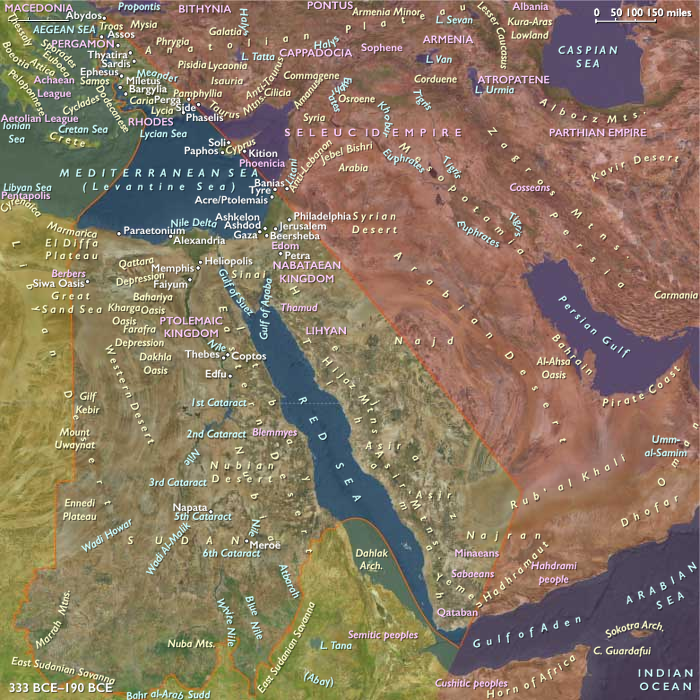
The so-called First Syrian War erupts in 274-273 BCE between Antiochus and Ptolemy, a conflict partly occasioned by Seleucid support for the revolt of Magas, the Ptolemaic governor of Cyrene, who is linked to Antiochus by marriage to his daughter, Apame.
Locations
People
Groups
Topics
Commodoties
Subjects
Regions
Subregions
Related Events
Filter results
Showing 10 events out of 63986 total
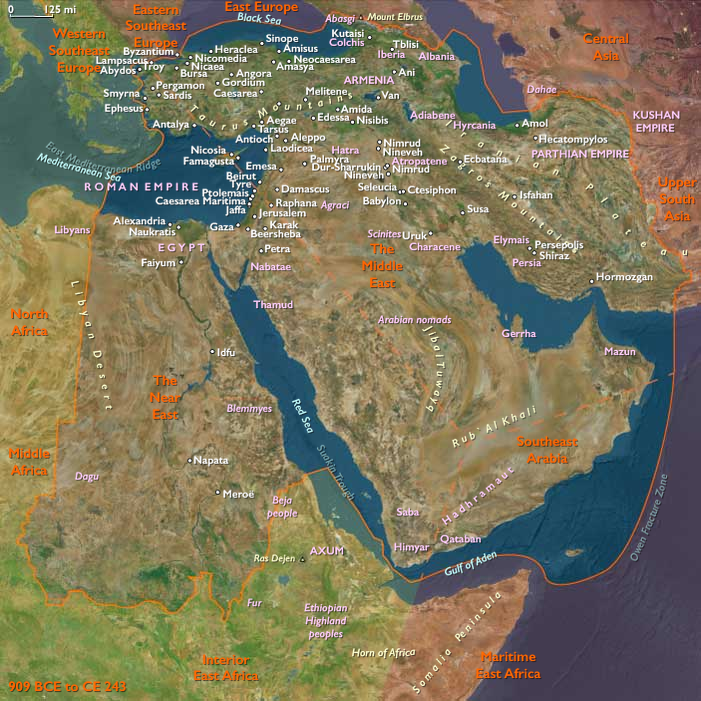
Ptolemy II conquers Tyre and renames the city Ptolemais.
Seleucid king Antiochus invades the Palestinian lands claimed by Ptolemaic Egypt, scoring successes in land operations in the year 274, and the next.
Pyrrhus's military adventures have overstrained the military resources of the Epirote state, but they have also brought it great prosperity.
He builds a magnificent stone theater at Dodona and …
…a new suburb at Ambracia (now Árta), which he makes his capital.
Pyrrhus, returning in 274 BCE full of thwarted ambition after the failure of his campaign in Italy, defeats the new Macedonian ruler, Antigonus II Gonatas, whose troops hail the Epirote ruler as king.
He drives Gonatus out of Upper Macedonia and Thessaly.
The Hellenistic conquerors and their followers, their rule not yet secure, integrate with the subject peoples of Macedonia, Syria, and Egypt, the three centers of power in the Hellenistic world of the second quarter of the third century BCE.
The First Syrian War is a major victory for the Ptolemies.
Antiochus, in his initial rush takes the Ptolemaic controlled areas in coastal Syria and southern Anatolia, but Ptolemy reconquers these territories by 271 BCE, extending Ptolemaic rule as far as Caria and into most of Cilicia.
With Ptolemy's eye focused eastward, his half-brother Magas declares his province of Cyrenaica to be independent, a status it will maintain until 250 BCE, when it will be reabsorbed into the Ptolemaic Kingdom.
The Middle East: 273–262 BCE
Hellenistic Consolidation and Internal Challenges
Integration and Stability in the Hellenistic World
From 273 to 262 BCE, the Hellenistic conquerors increasingly integrate with the local populations in the three major power centers: Macedonia, Syria, and Egypt. These rulers and their followers, initially foreign conquerors, begin to stabilize their rule through accommodation and cultural integration, laying the groundwork for sustained dynastic control.
Ptolemaic Ascendancy after the First Syrian War
The First Syrian War ends in a significant triumph for Ptolemy II, affirming Egypt’s supremacy in the eastern Mediterranean. Initially, Antiochus I, the Seleucid king, had briefly secured control over key territories in coastal Syria and southern Anatolia. However, by 271 BCE, Ptolemy recaptures these critical regions, pushing his influence northward as far as Caria and dominating most of Cilicia.
Independence of Cyrenaica
While Ptolemy is preoccupied with securing his eastern frontiers, his half-brother, Magas, exploits the opportunity to declare Cyrenaica independent. This region maintains its autonomous status until 250 BCE, at which point it is eventually reincorporated into the Ptolemaic Kingdom.
Continued Rivalries and Dynastic Fragmentation
Despite the temporary stability, Hellenistic monarchies continue to experience internal struggles and ongoing conflicts among themselves. The era remains marked by political maneuvering, shifting alliances, and dynastic rivalries that characterize much of the post-Alexandrian period.
Bindusara's death in 273 BCE leads to a war over succession to the Maurya throne.
According to Divyavandana, Bindusara wanted his son Sushim to succeed him but Ashoka, viceroy of Taxila and Ujjain, despite having several elder half-brothers from other wives of Bindusāra, is supported by his father's ministers.
A minister named Radhagupta seems to have played an important role.
Ashoka manages to become the king by getting rid of the legitimate heir to the throne through tricking him into entering a pit filled with live coals.
The Dipavansa and Mahavansa refer to Ashoka killing ninety-nine of his brothers, sparing only one, named Tissa, although there is no clear proof about this incident.
The coronation occurs in 269 BCE, four years after his succession to the throne.
Said to have had a wicked nature and bad temper, Ashoka submits his ministers to a test of loyalty and has five hundred of them killed.
He also keeps a harem of around five hundred women.
When a few of these women insult him, he has all of them burnt to death.
He also builds an elaborate and horrific torture chamber that earns him the name of Chand Ashoka (Sanskrit), meaning Ashoka the Fierce.
After ascending the throne, Ashoka spends the next eight years expanding his empire, from the present-day boundaries and regions of Burma–Bangladesh and the state of Assam in India in the east to the territory of present-day Iran and Afghanistan in the west; from the Pamir Knots in the north almost to the peninsular of southern India (i.e.
Tamil Nadu/Andhra Pradesh).

Near East (273–262 BCE): Rivalries and Cultural Consolidation in the Hellenistic World
The Hellenistic Near East remains a theater of intense rivalry among the dominant Macedonian successor states. The First Syrian War (274–271 BCE) between the Seleucid Empire under Antiochus I and Ptolemaic Egypt under Ptolemy II Philadelphus concludes with the consolidation of Ptolemaic authority over southern Syria, notably Palestine and the coastal cities, thereby securing Egypt's strategic interests along the Eastern Mediterranean.
Under the effective governance of Ptolemy II, Egypt experiences continued stability, prosperity, and significant cultural enrichment. Alexandria thrives as a cosmopolitan hub, attracting scholars and artists from across the Mediterranean world. The Library of Alexandria, already established as the preeminent intellectual institution, expands its collections dramatically, solidifying Alexandria’s position as the unrivaled center of Greek learning and culture.
Meanwhile, the Seleucid Empire, despite setbacks in its western provinces, seeks to stabilize its sprawling territories. Antiochus I, though militarily checked by Egypt, still controls a vast domain from Anatolia to Central Asia. He focuses on consolidating his rule internally, fostering urbanization and Greek cultural integration within his diverse territories, a hallmark of the Seleucid approach to imperial administration.
In Anatolia, regions such as Caria and Lycia, under firm Ptolemaic influence, continue to assimilate Greek traditions, evident in architecture, coinage, and civic organization. Local rulers balance loyalty to the Ptolemies with the assertion of regional autonomy, creating a dynamic political landscape marked by both cooperation and subtle rivalry.
Throughout the Near East, this era is defined by relative stability interspersed with diplomatic and military tensions. The great monarchies focus not only on their military fronts but also on embedding Hellenistic culture deeply into the societies under their rule, thereby laying enduring foundations for future cultural and political developments.
The origins of the Chremonidean War lie in the continuing desire of many Greek states, most notably Athens and Sparta, for a restoration of their former independence along with the Ptolemaic desire to stir up discontent within the sphere of influence of its Macedonian rival.
The ambitions of Ptolemy Philadelphus in the Aegean are threatened by Antigonus Gonatas's fleet, so he carefully builds up an anti-Macedonian coalition in Greece.
He especially concentrates on courting Athens, by supplying her with grain.
The anti-Macedonian faction in Athens, led by the stoic Chremonides, takes power and proceeds to declare war on Macedon (possibly as early as the autumn of 268 BE).
The first year of the conflict sees only minor confrontations, though they generally end favorably for the anti-Macedonian coalition.
After the indecisive campaign season of 266 BCE, the war begins to turn against the Greek city-states, and in 265 BCE Antigonus is able to win a decisive and crushing victory outside Corinth, in which the Spartan King Areus I falls.
With the discarding of the old rigid form of social organization characteristic of the polis, Greek towns are now a part of a larger entity, based not on kinship or residence but on power and control.
While a new power elite arises, made wealthy by the conquests of vast new territories and the payment of tribute, peasants suffer greatly from higher levies to support the upper class.
The weakness of the agricultural producers combines with constant warfare among kingdoms to make the Greeks vulnerable to a new Mediterranean power, Rome.