The Slavs return to menace Dyrrhachium in …
Years: 548 - 548
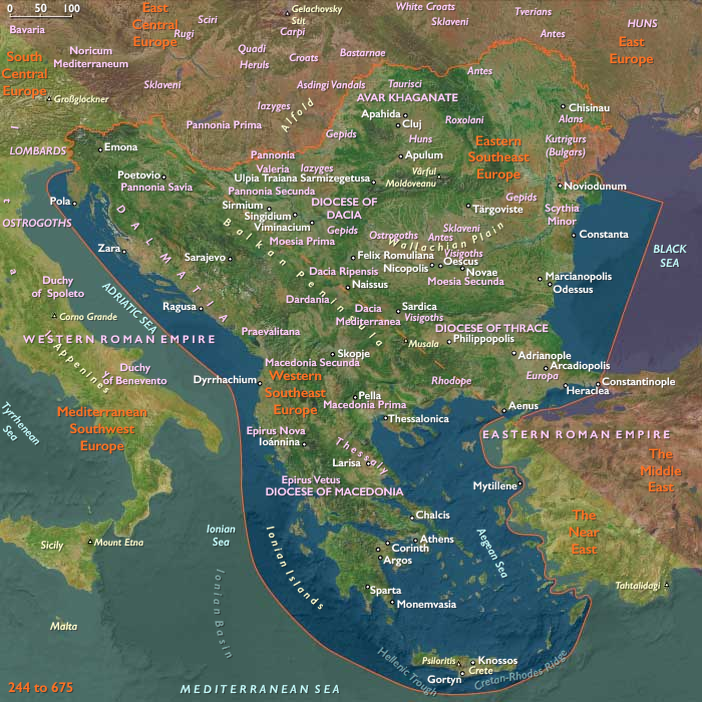
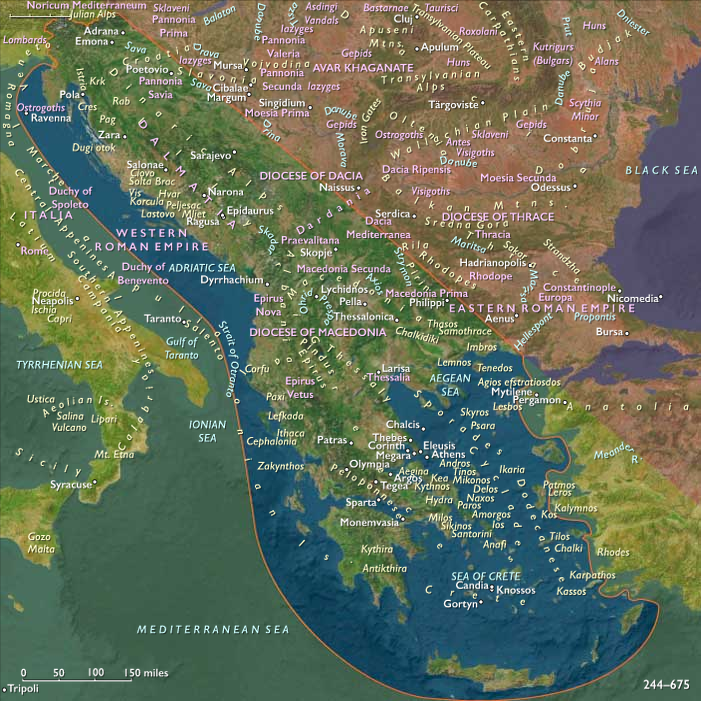
The Slavs return to menace Dyrrhachium in 548.
Locations
People
Groups
- Epirus Nova (Roman province)
- Illyricum, Praetorian prefecture of
- Slavs, South
- Roman Empire, Eastern: Justinian dynasty
- Albanians
Topics
Subjects
Regions
Subregions
Related Events
Filter results
Showing 10 events out of 57651 total
Ly Nam De, killed by Laotian tribesmen while on retreat from the Hong River Plain in 548, is succeeded by his elder brother Ly Thien Bao.
The death of the Empress Theodora at forty-eight, probably of breast cancer (according to bishop Victor of Tunnuna), subtracts both intensity and purpose from Justinian’s reign.
Her body is buried in the Church of the Holy Apostles.
Justinian relieves Belisarius from military service in favor of the seventy-year-old general Narses.
Germanus is by 548 acknowledged as the most influential of Emperor Justinian's relatives and his heir apparent, although this is never formally recognized.
In this year, his position is strengthened further by the death of Empress Theodora, who had disliked him intensely.
His stature at court is such that a plot is hatched by the disaffected general Artabanes and his kinsman Arsaces to assassinate Emperor Justinian and replace him with Germanus.
The conspirators think Germanus amenable to their plans, since he has been dissatisfied with Emperor Justinian's meddling in the settling of the will of his recently deceased brother Boraides.
The conspirators first tell Justin, Germanus's eldest son, of their intentions.
He, in turn, informs his father, who then holds counsel with the comes excubitorum, Marcellus.
In order to find out more of their intentions, Germanus meets the conspirators in person, while a trusted aide of Marcellus is concealed nearby and listens in.
Marcellus then informs Emperor Justinian, and the conspirators are arrested, but treated with remarkable leniency.
At first, Germanus and his sons too are suspected, until the testimony of Marcellus clears them.

King Gubazes II revolts against the Persians and requests for aid from Justinian I.
He sends an expeditionary force of eight thousand men under Dagisthaeus, who together with a Lazic force lays siege to the Persian garrison at Petra.
As the Persians are well provisioned, the siege drags on.
Dagisthaeus has neglected to keep watch over the mountain passes that led into Lazica, and a far larger Persian relief force under Mihr-Mihroe arrives and raises the siege, yet the Persians lack sufficient supplies.
Mihr-Mihroe departs after strengthening the garrison at Petra and leaving a further five thousand men under Phabrizus to secure its supply routes.
Alexandrian merchant Cosmas Indicopleustes describes the importance of the spice trade, especially in cloves and sweet aloe, in Ceylon, and the harvesting of pepper in India, in his Christian Topography.
The work, written around 548, contains some of the earliest and most famous world maps.
His description of India and Sri Lanka, based partly on his personal experiences as a merchant on the Red Sea and Indian Ocean in the early sixth century, is invaluable to historians.
Cosmas seems to have personally visited the Kingdom of Axum in modern Ethiopia, as well as Eritrea, India, and Sri Lanka.
Catherine of Alexandria, a Christian martyr according to tradition, had initially been sentenced to death on the wheel.
When this failed to kill her, however, she was beheaded, and angels took her remains to Mount Sinai.
Monks from the Sinai Monastery will find her purported remains around the year 800.
The monastery is commonly known as Saint Catherine's, but its full, official name is the Sacred and Imperial Monastery of the God-Trodden Mount of Sinai, and the patronal feast of the monastery is the Transfiguration.
The relics of Saint Catherine of Alexandria were purported to have been miraculously transported there by angels and it became a favorite site of pilgrimage.
The oldest record of monastic life at Sinai comes from the travel journal written in Latin in about 381-384 by a woman named Egeria.
She visited many places around the Holy Land and Mount Sinai, where, according to the Hebrew Bible, Moses received the Ten Commandments from God.
Saint Catherine's Monastery is built by order of Emperor Justinian I, enclosing the Chapel of the Burning Bush ordered to be built by Helena, the mother of Constantine I, at the site where Moses is supposed to have seen the burning bush; the living bush on the grounds is purportedly the original.
Structurally the monastery has the oldest known surviving roof truss in the world, a king post truss.
It is also referred to as "St. Helen's Chapel."
Rome's walls and other fortifications are soon restored after Totila’s withdrawal, so he marches against it again.
This time, Totila is defeated by Belisarius but the general does not follow up his advantage.
The Goths take several cities, including Perugia, while Belisarius remains inactive and then is recalled from Italy.
The octagonal church of San Vitale in Ravenna, begun in the 520s, is completed by 548.
Dedicated to the local saint, Vitalis, and noted for its fine mosaics, the church reflects the Late Roman interest in circular and octagonal domed structures.
The elaborate mosaics of the church of San Vitale occupy the extended chancel and apse.
The apse conch (half dome) depicts a beardless Christ in triumph flanked by angels, Saint Vitalis, and Bishop Ecclesius, during whose episcopate the building was begun.
The imagery portrays Christ bestowing a martyr’s crown on Saint Vitalis and receiving a model of the church from Ecclesius.
Above the richly sculpted arcades on each side are lunettes portraying Old Testament scenes whose themes are the offerings of Abel, Abraham, and Melchizedek.
Imaginative renditions of New Testament themes, as well as naturalistic Late Roman decorations, fill the arches, vaulting, and remaining space.
The two large wall panels flanking the altar depict the Eastern Roman emperor Justinian and his wife, the empress Theodora, with their retinues, presenting liturgical vessels to the church.
This naturalistic portrait of Justinian shows him as weary and troubled, but the bodies of the royal couple, overlapping one another like cutouts, appear weightless and without volume.
Despite their haloes, the monarchs are represented not as deities but as saintly rulers.
Theudigisel, a leading general of King Theudis when the latter is murdered, manages to have himself proclaimed ruler of the Visigothic Kingdom.
He had repelled the Franks from Spain after their invasion of 541, cutting them off in the pass of Valcarlos, but accepted a bribe to allow them to return to home.
The Ostrogoths under Totila besiege Rome for the third time after Belisarius has returned to Constantinople.
He offers a peace agreement, but this is rejected by emperor Justinian I.
Years: 548 - 548
Locations
People
Groups
- Epirus Nova (Roman province)
- Illyricum, Praetorian prefecture of
- Slavs, South
- Roman Empire, Eastern: Justinian dynasty
- Albanians