The Slavs in the vicinity of Thessalonica …
Years: 837 - 837
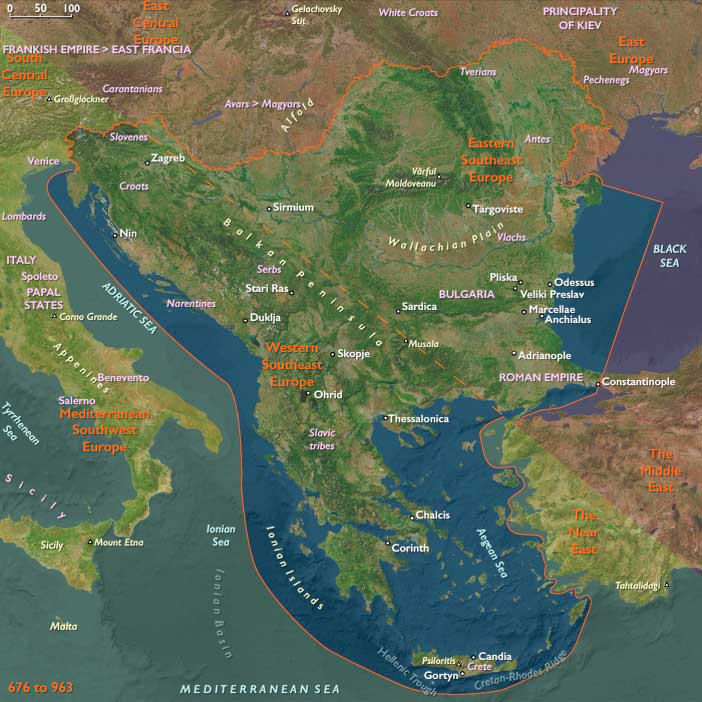
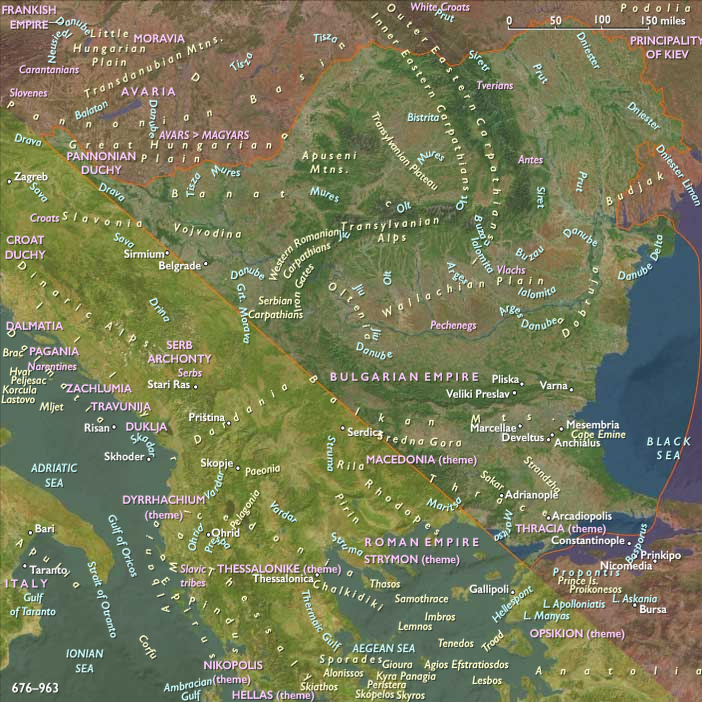
The Slavs in the vicinity of Thessalonica rebel against the Empire in 837, soon after Presian's accession.
Emperor Theophilos seeks Bulgarian support in putting down the rebellion, but simultaneously arranges for his fleet to sail through the Danube delta and undertake a clandestine evacuation of some of the Greek captives settled in trans-Danubian Bulgaria by Krum and Omurtag.
Locations
People
Groups
- Slavs, South
- Greeks, Medieval (Byzantines)
- Bulgarian Empire (First)
- Bulgarians (South Slavs)
- Thessalonica, East Roman Theme of
- Roman Empire, Eastern: Phrygian or Armorian dynasty
Topics
Commodoties
Subjects
Regions
Subregions
Related Events
Filter results
Showing 10 events out of 26 total
The Magyars devastate Burgundy in 937, overcoming French defenders led by Burgundy’s King Rudolph, who dies in this year, and is succeeded by his son Conrad.
Hugh makes peace in 933 with Rudolph of Upper Burgundy by giving him the Kingdom of Lower Burgundy, and the two the Transjurane and Cisjurane sections of Burgundy are combined into a single Kingdom of Burgundy (later called Arles).
Rudolph, in turn, relinquishes all his rights to Italy.
Hugh replaces Boso of Tuscany with his own son Hubert in 936.
He grants Octavion in the Viennois to Hugh Taillefer and patches up his relations with Charles-Constantine in a final effort to save influence in Provence.
Hugh of Italy has maintained friendly relations with Constantinople and, in 942, Hugh even comes to terms with Alberic, who marries one of Hugh's daughters.
Romanos concludes a treaty with Prince Igor of Kiev in 944.
This crisis having passed, Kourkouas is free to return to the eastern frontier.
It has sometimes been suggested that a marriage alliance might bring together the Eastern and Western parts of the empire and so provide for a united defense against the common enemy in Sicily—the Arabs.
In 944, Constantine's five-year-old son is married to a daughter of Hugh of Provence, the Carolingian claimant to Italy.
Constantine also keeps up diplomatic contact with Otto I, the Saxon king of Germany.
Romanos' later reign has been marked by the old emperor's heightened interest in divine judgment and his increasing sense of guilt for his role in the usurpation of the throne from Constantine VII.
On the death of Christopher, by far his most competent son, in 931, Romanos had not advanced his younger sons in precedence over Constantine VII.
Fearing that Romanos will allow Constantine VII to succeed him instead of them, his younger sons Stephen and Constantine, impatient to succeed to power, arrest their father in December 944, carry him off to the Prince's Islands and compel him to become a monk.
The Lekapenos brothers threaten the position of Constantine VII, and the people of Constantinople, fearing only that the Porphyrogenitus emperor might be included in the purge accompanying the seizure of power, riot until Constantine appears at a window of the palace.
This show of loyalty emboldens him to banish Romanus' sons on January 27, 945.
Stephen and Constantine are likewise stripped of their imperial rank and sent into exile to their father.
Having never exercised executive authority, Constantine remains primarily devoted to his scholarly pursuits and relegates his authority to bureaucrats and generals, as well as to his energetic wife Helena Lekapene, the daughter of Emperor Romanos I and his wife Theodora.
Romanos II is a son of Emperor Constantine VII and Helena Lekapene.
Named after his maternal grandfather, Romanos had been married, as a child, to Bertha, the illegitimate daughter of Hugh of Arles, King of Italy, who changes her name to Eudokia after her marriage.
Constantine crowns his son Romanos co-emperor on April 6, 945.
John Kourkouas, although considered by some of his contemporaries "a second Trajan or Belisarius," is dismissed after the fall of the Lekapenoi in 945.
Nevertheless, his campaigns in the East have paved the way for the even more dramatic reconquests in the middle and the second half of the tenth century.
Constantine, now thirty-nine, will rule alone from this point forward.
He appoints to the highest army commands four members of the Phokas family, which had been in disgrace under the Lekapenoi, but takes no further reprisals, except for an incidental remark, in De ceremoniis, that Romanus Lecapenus was neither an aristocrat nor a cultured man.
That he does not depart from the admiral's basic policy-at home, maintaining a delicate balance among civil and military officers, landed aristocrats, and peasant soldiers; abroad, friendship with the Rus, peace with the Bulgarians, a limited commitment in Italy, and a resolute offensive against the Muslims—may be ascribed to statesmanship as well as to timidity.
The policy continues to be effective.
The Chersonese Greeks had alert the emperor about the approaching Kievans, who fled in 944/945.
This time, Constantinople hastens to buy peace and concludes a treaty with Kievan Rus'.
Its text is quoted in full in the Primary Chronicle.
The Emperor had sent gifts and offered tribute in lieu of war, and the Rus’ had accepted.
Envoys are sent between the Rus’, Constantinople, and the Bulgarians in 945, and a peace treaty is completed.
The agreement again focused on trade, but this time with terms less favorable to the Rus’, including stringent regulations on the conduct of Rus’ merchants in Cherson and Constantinople and specific punishments for violations of the law.
Constantinople may have been motivated to enter the treaty out of concern of a prolonged alliance of the Rus', Pechenegs, and Bulgarians against them, though the more favorable terms further suggest a shift in power.

Within the Kingdom of Italy, Hugh has intensified his existing habit of giving any available offices or lands to relations, including his numerous legitimate and illegitimate progeny, and a small circle of old and trusted friends.
The effect this has had on Italian nobles, who see this as threatening themselves, eventually results in rebellion.
In 941, Hugh had expelled Berengar of Ivrea from Italy and abolished the March of Ivrea.
In 945, Berengar returns from exile in Germany and defeats Hugh in battle.
By a diet Berengar holds at Milan, Hugh is deposed, though he manages to come to terms by which he nominally keeps the crown and the title rex (king) but returns to Provence, leaving his son Lothair as nominal king, but with all real power in Berengar's hands.
Hugh had retired to Provence, but continued to carry the royal title until his death in 947.
Lothair II, although he holds the title of rex Italiae, will never succeeded in exercising power here.
He had been betrothed in 931 and had been married, on December 12, 947, to the fifteen-year-old Adelaide, the spirited and intelligent daughter of Rudolph II of Burgundy and Bertha of Swabia.
Their marriage is part of a political settlement designed to conclude a peace between her father and his.
In 933, Hugh of Arles had given up his kingdom (Provence) to his inveterate enemy Rudolph II, who merged the two kingdoms into a new Kingdom of Arles, but died in 937.
The couple have a daughter, Emma, born as early as 948, who will be married in 966 to the Carolingian Lothair of France.
Lothair's power in Italy is nominal.
From the time of the successful uprising of the nobles in 945, when Hugh had been forced into exile, Berengar of Ivrea has kept all real power and patronage in his hands.
Lothair's brief "reign" comes to an end with his death on November 22, 950, presumably poisoned by Berengar II, leaving Adelaide widowed before her twentieth birthday.
Berengar II crowns himself king with his son Adalbert of Italy as his co-ruler and heir apparent.
Failing to receive widespread support for his right to the crown, Berengar II attempts to legitimize his reign and tries to force Adelaide, the respective daughter, daughter-in-law and widow of the last three Italian kings, into marriage with Adalbert.
Adelaide fiercely refuses and is imprisoned by Berengar II at Garda Lake.
Adelaide, after four months’ imprisonment, manages to escape with the help of Count Adalbert Atto of Canossa.
Besieged by Berengar II in Canossa, she sends an emissary across the Alps seeking Otto’s protection and marriage.
Otto, widowed since 946, knows a marriage to Adelaide will allow him to fulfill his ambition of ruling Italy and, ultimately, claiming the imperial crown as Charlemagne’s true heir.
Knowing of Adelaide’s great beauty and immense wealth, the thirty-eight-year-old Otto accepts the nineteen-year-old queen's marriage proposal and prepares for an expedition into Italy.
Otto’s son Liudolph, from his stronghold in Swabia located just north of the Alps, is in closer proximity to the Italian border than his father in Saxony.
Liudolf prepares an Italian campaign is to overthrow Berengar II and therefore render unnecessary Otto's own expedition into Italy, and thus his marriage to Adelaide.
While the exact reason for Liudolf's actions are unclear, dynastic concerns and family ties to Adelaide may have been a factor.
Adelaide's mother, Bertha of Swabia, was a daughter of Regelinda, the mother of Liudolf's wife Ida, from her first marriage to Burchard II, Duke of Swabia.
Liudolf, therefore, may have intervened in the Italian campaign at the request of Adelaide's relatives.
Additionally, Liudolf, nineteen years old himself, does not view the idea of a young stepmother as in his best interests.
Though Otto had named him as his successor, Liudolf fears any potential stepbrother may usurp his claim to the German throne.
While Liudolf is preparing his expedition, the Bavarian Duke Henry, Otto's brother and Liudolf's uncle, conspires against him; Swabia and Bavaria share a long common border and the two dukes are involved in a border dispute.
Henry influences the Italian aristocrats not to join Liudolf's campaign.
Therefore, when Liudolf arrives in Lombardy in early summer 951, he finds no support and is unable to sustain his troops.
His army is near destruction until Otto's own army crosses the Alps.
The King reluctantly receives Liudolf's forces into his command, angry at his son for his inconsiderate and independent actions.
Otto and Liudolf arrive n northern Italy in September 951 without opposition from Berengar II.
As they descend into the Po River valley, the Italian nobles and clergy withdraw their support for Berengar and provide aid to Otto and his advancing army.
Recognizing his weakened position, Berengar II flees from his capital in Pavia.
When Otto arrives at Pavia on September 23, 951, the city willingly opens its gate to the German king.
In accordance with Lombard tradition, Otto is crowned with the Iron Crown of the Lombards on October 10.
Like Charlemagne before him, Otto is now concurrent King of Germany and King of Italy.
Otto sends a message to his brother Henry in Bavaria to escort his bride from Canossa to Pavia, where the two marry.
Soon after his father's marriage, Liudolf leaves Italy and returns to Swabia.
Years: 837 - 837
Locations
People
Groups
- Slavs, South
- Greeks, Medieval (Byzantines)
- Bulgarian Empire (First)
- Bulgarians (South Slavs)
- Thessalonica, East Roman Theme of
- Roman Empire, Eastern: Phrygian or Armorian dynasty