…the Sixth Ferrata, a Syrian garrison unit, …
Years: 106 - 106
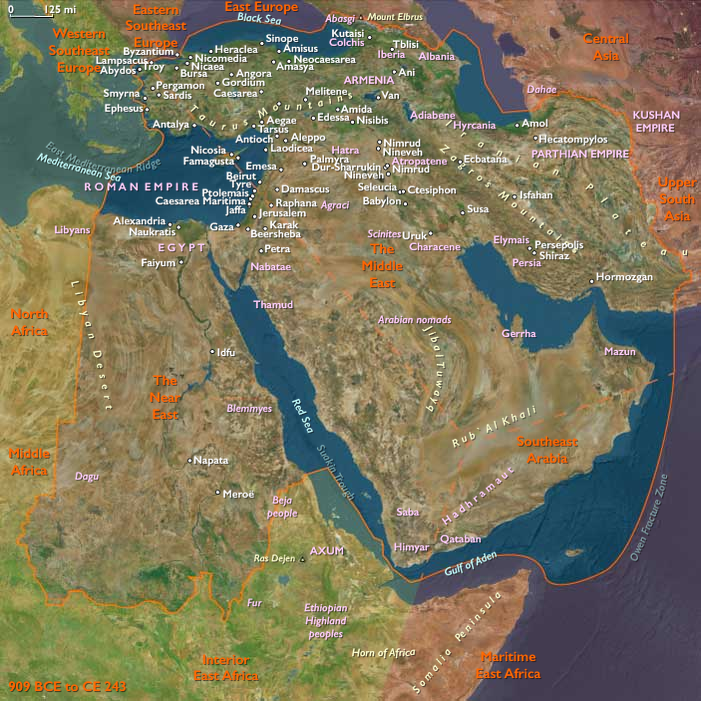
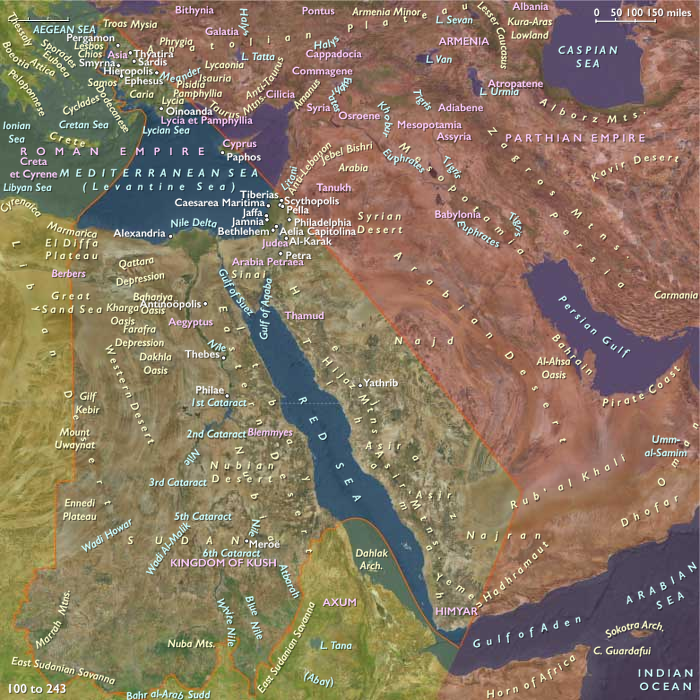
…the Sixth Ferrata, a Syrian garrison unit, moves south to occupy Bostra, present Busra ash-Sham in Syria.
The casual conquest of Nabataea by Trajan in March 106 is meant to consolidate control of the area before he acts on his designs for territory across the Tigris and eventually into Mesopotamia proper.
Trajan thus absorbs Nabataea into the Roman Empire as the province of Palestina Tertia.
Bosra is renamed Nova Trajana Bostra, and is the residence of the legio III Cyrenaica and capital of the Roman province Arabia Petraea.
The city will flourish and become a major metropolis at the juncture of several trade routes, including the Roman road to the Red Sea.
Locations
People
Groups
- Arab people
- Nabataean Kingdom
- Syria (Roman Province)
- Egypt (Roman province)
- Roman Empire (Rome): Nerva-Antonine dynasty
Topics
Commodoties
Subjects
Regions
Subregions
Related Events
Filter results
Showing 10 events out of 19 total
Mahgoub had continued in office for another eight months but resigns in July 1966 after a parliamentary vote of censure, which splits Umma.
A traditional wing led by Mahgoub, under the Imam Al Hadi, al Mahgoub's spiritual leadership, opposes the party's majority.
The latter group professes loyalty to the Imam's nephew, the younger Sadiq al Mahdi, who is the Umma's official leader and who rejects religious sectarianism.
Sadiq becomes prime minister with backing from his own Umma wing and from NUP allies.
Sadiq al Mahdi also plans to use his personal rapport with southern leaders to engineer a peace agreement with the insurgents.
He proposes to replace the Supreme Commission with a president and a southern vice president calling for approval of autonomy for the southern provinces.
The educated elite and segments of the army oppose Sadiq al Mahdi because of his gradualist approach to Sudan's political, economic, and social problems.
Leftist student organizations and the trade unions demand the creation of a socialist state.
Their resentment of Sadiq increases when he refuses to honor a Supreme Court ruling that overturns legislation banning the SCP and ousting communists elected to parliamentary seats.
In December 1966, a coup attempt by communists and a small army unit against the government fails.
Many communists and army personnel are subsequently arrested.
Sadiq al Mahdi's wing of the Umma wins fifteen seats, the federalist SANU ten, and the NUP five.
Despite this apparent boost in his support, however, Sadiq's position in parliament has become tenuous: concessions he had promised to the south in order to bring an end to the civil war are not agreed.
The Umma traditionalist wing oppose Sadiq al Mahdi: they argue strongly against constitutional guarantees for religious freedom and his refusal to declare Sudan an Islamic state.
When the traditionalists and the NUP withdraw their support, the government falls.
Sadiq al Mahdi's wing holds a majority in parliament and can thwart any government action.
When Mahgoub dissolves parliament Sadiq refuses to recognize the legitimacy of the prime minister's action.
An uneasy crisis develops: two governments function in Khartoum—one meeting in the parliament building and the other on its lawn—both of them claiming to represent the legislature's will.
The army commander requests clarification from the Supreme Court regarding which of them has authority to issue orders.
The court backs Mahgoub's dissolution; and the government schedules new elections for April.
Thirty-six seats go to the Umma traditionalists, thirty to the Sadiq wing, and twenty-five to the two southern parties—SANU and the Southern Front.
The SCP secretary general, Abdel Khaliq Mahjub, also wins a seat.
In a major setback, Sadiq loses his own seat to a traditionalist rival.
Because it lacks a majority, the DUP concludes an alliance with Umma traditionalists, who receive the prime ministership for their leader, Muhammad Ahmad Mahgoub, and four other cabinet posts.
The coalition's program includes plans for government reorganization, closer ties with the Arab world, and renewed economic development efforts, particularly in the southern provinces.
The Muhammad Ahmad Mahgoub government also accepts military, technical, and economic aid from the Soviet Union.
Sadiq al Mahdi's wing of the Umma forms the small parliamentary opposition.
When it refuses to participate in efforts to complete the draft constitution, already ten years overdue, the government retaliates by closing the opposition's newspaper and clamping down on pro-Sadiq demonstrations in Khartoum.
Imam al-Hadi al-Mahdi has withdrawn to his Aba Island stronghold in the Nile, near Khartoum, in the belief that the government has decided to strike at the Ansar movement.
The Imam has demanded a return to democratic government, the exclusion of communists from power, and an end to RCC rule.
In March 1970, hostile Ansar crowds prevent Nimeiry from visiting the island for talks with the imam.
Fighting subsequently erupts between government forces and as many as thirty thousand Ansar.
When the Ansar ignore an ultimatum to surrender, army units with air support assault Aba Island.
About three thousand people die during the battle.
The Imam escapes only to be killed while attempting to cross the border into Ethiopia.
The government exiles Sadiq al Mahdi to Egypt, where Nasser promises to keep him under guard to prevent him from succeeding his uncle as head of the Ansar movement.
This strategy prompts an internal debate within the SCP.
The orthodox wing, led by party secretary general Abdel Khaliq Mahjub, demands a popular front government with communists participating as equal partners.
The National Communist wing, on the other hand, supports cooperation with the government.
The Imam escapes only to be killed while attempting to cross the border into Ethiopia.
The government exiles Sadiq al Mahdi to Egypt, where Nasser promises to keep him under guard to prevent him from succeeding his uncle as head of the Ansar movement.
The Near East, 1972 to 1983 CE: Shifts in Alliances and Economic Challenges
Sudan: Economic Struggles and Foreign Influence
Beginning in 1972, the Sudanese government shifts toward a more pro-Western stance, focusing on increasing agricultural exports. Until the early 1970s, Sudan's agricultural production primarily satisfied domestic consumption. Plans to boost exports by mechanizing agriculture quickly encounter difficulties as global commodity prices decline throughout the 1970s. Simultaneously, the rising costs of debt servicing—due to the heavy investment in mechanized farming—compound Sudan's economic troubles.
In 1978, the Sudanese government negotiates a Structural Adjustment Program with the International Monetary Fund (IMF), which further emphasizes mechanized export agriculture. This policy negatively impacts pastoralists, particularly the indigenous ethnic communities inhabiting the Nuba Mountains in South Kordofan state, exacerbating economic disparities and social tensions.
Military Alliances and Arms Acquisitions
Sudan's foreign military relations shift notably during this period. Having traditionally relied on British training and supplies, Khartoum severed ties with Western countries following the Arab-Israeli Six-Day War (1967). Between 1968 and 1971, the Soviet Union and its Eastern Bloc allies significantly bolster Sudan's military capabilities, increasing the army's strength from eighteen thousand to about fifty thousand troops and supplying tanks, aircraft, and artillery.
After the 1971 Sudanese Coup d'état, however, Sudan seeks to diversify its military partnerships. Egypt emerges as a significant supplier throughout the 1970s, providing missiles, personnel carriers, and other military hardware. Western countries resume supplying Sudan in the mid-1970s, notably the United States, which begins substantial equipment sales around 1976. Under President Ronald Reagan’s administration, American military sales peak in 1982 at $101 million, making Sudan the second-largest recipient of U.S. aid to Africa, following Egypt. Total American assistance grows dramatically from $5 million in 1979 to $200 million in 1983, predominantly for military programs.
Political Reconciliation and Instability
In 1976, the Ansars, followers of the Mahdi tradition, attempt a bloody but unsuccessful coup (Sudanese Revolt) against President Jaafar Nimeiry’s regime. Despite this violence, reconciliation follows when Nimeiry meets Ansar leader Sadiq al-Mahdi in July 1977. The government releases hundreds of political prisoners and announces a general amnesty in August, temporarily easing internal political tensions.
Strategic Developments
By 1983, Sudan agrees to significant strategic developments, including constructing four air bases to accommodate units of the U.S. Rapid Deployment Force and establishing a powerful Central Intelligence Agency (CIA) listening station near Port Sudan. These installations reflect Sudan’s deepening alignment with Western interests during the late stages of the Cold War.
Regional Turmoil and Conflicts
The Near East experiences significant turmoil and conflicts during this period. Although the First Sudanese Civil War officially ends in 1972, underlying tensions continue, eventually reigniting into the Second Sudanese Civil War in 1983, a prolonged conflict that deeply impacts the region.
In Yemen, repeated conflicts erupt between North and South, known as the North-South Yemen Wars, occurring first in 1972 and again in 1979, reflecting the region's chronic instability and ideological divisions exacerbated by the global Cold War context.
Egypt faces profound socio-economic upheaval as President Anwar Sadat introduces economic liberalization policies known as the "Infitah", which lead to severe unrest and widespread riots in 1977. Egypt also experiences a traumatic event in 1981 with the assassination of President Anwar Sadat, marking a turbulent shift in the country's political trajectory.
The complex Arab-Israeli conflict further escalates with the 1978 South Lebanon conflict, culminating in the landmark Camp David Accords (1978), reshaping regional alliances. The tension reaches a peak with the Israeli Invasion of Lebanon in 1982, significantly heightening regional instability and intensifying violent activities by the Palestine Liberation Organization (PLO).
Collectively, these events profoundly shape the political and social landscape of the Near East, embedding lasting tensions and setting the stage for ongoing regional dynamics.
Legacy of the Era
From 1972 to 1983, Sudan experiences major economic challenges, shifting international alignments, and internal political instability. These factors create lasting social, economic, and political impacts, laying the groundwork for continued internal strife and complex regional dynamics in subsequent decades.

Years: 106 - 106
Locations
People
Groups
- Arab people
- Nabataean Kingdom
- Syria (Roman Province)
- Egypt (Roman province)
- Roman Empire (Rome): Nerva-Antonine dynasty