
Songhai's sway over western Hausaland includes the …
Years: 1540 - 1683
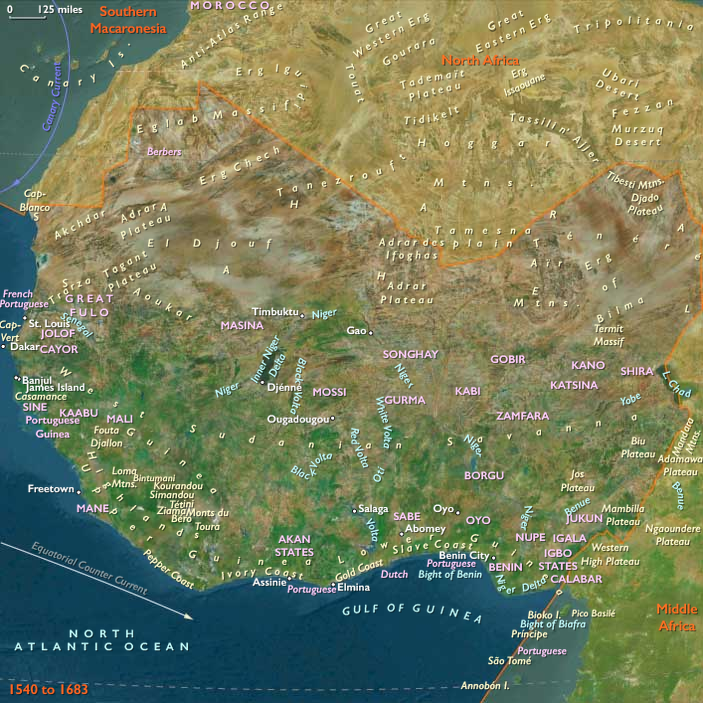
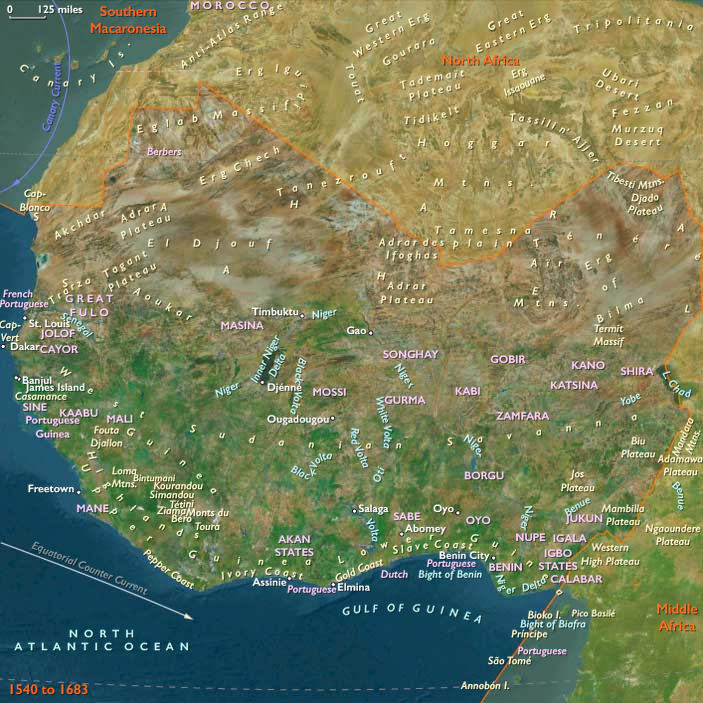
Songhai's sway over western Hausaland includes the subordination of Kebbi, whose kanta (king) controls the territory along the Sokoto River.
Katsina and Gobir also pay tribute to Songhai, while Songhai merchants dominate the trade of the Hausa towns.
It is at this time that the overland trade in kola nuts from the Akan forests of modern Ghana is initiated.
Largely because of Songhai's influence, there is a remarkable blossoming of Islamic learning and culture.
The influence of Songhai collapses abruptly in 1591, when an army from Morocco crosses the Sahara and conquers the capital city of Gao and the commercial center of Timbuktu.
Morocco is not able to control the whole empire, and the various provinces, including the Hausa states, become independent.
The collapse undermines Songhai's commercial and religious hegemony over the Hausa states and abruptly alters the course of history in the region.
Locations
Groups
- Polytheism (“paganism”)
- Hausa Kingdoms, the
- Hausa people
- Islam
- Fula people
- Kanembu people
- Kanuri people
- Mali Empire
- Jukun people (West Africa)
- Songhai (Songhay) Empire
- Bornu, Kingdom of
- Nupe, Kingdom of the
- Morocco, Sa'di Sharifate of
Topics
- Islamization of the Sudan region
- Sub-Saharan Africa, Medieval
- Interaction with Subsaharan Africa, Early European
Commodoties
Subjects
Regions
Subregions
Years: 1540 - 1683
Locations
Groups
- Polytheism (“paganism”)
- Hausa Kingdoms, the
- Hausa people
- Islam
- Fula people
- Kanembu people
- Kanuri people
- Mali Empire
- Jukun people (West Africa)
- Songhai (Songhay) Empire
- Bornu, Kingdom of
- Nupe, Kingdom of the
- Morocco, Sa'di Sharifate of
Topics
- Islamization of the Sudan region
- Sub-Saharan Africa, Medieval
- Interaction with Subsaharan Africa, Early European
Commodoties
Subjects
Regions
Subregions