
The site of the Japanese capital had …
Years: 712 - 712
The site of the Japanese capital had been moved in 710 to the northwest sector of the Nara Basin.
(The new capital, called Heijo-kyo, is known today as Nara.)
Overcrowding, the relative isolation of the Fujiwara capital, and what will prove to be a constant nemesis to the Japanese state, an overly powerful Buddhist establishment, had been some of the main factors contributing to the move.
The Kojiki (Record of Ancient Matters), the earliest written Japanese history, is compiled in 712 by court officials on the order of the empress Genmei.
The 43rd imperial ruler of Japan, according to the traditional order of succession, and the fourth woman to hold such a position, she had been a daughter of Emperor Tenji and the wife of Crown Prince Kusakabe no Miko, who had been the son of Emperor Temmu and Empress Jitō.
Kusakabe was also Genmei's first cousin and her nephew.
After their son Emperor Mommu died in 707, she had succeeded to the throne, in hopes of holding it until her grandson, Prince Obito reached maturity.
The initial attempts of her father-in-law, Emperor Temmu, in 680, had failed to finalize the publication of the Kojiki before his death in 686, and Genmei has continued the commission during her reign.
The first section, entitled “The Age of the Gods,” is a mythical telling of the creation of the world, In describing the descent from heaven of Ninigi, grandson of the Sun goddess Amaterasu, the legendary ancestor of the imperial family, the Kojiki establishes the divine origin of Japan's imperial dynasty and its right to rule over the country.
The second and third sections contain semi-historical traditions about the history of Japan down to the beginning of the seventh century.
Locations
People
Groups
Subjects
Regions
Subregions
Related Events
Filter results
Showing 10 events out of 55774 total
East Central Europe (712–723 CE): Saxon Consolidation, Slavic State Formation, and Regional Stability
Between 712 and 723 CE, East Central Europe—encompassing Poland, Czechia, Slovakia, Hungary, and those portions of Germany and Austria lying east of 10°E and north of a line stretching from roughly 48.2°N at 10°E southeastward to the Austro-Slovenian border near 46.7°N, 15.4°E—saw intensified consolidation of Saxon political dominance, further stabilization of emerging Slavic states in Bohemia and Moravia, continued stability within the Avar Khaganate, and persistent autonomy in Thuringia. Saxon influence reshaped regional political dynamics, trade, and cultural interactions, laying critical groundwork for future medieval developments.
Political and Military Developments
Strengthened Saxon Dominance
-
Saxon tribal leaders solidified control over territories east of the Elbe River, influencing regions of modern eastern Germany and western Poland. This territorial consolidation positioned the Saxons as a dominant regional power, significantly influencing surrounding Slavic and Frankish communities.
Early Slavic State Formation
-
Bohemia and Moravia continued their steady evolution from tribal federations into structured early medieval states, characterized by more centralized leadership, clearer territorial boundaries, and stronger internal political organization.
Continued Autonomy in Thuringia
-
Thuringian dukes maintained de facto independence from increasingly weakened Merovingian kings, underscoring persistent Frankish fragmentation and regional power shifts toward local aristocratic rule.
Stability and Diplomatic Balance in the Avar Khaganate
-
The Avars preserved stable political control within their core Carpathian Basin territories, carefully balancing diplomatic relations with neighboring Slavs, Saxons, and Franks to prevent major conflicts.
Economic and Technological Developments
Regional Economic Prosperity
-
Economic stability persisted across East Central Europe, fueled by active trade among Saxon, Slavic, Bavarian, Avar, and Frankish territories. Products traded included agricultural goods, metalwork, textiles, ceramics, and livestock.
Expansion of Fortified Infrastructure
-
Saxon, Slavic, and Avar communities further developed fortified settlements and defensive earthworks, reflecting increased strategic planning, political centralization, and regional competition.
Cultural and Artistic Developments
Saxon Cultural Influence
-
Saxon cultural influence expanded markedly, introducing distinct Germanic elements into regional craftsmanship, pottery, jewelry, and burial practices, particularly noticeable in eastern Germany and adjacent Slavic areas.
Continued Formation of Slavic Identities
-
Distinct regional cultures emerged more clearly among Bohemian and Moravian Slavs, visible archaeologically in differentiated pottery, metalwork, and settlement forms, reinforcing early medieval identities.
Persistent Avar Artistic Legacy
-
Avar cultural traditions continued to shape local artistic practices, notably in sophisticated metalwork, jewelry, and decorative arts, maintaining cultural influence across East Central Europe.
Settlement and Urban Development
Saxon Territorial and Urban Growth
-
Saxon settlements expanded and grew increasingly fortified and economically vibrant, establishing the foundation for future urban centers across eastern Germany and western Poland.
Development of Slavic Political and Economic Centers
-
Emerging urban and administrative centers in Bohemia and Moravia expanded significantly, reflecting political stability, demographic growth, and economic prosperity.
Stability of Bavarian and Thuringian Settlements
-
Bavarian and Thuringian settlements, notably Regensburg and regional Thuringian centers, maintained economic stability and political independence, benefiting from peaceful trade and minimal external pressures.
Social and Religious Developments
Saxon Hierarchical Leadership
-
Saxon tribes further solidified hierarchical leadership structures, dominated by powerful warrior-aristocratic elites whose authority was reinforced through military success, wealth accumulation, and territorial control.
Centralized Authority in Slavic Principalities
-
Bohemian and Moravian leadership became increasingly centralized, establishing clearer governance and stronger defensive capabilities.
Continuation of Avar Social Structure
-
The Avars retained stable hierarchical social structures under a powerful khaganate, managing internal cohesion and external diplomacy effectively.
Long-Term Consequences and Historical Significance
The era 712–723 CE represented a formative period in East Central Europe, characterized by growing Saxon political dominance, further Slavic state formation, sustained Avar regional stability, and persistent Thuringian autonomy. These developments profoundly shaped future political landscapes, cultural identities, and economic patterns, setting the stage for the early medieval transformation of the region.
The Arab raids from 712 on penetrate ever deeper into Anatolia, with the final objective of mounting an assault on Constantinople.
Emperor Anastasios constructs extensive military fortifications in and around Constantinople, which the Arabs, renewing their assaults by land and sea, again besiege in 717, lured by the unsettled conditions following the second deposition of Justinian II.
The repulsion in 718 of the second Arab siege of Constantinople is a major imperial success, and halts Arab attacks against the Empire for a few years.
Eastern Southeast Europe (712–723 CE): Fortification and Imperial Triumph
Settlement and Migration Patterns
Continued Stability Amid Persistent Threats
From 712 to 723 CE, Eastern Southeast Europe experienced continued stability within settled regions despite relentless external threats. The integration and cultural cohesion between Slavic and Bulgar populations persisted, reinforcing demographic stability.
Political and Military Developments
Escalation of Arab Raids
Arab raids intensified significantly from 712 onward, penetrating deeper into Anatolia with the strategic objective of eventually attacking Constantinople itself. These incursions posed severe threats to imperial security and territorial integrity.
Emperor Anastasios’ Fortifications
Recognizing the escalating threat, Emperor Anastasios commissioned extensive military fortifications in and around Constantinople. These preparations were critical in bolstering the city's defenses against anticipated Arab attacks.
Second Arab Siege of Constantinople (717–718 CE)
Following internal instability triggered by the second deposition of Emperor Justinian II, the Arabs launched a renewed and determined siege of Constantinople by both land and sea in 717. The successful repulsion of this siege in 718 marked a significant triumph for the empire, effectively halting Arab offensives for several subsequent years and reasserting Byzantine strategic dominance.
Economic and Technological Developments
Economic Resilience and Resource Allocation
Despite ongoing military pressures, the regional economy demonstrated resilience through strategic resource allocation and sustained trade networks. Constantinople’s enhanced fortifications and defenses played a vital role in safeguarding economic stability.
Advanced Defensive Strategies
The era witnessed continued development in defensive strategies and technologies, particularly in naval warfare and urban fortifications. These innovations proved decisive in successfully repelling the major Arab siege.
Cultural and Artistic Developments
Cultural Continuity Amid Conflict
Cultural and artistic expressions continued to flourish, sustaining regional identity and spiritual resilience. The religious and artistic innovations established in earlier periods persisted, further embedding Byzantine cultural heritage.
Scholarly and Intellectual Persistence
Intellectual institutions remained dedicated to preserving classical and theological knowledge. These scholarly efforts continued uninterrupted, reinforcing the cultural and educational foundations of the region.
Social and Religious Developments
Consolidation of Eastern Orthodoxy
Eastern Orthodox Christianity solidified its central role within society, providing moral and social cohesion amid ongoing military threats. Religious institutions continued to play an influential role in community resilience and spiritual guidance.
Reinforced Community Identity
The successful defense of Constantinople in 718 strengthened communal identity and regional pride, reinforcing societal cohesion and resilience during periods of conflict.
Long-Term Consequences and Historical Significance
The period from 712 to 723 CE was marked by critical military challenges, including the significant Arab siege of Constantinople and its successful repulsion, thanks to extensive fortifications and strategic defense preparations by Emperor Anastasios. These events decisively shaped the regional geopolitical landscape, reinforced imperial authority, and provided lasting stability for Eastern Southeast Europe.
The Middle East: 712–723 CE
Expansion, Governance, and Cultural Consolidation under the Umayyads
Umayyad Expansion into Central Asia and South Asia
The early eighth century is marked by vigorous expansion of the Umayyad Caliphate. Under Caliph Al-Walid I and his successors, Arab armies push far beyond traditional frontiers, extending Islamic influence deeper into Central Asia, reaching regions like Transoxiana and the fringes of the Indian Subcontinent. In 712, the young general Muhammad ibn Qasim captures Sindh (in present-day Pakistan), significantly extending Muslim authority into South Asia for the first time.
Administration and Infrastructure
Under Caliph Sulayman ibn Abd al-Malik (715–717) and his successor Umar ibn Abd al-Aziz (717–720), the Umayyads emphasize consolidating their vast territories through administrative reform. Known for his justice and piety, Umar II implements fiscal fairness, reducing taxes on non-Arab Muslims and promoting conversions to Islam through equitable governance. His brief rule is remembered for stabilizing the empire and reinforcing Islamic institutions.
Cultural and Religious Developments
During this period, the Umayyad court continues to patronize literature, architecture, and religious scholarship, laying foundations for a flourishing Islamic culture. In Damascus, monumental architecture such as the Great Umayyad Mosque, completed in 715, symbolizes the dynasty's authority and religious devotion, becoming a cornerstone of Islamic cultural identity.
At the same time, scholars and theologians at major centers like Basra and Kufa engage in intense theological debates, laying critical groundwork for Sunni Islamic jurisprudence. This period thus witnesses both significant territorial expansion and the deepening of Islam's cultural and religious roots across the Middle East and beyond.
Three major mosques are constructed during the rule of the Umayyad prince al-Walid I at Medina, Jerusalem, and Damascus.
Mediterranean Southwest Europe (712–723 CE): Islamic Conquest of Iberia, Byzantine Decline, and Lombard Continuity
The era 712–723 CE in Mediterranean Southwest Europe witnesses the dramatic Islamic conquest of the Visigothic Kingdom, severe territorial and political setbacks for Byzantine authorities, and ongoing stability and territorial strength in Lombard Italy.
Islamic Conquest and the End of Visigothic Rule
In 711 CE, the Visigothic kingdom collapses under the rapid and decisive invasion of Muslim forces led by Tariq ibn Ziyad. By 712 CE, Islamic armies have effectively dismantled Visigothic authority, establishing control over most of the Iberian Peninsula. The conquest profoundly transforms the region politically, culturally, and religiously, introducing lasting Islamic influence and initiating the period of Al-Andalus.
Byzantine Weakness and Increased Fragmentation
The dramatic events in Iberia coincide with further weakening of Byzantine authority in Italy. The Byzantine Exarchate of Ravenna struggles increasingly against persistent Lombard pressure, internal revolts, and maritime threats from Islamic naval raids. Byzantine territories diminish significantly, leaving them restricted to small coastal enclaves and urban strongholds, severely limiting imperial influence in the western Mediterranean.
Lombard Stability and Governance under Liutprand
In sharp contrast to Iberian turmoil and Byzantine decline, the Lombard Kingdom under King Liutprand (r. 712–744 CE) enjoys stability and territorial cohesion. Liutprand's effective governance and diplomatic acumen strengthen Lombard authority, consolidating power throughout northern and central Italy. His reign marks a high point in Lombard political and cultural achievements, reinforcing the kingdom's position as the dominant power on the Italian peninsula.
Ecclesiastical Challenges and Papal Diplomacy
The papacy continues navigating challenging political circumstances, adapting to the new realities introduced by Islamic expansion in Iberia and ongoing Lombard power in Italy. Papal leaders focus on diplomatic outreach and doctrinal unity, reinforcing the Church's crucial role in providing societal stability and cultural continuity amid significant geopolitical shifts.
Legacy of the Era
The era 712–723 CE profoundly reshapes Mediterranean Southwest Europe, dramatically altering Iberia through Islamic conquest, severely constraining Byzantine influence, and solidifying Lombard dominance in Italy. These transformations set the stage for enduring medieval political, cultural, and religious dynamics in the region.
North Africa (712–723 CE)
Umayyad Dominance, Berber Integration, and the Expansion into Al-Andalus
Between 712 and 723 CE, the Umayyad Caliphate solidifies its control across North Africa, completes the integration of significant Berber contingents into its ranks, and extends its reach across the Strait of Gibraltar into the Iberian Peninsula, initiating the conquest of Al-Andalus.
Following earlier successes under Musa ibn Nusayr, the governor of Ifriqiya, Umayyad forces capitalize on their newly stabilized North African territories. In 711 CE, Musa dispatches the Berber general Tariq ibn Ziyad with a substantial army—largely composed of Berber troops—across the Strait of Gibraltar into Visigothic Spain. The subsequent victories at battles such as the decisive Battle of Guadalete in 711 CE lead to the rapid conquest of most of the Iberian Peninsula.
Musa himself follows Tariq in 712 CE, reinforcing Arab-Berber control of Al-Andalus and firmly establishing Muslim rule there. These events significantly amplify the strategic and economic importance of North African territories, now acting as the critical bridge between the Islamic heartlands and the newly acquired territories in Spain.
Back in North Africa, the Umayyads pursue further internal stabilization, strengthening urban administrative centers such as Kairouan, which grows into a key cultural and scholarly hub within the Islamic world. Local governance under the Umayyads involves enhanced administrative organization, including reforms to taxation and regional security that encourage prosperity in agricultural and urban economic centers.
Nevertheless, indigenous Berber resistance remains active, particularly in remote mountain areas. The Aurès Mountains tribes, notably the Austoriani and Leutae, sustain sporadic revolts. Further inland and westward, groups such as the pastoral Arzuges and the warlike Laguatan tribes continue to challenge Umayyad governance through persistent raids and localized rebellions.
Meanwhile, Saharan trade routes controlled by influential Tuareg tribes flourish, facilitating trans-Saharan commerce that significantly enriches coastal and inland trading cities, linking North Africa economically to sub-Saharan Africa.
Culturally, the early eighth century witnesses the deepening integration of Islamic religious practices among Berber populations. This period sees substantial Berber conversions to Islam, motivated by both genuine belief and practical advantages under the new political and social order. Still, indigenous cultural traditions persist strongly, contributing to the distinct regional identity that characterizes Islamic North Africa.
By 723 CE, the Umayyad Caliphate firmly controls North Africa, having effectively leveraged Berber military support in major external conquests and significantly expanded its cultural and economic influence. The period concludes with the region positioned as a vital component of the broader Islamic world, intricately linked to the rapidly expanding Umayyad territories in the Iberian Peninsula.
Atlantic Southwest Europe (712–723 CE): Islamic Conquest, Christian Resistance, and Emergence of the Asturian Kingdom
Between 712 and 723 CE, Atlantic Southwest Europe—encompassing Galicia, northern and central Portugal, Asturias, Cantabria, and northern Spain south of the Franco-Spanish border (43.05548° N, 1.22924° W)—experienced a dramatic transformation. Following the swift and decisive Islamic conquest of Visigothic Iberia (711–718 CE), the region faced unprecedented challenges. While the southern and eastern parts of Iberia rapidly fell under Islamic rule, Atlantic Southwest Europe emerged as a nucleus of determined Christian resistance, leading directly to the founding of the Kingdom of Asturias.
Political and Military Developments
Islamic Conquest and Initial Domination
In 711 CE, Islamic forces under Tariq ibn Ziyad decisively defeated Visigothic King Roderic at the Battle of Guadalete, triggering the rapid collapse of Visigothic rule. By 712–715 CE, Muslim armies swiftly occupied much of central and southern Iberia, including key regional cities such as Emerita Augusta (Mérida) and Olissipo (Lisbon), imposing direct Umayyad governance over these territories. However, due to the region's mountainous terrain and strong local resistance, their control over the far northwest remained tenuous.
Christian Resistance and Foundation of the Kingdom of Asturias
In the northwestern territories of Galicia, Asturias, and Cantabria, resistance emerged immediately, led by Visigothic nobles and local aristocrats. By 718 CE, under the leadership of the Visigothic nobleman Pelagius (Pelayo), Asturian warriors openly resisted Islamic authority, culminating in the symbolic but strategically significant Battle of Covadonga (718 or 722 CE). This battle, traditionally dated to 722 CE, represented a decisive turning point, marking the formal beginning of the Kingdom of Asturias and the initiation of the centuries-long Christian Reconquista.
Economic Developments
Economic Disruption and Localized Stability
The initial Islamic conquest and subsequent military conflicts significantly disrupted regional economies, especially in areas directly impacted by warfare or occupation. Despite this upheaval, rural areas and mountainous territories (Galicia, Asturias, northern Lusitania) retained substantial economic continuity. Agricultural production, livestock husbandry, artisanal crafts, and mining activities continued, albeit at reduced scales.
Decline of Maritime Trade
Coastal commerce, especially through cities such as Olissipo (Lisbon), was temporarily diminished due to shifting trade routes, reduced regional security, and initial Islamic control of maritime access points. However, smaller ports and coastal villages retained limited regional trade networks.
Cultural and Religious Developments
Ecclesiastical Institutions as Centers of Resistance
During this period of upheaval, influential bishoprics—particularly Braga and Asturica Augusta—emerged as critical symbols and organizers of resistance against Islamic rule, reinforcing their central leadership role within local communities. Bishops and monastic communities provided essential social cohesion, education, and support, becoming vital rallying points for emerging Christian resistance.
Growth of Monasticism in Northern Iberia
Monastic communities expanded significantly in remote regions, promoting education, manuscript preservation, and social welfare. Monasteries became centers of resistance, cultural preservation, and refuge, significantly contributing to the establishment of distinct medieval Christian identities.
Cultural Syncretism and Identity
The distinctive blend of orthodox Christianity and indigenous Iberian and Celtic traditions remained resilient and essential in rural Galicia, Asturias, and northern Portugal. These enduring practices became central to the emerging Asturian Christian identity, contrasting sharply with the Islamic culture introduced to southern Iberia.
Civic Identity and Governance
Emergence of New Political Identities
The collapse of Visigothic and partial Islamic rule led to new civic identities and political structures. The establishment of the Kingdom of Asturias under Pelagius significantly reshaped regional governance, laying foundations for medieval Christian kingdoms in Iberia. Local leadership structures transformed from aristocratic autonomy into formalized royal and ecclesiastical governance.
Notable Tribal Groups and Settlements
-
Astures and Cantabri: Provided the core strength of early Christian resistance, quickly establishing Asturias as a powerful symbol of independent governance and identity.
-
Galicians and Lusitanians: Maintained autonomous governance in rural areas, cautiously balancing interactions with Islamic occupiers and early Asturian resistance.
-
Vascones: Continued their historical neutrality and territorial independence, largely insulated from the broader political upheaval, though closely monitoring developments in neighboring territories.
Long-Term Significance and Legacy
Between 712 and 723 CE, Atlantic Southwest Europe:
-
Experienced transformative political shifts triggered by the rapid Islamic conquest, resulting in the collapse of Visigothic governance.
-
Witnessed the birth of determined Christian resistance in Asturias, marking the beginning of the Kingdom of Asturias and laying foundations for the centuries-long Reconquista.
-
Solidified ecclesiastical institutions, monastic traditions, and regional identities, decisively influencing subsequent medieval social and political development.
This era set a critical historical trajectory for the region, profoundly shaping its cultural identity and establishing enduring political foundations that defined Atlantic Southwest Europe throughout the medieval period.
Atlantic West Europe, 712–723: Fragmentation, Islamic Expansion, and Early Carolingian Rise
Between 712 and 723, Atlantic West Europe underwent a period of intense political fragmentation, significant military challenges from expanding Islamic forces, and the initial rise of the Carolingian dynasty under Charles Martel. This era saw critical territorial shifts, internal power struggles among Merovingian rulers, and early responses to external threats that shaped subsequent developments in the region.
Political and Military Developments
-
Umayyad Conquests in Southern Gaul
- Beginning in 719, Umayyad forces from Al-Andalus launched incursions across the Pyrenees, capturing Narbonne in 720.
- Their advance threatened Aquitaine and areas of southern France, posing a direct challenge to existing power structures and prompting local rulers to seek new alliances.
-
Fragmented Merovingian Rule
- Merovingian kings remained largely powerless figureheads, overshadowed by the increasing authority of powerful Mayors of the Palace, especially in Austrasia and Neustria.
- Internal struggles among the Frankish nobility exacerbated political fragmentation, weakening effective resistance to external threats.
-
Rise of Charles Martel
- Following the death of his father Pepin of Herstal in 714, Charles Martel initially faced strong opposition from rivals seeking control over Austrasia and Neustria.
- By 718, Charles decisively defeated rival Neustrian and Frisian factions at the Battle of Soissons (719), consolidating his position as Mayor of the Palace and emerging as the dominant power behind the Merovingian throne.
Economic and Social Developments
-
Disruptions from Conflict
- Repeated military incursions, notably from Umayyad forces and internal Frankish conflicts, disrupted agricultural productivity and trade, especially in southern and western territories.
- The region’s economy became increasingly localized, as disrupted trade routes necessitated greater self-sufficiency.
-
Land Redistribution and Proto-Feudal Structures
- Early signs of proto-feudal arrangements emerged as Charles Martel redistributed confiscated church and noble lands to loyal followers, creating a network of personal allegiances and laying the groundwork for future feudalism.
Religious and Cultural Developments
-
Church Authority and Land Controversies
- The redistribution of church lands by Charles Martel generated tensions between secular and ecclesiastical authorities, setting the stage for ongoing disputes about church autonomy and secular control.
-
Missionary Efforts and Conversion
- Saint Boniface began his missionary activities around 719, with initial efforts to convert Germanic peoples to Christianity supported by the Frankish rulers. These missions would have long-lasting impacts on European religious identity.
Intellectual and Artistic Developments
- Cultural Continuity Amid Turmoil
- Despite widespread disruption, monastic centers and bishoprics continued preserving classical texts and traditions, maintaining cultural continuity and literacy in a volatile period.
- Limited manuscript illumination and literary activity persisted, although growth remained modest due to instability.
Long-Term Significance
The period 712–723 was pivotal for Atlantic West Europe, marking the onset of sustained Islamic incursions from Al-Andalus into southern Gaul, challenging regional powers and reshaping military priorities. Internally, the emergence of Charles Martel represented a decisive shift away from fragmented Merovingian rule toward centralized Carolingian authority. His political consolidation laid critical foundations for subsequent decades, enabling the Franks to effectively respond to external threats and establishing the conditions for future Carolingian ascendancy.
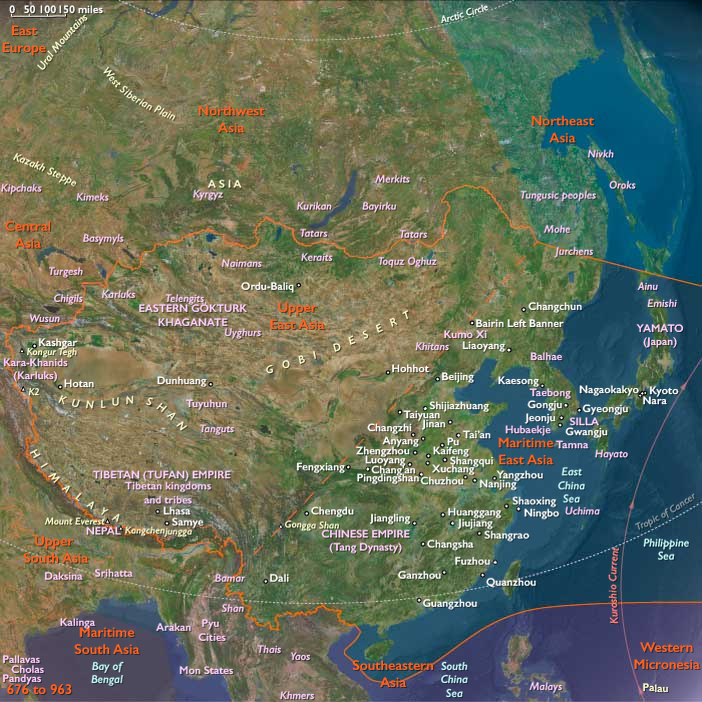
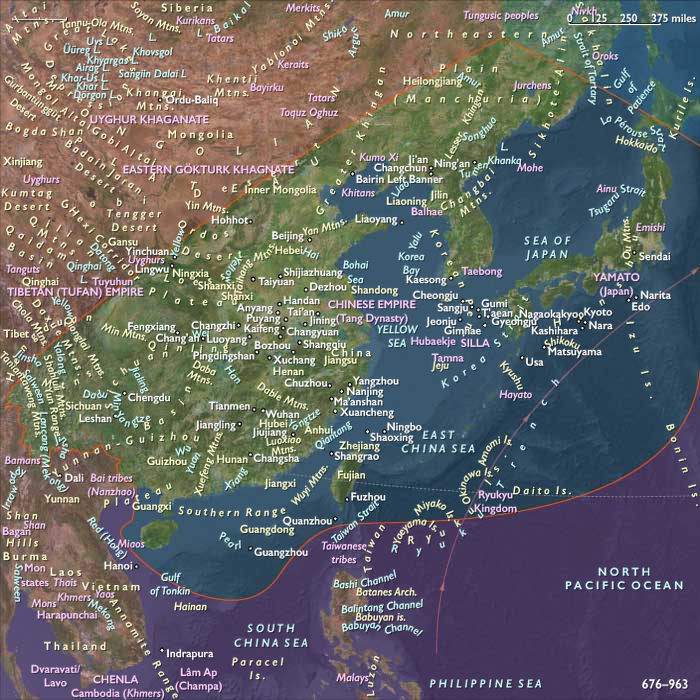
The Tang capital, Chang'an (present-day Xi'an), is the most populous city in the world at this time.
The first century of the Tang dynasty has so far been one of the most prosperous and brilliant periods in the history of Chinese civilization.
The empire now extends so far across Central Asia that for a while Bukhara and Samarkand are under Chinese control, the Central Asian kingdoms pay China tribute, and Chinese cultural influence reaches Korea and Japan.
Chang'an has become the greatest city in the world; its streets are filled with foreigners, and foreign religions—including Zoroastrianism, Buddhism, Manichaeism, Nestorianism, Christianity, Judaism, and Islam—flourish.
This confident cosmopolitanism is reflected in all the arts of this period.
Li Longji, born in 685 into an era when power was virtually in the hands of his grandmother, the Empress Wu Zetian, widow of Emperor Zhongzong, had become the only glimmer of hope for the restoration of the imperial Li family.
His aunt, the Princess Taiping, daughter of the Empress, had fiercely protected Longji from harm by the Wu family.
In conspiring with Princess Taiping to put an end to the Empress’s attempted usurpation of power, Longji had killed Empress Wei in 710 a palace coup which had placed his own father, Emperor Ruizong, on the throne.
Longji had been appointed chancellor for a few months before becoming the crown prince.
Tensions between Princess 'aiping and Li Longji had soon mounted, however.
Princess Taiping, who has many supporters at court, hopes to ascend the imperial throne as her mother Empress Wu had done.
Ruizong exiles his sister to the provinces, hoping to defuse tension, but Longji, who fears that Princess Taiping would hold him responsible for her exile and would have him murdered, asks his father to recall the princess, who is allowed to return to the imperial court.
Eventually, in September 712, a disgruntled Ruizong, tired of court feuds, abdicates in favor of his son, who becomes Emperor Tang Xuanzong.
Suddenly it is Princess Taiping who is at risk of falling victim.
Alarmed by Ruizong's decision, the princess manages to have the court name him Taishang Huang (sometimes translated as "retired emperor", or "emperor emeritus"), a position in which Ruizong is to keep effective control of power with the new emperor Xuangzong only formally attending court audiences and ceremonies.
Appointments to high offices, controlled by Ruizong, are filled with the Princess' supporters.
Years: 712 - 712
Locations
People
Groups
Subjects
Regions
Subregions