
The Sidonian king Abdi-Milkutti rises up against …
Years: 681BCE - 670BCE
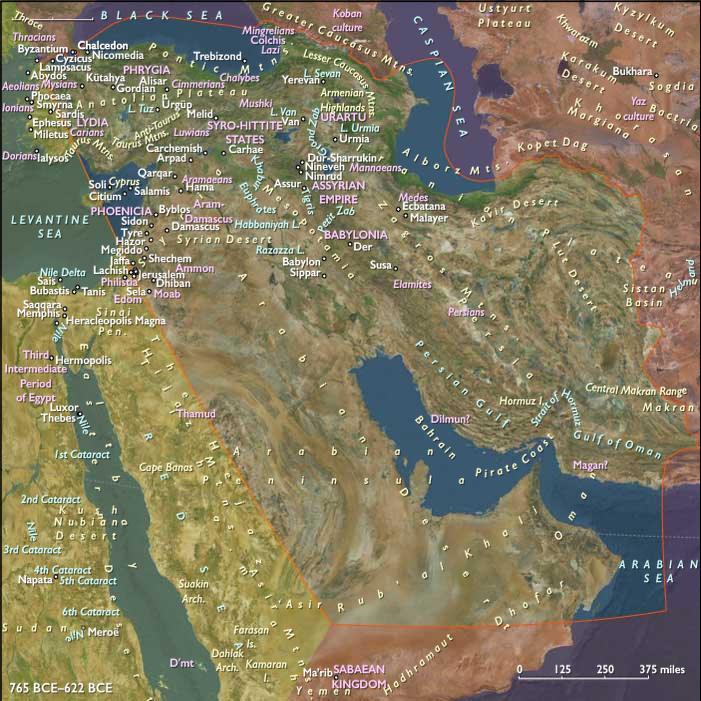
The Sidonian king Abdi-Milkutti rises up against the Assyrian king in 680 BCE.
Unwilling to pay tribute to Assyria, he has formed an alliance with Sanduarri, king of Kundu (in western Cilicia), and Sizzu, a prince of the Lebanon, probably during the time of the civil war waged between Esarhaddon and two of his brothers who, after having murdered his father, dispute his succession.The two king swear to each other by the names of the great gods and revolt.
Abdi-Milkutti is defeated in 677 BCE after three years of siege, and beheaded.
The town of Sidon is destroyed and rebuilt as Kar-Ashur-aha-iddina, the "Harbor of Esarhaddon".
The population is deported to Assyria.
Sanduarri is also captured and decapitated and the heads of the two kings are hung around the necks of their nobles who are paraded through the streets of Nineveh.
A share of the plunder goes to the loyal king of rival Tyre, Baal I, himself an Assyrian puppet.
The partly conserved text of a treaty with Tyre mentions the kings of Judah, Edom, Moab, Gaza, Ashkelon, Ekron, Byblos, Arvad, Samsi-muruna, Ammon, Ashdod, ten kings from the coast of the sea, and ten kings from the middle of the sea (usually identified with Cyprus), as Assyrian allies.
Esarhaddon sends off to Assyria a rich treasure, including: “gold, silver, precious stones, elephant hides, ivory, maple and boxwood, garments of brightly colored wool and linen.”
He also takes away the king’s wife, his children, and his courtiers: “His people from far and near, which were countless.”
The defeated and executed king of Sidon is depicted on the Sam'al stele of Esarhaddon from Zenjirli.
The stele shows Abdi-Milkutti, dressed in his native costume and held with a coiled leash.
Although he is shown standing with his hands raised, he reaches only to about Esarhaddon's knee.
Next to him is shown a kneeling Egyptian prince.
Locations
People
Groups
- Mesopotamia
- Phoenicians
- Tyre, Kingdom of (Phoenicia)
- Ammonites, Kingdom of the
- Edomites, Kingdom of the
- Moabites, Kingdom of the
- Philistines
- Egypt (Ancient), Third Intermediate Period of
- Judah, Kingdom of
- Cyprus, Classical
- Assyrian people
- Assyria, (New) Kingdom of (Neo-Assyrian Empire)
Topics
- Younger Subboreal Period
- Iron Age, Near and Middle East
- Iron Age Cold Epoch
- Classical antiquity
- Assyrian Wars of c. 745-609 BCE
Commodoties
Subjects
Regions
Subregions
Years: 681BCE - 670BCE
Locations
People
Groups
- Mesopotamia
- Phoenicians
- Tyre, Kingdom of (Phoenicia)
- Ammonites, Kingdom of the
- Edomites, Kingdom of the
- Moabites, Kingdom of the
- Philistines
- Egypt (Ancient), Third Intermediate Period of
- Judah, Kingdom of
- Cyprus, Classical
- Assyrian people
- Assyria, (New) Kingdom of (Neo-Assyrian Empire)
Topics
- Younger Subboreal Period
- Iron Age, Near and Middle East
- Iron Age Cold Epoch
- Classical antiquity
- Assyrian Wars of c. 745-609 BCE
Commodoties
Subjects
Regions
Subregions