
The ships of the sixth Portuguese India …
Years: 1504 - 1504
May
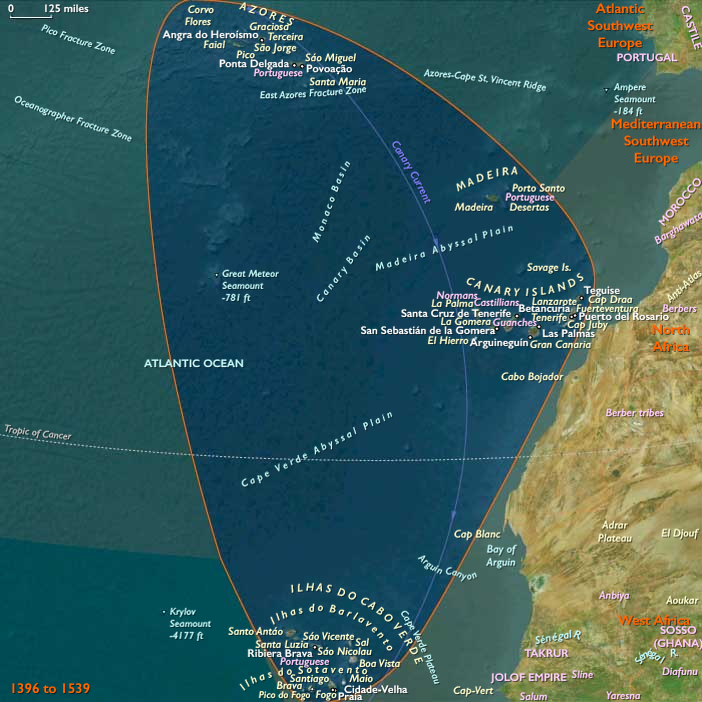
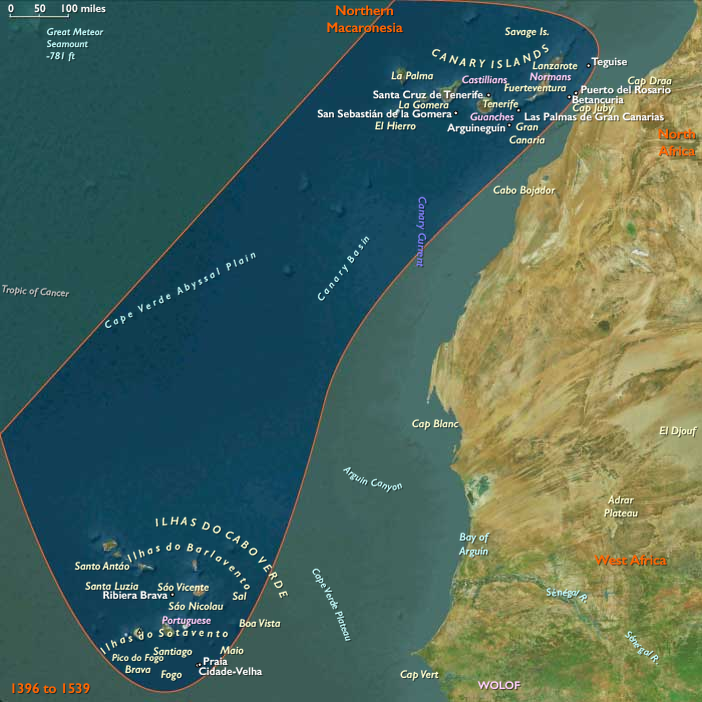
The ships of the sixth Portuguese India armada arrive at the first collection point, Cape Verde, on May 2.
Lopo Soares announces that as they had left Lisbon so late, there is no room for error.
He lays down a set of strict sailing instructions, and warns pilots and masters he will dock their pay for every mistake.
Locations
People
- Afonso de Albuquerque
- Francisco de Almeida
- João da Nova
- Lopo Soares de Albergaria
- Lourenço de Almeida
- Manuel I of Portugal
- Tristão da Cunha
Groups
- Islam
- Kolattunādu (Kingdom of Cannanore)
- Christians, Roman Catholic
- Cochin, Kingdom of
- Ormus, Kingdom of
- Ethiopia, Solomonid Dynasty of
- Kozhikode, or Calicut, Kingdom of
- Egypt and Syria, Mamluk Burji Sultanate of
- Portugal, Avizan (Joannine) Kingdom of
- Portuguese Empire
- Portuguese Mozambique
Topics
- India, Medieval
- Yemen, Medieval
- Age of Discovery
- Portuguese Conquests in India and the East Indies
- Colonization of Asia, Portuguese
- Cochin, Battle of
- Portuguese–Mamluk naval war
- Portuguese Ceylon
Commodoties
Subjects
- Commerce
- Watercraft
- Engineering
- Labor and Service
- Conflict
- Exploration
- Faith
- Government
- Custom and Law
- Technology
- Finance
Regions
Subregions
Related Events
Filter results
Showing 10 events out of 39659 total
The Tamil Bell, a broken bronze bell discovered in approximately 1836 by Cornish Christian missionary William Colenso, had been used as a pot to boil potatoes by Māori women near Whangarei in the Northland Region of New Zealand.
The bell, thirteen centimeters long and nine centimeters deep, has an inscription running around the rim of the bell that has been identified as old Tamil.
Translated, it says "Muhayideen Baksh’s ship’s bell".
Some of the characters in the inscription are of an archaic form no longer seen in modern Tamil script, thus suggesting that the bell could be about five hundred years old, or possibly even earlier, from the Later Pandya period.
The discovery of the bell has led to speculation about a possible Tamil presence in New Zealand.
Seafarers from Trincomalee may have reached New Zealand during the period of increased trade between the Vanni country and South East Asia.
The bell might have been dropped off the shore by a Portuguese ship, whose sailors had been in touch with the Indians.
Also, a number of Indian vessels are captured by the Europeans during the period; thus, another possibility is that the bell might have belonged to a such a wrecked vessel, cast away on the New Zealand shores.
Afonso de Albuquerque completes the capture of Hormuz in 1515, while other Portuguese establish trading relations with Macao in China.
With the acquisition of these bases, the Portuguese have not only gained access to the rich spice trade of the East Indies but are now positioned to destroy their rivals, the Arab seafarers.
Contacts between Asia and the west already dated back hundreds of years, especially between the Papacy and the Mongol Empire in the thirteenth century.
There were also numerous traders that traveled between the continents, the most famous of which is Marco Polo.
Christianity is not new to the Mongols, as many have been practicing Nestorian Christianity since the seventh century.
However, the overthrow of the Mongol Yuan Dynasty by the Ming in 1368 resulted in a strong assimilatory pressure on China's Muslim, Jewish, and Christian communities, and outside influences were forced out of China.
By the sixteenth century, there is no reliable information about any practicing Christians remaining in China.
Syphilis seemed to have reached Guangzhou in 1505.
The first Portuguese explorer credited with reaching China is Jorge Álvares, who arrives at Guangzhou via the Pearl River Delta in 1513.
The throne of Mongolia had passed into the hands of Jorightu Khan Yesüder, an Arib-Bokid prince, in 1388 after the demise of the Northern Yuan emperor Tögüs Temür, Kublai Khan's descendant.With the anarchy after the Mongol Emperor's death, Chagatai Khan's descendant, Gunashiri, who followed the Yuan court's retreat into Mongolia, attempted to break away from the new Khan's rule.
Gunashiri, himself Buddhist, had by 1390 successfully established himself in Hami, where the Uighurs live.
The Kara Del in 1404 had accepted the Ming supremacy to save its existence, and had come under Ming control as Hami Prefecture.
The Kara Del ruler Enke-temur had been granted the title Zhongshunwang (meaning the obedient prince) by the Ming court.
They are threatened by Mongolian Emperors, however, particularly during the reign of Yesüder, from the north.
The Oirats from Western Mongolia have from the fifteenth century pressured the kingdom.
Their leader and Yuan taishi, Esen, a future Emperor of the Mongols, had in 1430 forced the submission of the Kara Del khan.
The kingdom is one of two Chagatyid realms conquered by Esen, the other one being Moghulistan around 1432.
He extensively supported the rivalry between successor of Gunashiri and intervened in their dynastic struggles.
The Ming Dynasty was trying to place their puppet on the throne to secure their claim at the time.
A pro-Mongol faction overthrew the khan in 1463 and a serious succession crisis began.
Ming Emperors from 1467 have reinstalled members of Gunashiri's house but the failure is evident.
Hami is conquered in 1513 by Mansur, the khan of eastern Moghulistan, putting an end to the dynasty.
Mansur forcefully converts all people living in Kara Del to Islam.
East Europe (1504–1515 CE): Muscovite Expansion and Administrative Refinement
Political and Military Developments
Territorial Consolidation and Administration
Between 1504 and 1515 CE, Muscovy expanded further and solidified its hold over newly acquired territories. Under the leadership of Vasili III, administrative reforms improved governance and facilitated stronger centralized control.
Complex Relations with Regional Khanates
Muscovy's interactions with the Khanates of Kazan, Crimea, and Astrakhan remained dynamic and occasionally tense. Strategic diplomacy and targeted military campaigns helped secure Muscovy’s territorial integrity and political influence.
Military Innovations and Defense Enhancements
Continued military advancements, including improved fortifications, refined siege tactics, and sophisticated cavalry strategies, enhanced Muscovy’s defense capabilities and supported its regional ambitions.
Economic and Technological Developments
Economic Stability and Growth
The Muscovite economy continued to thrive, supported by robust internal commerce and active participation in international trade. Key urban centers, particularly Moscow, prospered significantly.
Infrastructure and Technological Advancements
Technological progress continued, particularly in military infrastructure and urban development, reinforcing regional security and supporting administrative efficiency.
Cultural and Artistic Developments
Cultural Flourishing and Artistic Innovation
Cultural development thrived, driven by Muscovite patronage, with notable advancements in architecture, religious art, and secular cultural activities. These achievements further enriched Muscovite cultural identity.
Literary and Intellectual Continuity
Intellectual and literary productivity remained high, with scholars and chroniclers extensively documenting historical, religious, and cultural events, significantly reinforcing regional identity and continuity.
Settlement Patterns and Urban Development
Continued Urban Expansion
Urban centers, especially Moscow, experienced ongoing demographic and economic growth, facilitated by improved infrastructure and advanced urban planning, thus enhancing regional administrative coherence.
Strategic Urban Fortifications
Continued improvement in fortifications strengthened urban defense systems, safeguarding regional stability amid political and military challenges.
Social and Religious Developments
Social Cohesion and Ethnic Integration
Social integration of diverse ethnic communities—including the Mari, Mordvins, Udmurts, Komi, and Vepsians—continued, enhancing social cohesion and administrative effectiveness.
Influential Role of the Orthodox Church
The Orthodox Church continued to exert significant influence over educational, moral, and social aspects of Muscovite life, further stabilizing society and reinforcing cultural continuity.
Long-Term Consequences and Historical Significance
The period from 1504 to 1515 CE saw continued Muscovite expansion, administrative refinement, and cultural enrichment. These developments laid important foundations for the cohesive political structure and robust cultural identity of the emerging Russian state.
A conflict arises in Muscovy in the second quarter of the sixteenth century between church and state, as well as between cultural nativism and innovation.
It ends in compromise: the agreement reaffirms and strengthens the autocratic political values of Moscow while respecting the economic power and position of the church.
It also liberalizes cultural life to admit the influences from the Balkans and western Europe.
Yet the strain between those who champion a spiritualistic church, divested of worldly wealth (the nonpossessors, or Volga Elders), and the possessors, followers of Joseph of Volokolamsk, who seek to retain the church's wealth and institutional power, continue to affect Muscovite cultural life.
The Beginnings of Medical Licensing in Europe (1509)
By 1509, European authorities began making the first formal attempts to regulate the practice of medicine, requiring physicians to be licensed in order to practice. This marked an important step toward professionalizing the medical field, ensuring higher standards of care, and limiting the influence of unqualified healers.
Why Was Medical Licensing Introduced?
-
The Growth of Universities and Medical Schools
- By the early 16th century, institutions such as the University of Bologna, University of Paris, University of Padua, and University of Salamanca had established formal medical faculties.
- The development of anatomy, surgery, and pharmacology led to a greater emphasis on scientific training for doctors.
-
The Influence of Renaissance Humanism and Scientific Inquiry
- The Renaissance sparked renewed interest in medical texts from Galen, Hippocrates, and Avicenna.
- Humanist scholars advocated for standardized education and formal qualifications, leading to greater oversight of the medical profession.
-
Growing Concerns Over Quackery and Charlatans
- Before licensing, untrained healers, herbalists, and barber-surgeons often provided medical care, sometimes with dangerous or ineffective treatments.
- Governments sought to protect public health by ensuring only trained physicians could practice legally.
How Was Medical Licensing Enforced?
-
Local and national authorities introduced new regulations, often requiring physicians to:
- Obtain a diploma from an accredited university.
- Pass an examination administered by a medical board.
- Receive official approval from local governing bodies or royal authorities.
-
Spain, Italy, and France were among the first countries to enforce medical licensing.
- In Spain, the Catholic Monarchs implemented medical laws requiring doctors to be trained and licensed.
- In Italy, Venice and Florence established state-supervised medical boards.
- In France, the University of Paris had already imposed strict medical qualifications by the late Middle Ages.
Impact of Medical Licensing on European Medicine
-
Raised Standards of Medical Care
- Licensing ensured that physicians were trained in anatomy, diagnostics, and treatments, leading to better patient outcomes.
-
Shift Toward Institutional Medicine
- The rise of regulated medical practice led to the growth of hospitals and medical institutions, which became centers of learning and patient care.
-
Legal Recognition of Medicine as a Profession
- Medicine became a recognized field requiring formal education, similar to law and theology.
Conclusion: The Foundation of Modern Medical Practice
The first licensing regulations for physicians in 1509 marked the beginning of modern medical professionalism. Over time, these early laws expanded across Europe, paving the way for the structured, scientific, and regulated medical profession we recognize today.
Northeast Europe (1504–1515 CE): Union Fractures, Teutonic Struggles, and Emerging Geopolitical Shifts
Between 1504 and 1515 CE, Northeast Europe witnessed deepening instability within the Kalmar Union, continued decline of the Teutonic Order, and the assertive rise of the Polish–Lithuanian Union. Economic prosperity persisted despite geopolitical uncertainties, while strategic diplomacy reshaped alliances and territorial arrangements.
Deepening Divisions in the Kalmar Union
Under King John (Hans), and subsequently his son Christian II, the Kalmar Union faced escalating internal discord. Swedish resistance to centralized Danish control intensified significantly, fueled by economic grievances and demands for autonomy by powerful Swedish nobles. These mounting tensions increasingly destabilized the Union’s political coherence, laying foundations for future dissolution.
Further Decline of the Teutonic Order
The Teutonic Order continued grappling with severe internal divisions, dwindling economic resources, and diplomatic isolation. Unable to recover from earlier territorial losses and military defeats, particularly at the hands of Poland-Lithuania, the Order's grip on its remaining territories, especially in Prussia, weakened further. Urban centers like Königsberg remained economically resilient, but the Order’s broader territorial influence steadily diminished.
Polish–Lithuanian Union’s Expanding Influence
Under King Sigismund I the Old, the Polish–Lithuanian Union significantly enhanced its geopolitical position, consolidating control over contested border territories and reinforcing diplomatic ties throughout the region. Effective military strategies and robust internal governance allowed the union to further assert its dominance, particularly at the expense of the weakened Teutonic Order.
Stability and Economic Strength in Livonian Territories
The Livonian Confederation, centered in the strategic trading city of Riga, maintained political stability and economic resilience through skillful diplomacy and fortified urban governance. Its autonomy and strategic economic position allowed it to successfully navigate complex regional rivalries, sustaining prosperity amid broader geopolitical turbulence.
Swedish Consolidation in Finland
Despite the rising internal tensions within the Kalmar Union, Sweden strengthened its administrative and military integration in southern Finland. Enhancing fortifications, governance structures, and ecclesiastical influence further solidified Finland’s role as a strategically vital and culturally cohesive component of Swedish territory.
Prosperity of Major Urban Centers
Economic vitality characterized key urban centers including Reval (Tallinn), Riga, Königsberg, and Visby on Gotland, which thrived through robust maritime commerce and active merchant networks. These prosperous cities continued to support regional economic stability, significantly offsetting geopolitical disruptions.
Ecclesiastical Institutions and Cultural Cohesion
Ecclesiastical institutions, notably regional bishoprics and the increasingly beleaguered Teutonic Order, maintained their critical roles in educational advancement, social governance, and cultural continuity. Their sustained promotion of Latin Christian traditions provided enduring regional stability and cohesion amidst shifting political dynamics.
Diplomatic Shifts and Strategic Alliances
Strategic diplomacy intensified among regional powers, including the weakening Teutonic Order, fracturing Kalmar Union, influential Polish–Lithuanian Union, and autonomous Livonian Confederation. These diplomatic interactions emphasized cautious territorial negotiations, shifting alliances, and conflict avoidance, profoundly reshaping the regional geopolitical landscape.
Legacy of the Era
The era from 1504 to 1515 CE significantly reshaped Northeast Europe's political dynamics, defined by deepening internal divisions, territorial realignments, and the emergence of dominant new powers. These developments had lasting impacts on regional political boundaries, diplomatic strategies, and cultural identities, fundamentally influencing Northeast Europe's subsequent historical trajectory.
East Central Europe (1504–1515 CE): Jagiellonian-Habsburg Rivalry, Ottoman Encroachment, and Dynastic Alliances
From 1504 to 1515 CE, East Central Europe experienced intense geopolitical shifts driven by escalating rivalry between the Jagiellonian dynasty (in Hungary, Bohemia, and Poland-Lithuania) and the ascendant Habsburg dynasty, as well as growing Ottoman pressures from the south. Diplomatic realignments, including strategic dynastic marriages, reshaped alliances, setting the stage for future Habsburg dominance and enduring regional tensions.
Political and Military Developments
Jagiellonian Rule and Internal Struggles
-
Under Vladislaus II Jagiellon (r. 1490–1516), Hungary and Bohemia increasingly faced internal aristocratic conflicts and weakening royal authority. Vladislaus’s ineffective governance led to greater political fragmentation and noble autonomy.
-
Poland-Lithuania, ruled by Sigismund I the Old (r. 1506–1548), faced continued threats from the Teutonic Order and Moldavia, prompting intensified military and diplomatic efforts to secure eastern and northern frontiers.
Escalation of Jagiellonian-Habsburg Rivalry
-
Habsburg Emperor Maximilian I (r. 1493–1519) pursued an aggressive strategy to assert dominance over Hungarian and Bohemian territories, heightening rivalry with the Jagiellonians.
-
Diplomatic tensions culminated in the First Congress of Vienna (1515), resulting in strategic marriages between the Jagiellonian and Habsburg houses, profoundly influencing future dynastic successions. The treaties at this congress arranged double marriages: Vladislaus’s children, Louis II of Hungary and Bohemia, and Anne Jagiellon, married into the Habsburg dynasty, profoundly reshaping regional alliances.
Increasing Ottoman Threats to Hungary
-
The Ottoman Empire, under Sultan Selim I (r. 1512–1520), intensified its incursions into southern Hungarian territories, significantly straining Hungary’s resources and defenses. Frequent Ottoman raids prompted increased military expenditures and defensive strategies.
Economic and Technological Developments
Continued Urban Prosperity and Trade
-
Economic vitality persisted, particularly within Hanseatic cities (Gdańsk, Toruń, Elbląg, Stettin) and urban centers such as Prague, Kraków, Vienna, and Buda, driven by strong commercial networks trading grain, textiles, metals, and luxury goods.
-
Increased artisanal productivity and expanding mercantile activities significantly enhanced regional economic stability and urban wealth.
Mining and Metallurgical Growth
-
Notably in Hungarian and Slovak mining centers (Banská Štiavnica, Banská Bystrica, Kremnica), robust extraction of precious metals (gold, silver, copper) continued, significantly contributing to regional prosperity and enhancing Hungary’s economic influence.
Cultural and Artistic Developments
Renaissance Flourishing under Jagiellonian and Habsburg Patronage
-
Hungarian Renaissance culture thrived under Vladislaus II, who continued fostering intellectual, artistic, and architectural developments, especially in Buda and Esztergom, further enhancing Hungary’s cultural prestige.
-
Polish cities, notably Kraków under Sigismund I, experienced significant Renaissance cultural patronage, reflected in humanist scholarship, artistic achievements, and architectural innovations.
Bohemian Artistic Continuity
-
Bohemian culture continued blending Gothic and emerging Renaissance influences, particularly in Prague, where royal patronage sustained artistic and architectural projects, despite Vladislaus’s largely absent governance.
Settlement and Urban Development
Defensive Urban Fortification
-
Persistent Ottoman threats and regional conflicts led to enhanced urban fortifications across Hungary, notably Buda, Pest, Székesfehérvár, and along frontier regions, significantly shaping urban development and military infrastructure.
Expansion and Urbanization in Poland and Bohemia
-
Urban centers like Kraków, Lublin, and Prague continued to expand and prosper, driven by robust trade, artisanal activities, and growing populations, reflecting stable urban economies and effective civic governance.
Social and Religious Developments
Nobility’s Growing Power and Influence
-
Aristocratic power significantly expanded, particularly in Hungary, Bohemia, and Poland-Lithuania. Noble diets, notably the Hungarian Diet and Polish Sejm, increasingly dominated royal decision-making, fiscal policy, and regional governance.
-
Nobility’s rising influence contributed to weakened royal authority, internal divisions, and more decentralized governance structures, profoundly shaping regional political dynamics.
Religious Stability and Ecclesiastical Influence
-
The Catholic Church remained influential across East Central Europe, promoting ecclesiastical scholarship, education, and artistic patronage, reinforcing cultural cohesion. Monastic and ecclesiastical institutions notably influenced education, religious practices, and social norms.
Long-Term Consequences and Historical Significance
The era 1504–1515 CE proved pivotal for East Central Europe, significantly reshaped by escalating Jagiellonian-Habsburg rivalry, strategic dynastic marriages from the Congress of Vienna (1515), and intensified Ottoman threats. Diplomatic alliances secured at Vienna laid foundations for eventual Habsburg dominance in Bohemia and Hungary, significantly influencing Central European geopolitics throughout the 16th century. Continued economic vitality and cultural flourishing under Renaissance patronage strengthened regional prosperity, despite rising external threats and internal divisions. These developments profoundly influenced East Central Europe’s trajectory, establishing political and cultural patterns that endured through the early modern period.
The fifteenth and sixteenth centuries in Poland will be known as the Złoty Wiek or Golden Age.
Many works of Polish Renaissance art and architecture are created, including ancient synagogues in Kraków's Jewish quarter located in the northeastern part of Kazimierz, such as the Old Synagogue.
During the reign of Casimir IV, various artists had come to work and live in Kraków, and Johann Haller had established a printing press in the city after Kasper Straube had printed the Calendarium Cracoviense, the first work printed in Poland, in 1473.
The press first publishes works in the vernacular in 1513.
A yeshiva had been established in Krakow in 1500, at which time there were an estimated twenty thousand to thirty thousand Jews living in Poland.
King Sigismund, although a devout Catholic, nevertheless grants religious freedom to Protestants, and accords religious toleration to Greek Orthodox Christians and royal protection to Jews, thereby making Poland the most tolerant state in Europe.
Years: 1504 - 1504
May
Locations
People
- Afonso de Albuquerque
- Francisco de Almeida
- João da Nova
- Lopo Soares de Albergaria
- Lourenço de Almeida
- Manuel I of Portugal
- Tristão da Cunha
Groups
- Islam
- Kolattunādu (Kingdom of Cannanore)
- Christians, Roman Catholic
- Cochin, Kingdom of
- Ormus, Kingdom of
- Ethiopia, Solomonid Dynasty of
- Kozhikode, or Calicut, Kingdom of
- Egypt and Syria, Mamluk Burji Sultanate of
- Portugal, Avizan (Joannine) Kingdom of
- Portuguese Empire
- Portuguese Mozambique
Topics
- India, Medieval
- Yemen, Medieval
- Age of Discovery
- Portuguese Conquests in India and the East Indies
- Colonization of Asia, Portuguese
- Cochin, Battle of
- Portuguese–Mamluk naval war
- Portuguese Ceylon
Commodoties
Subjects
- Commerce
- Watercraft
- Engineering
- Labor and Service
- Conflict
- Exploration
- Faith
- Government
- Custom and Law
- Technology
- Finance
