
The Sharqi rulers of Jaunpur have become …
Years: 1479 - 1479
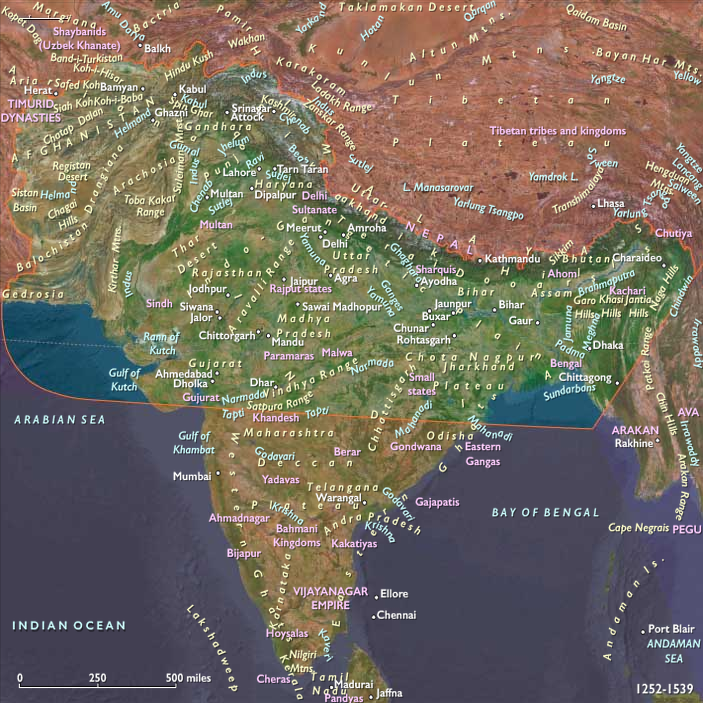
The Sharqi rulers of Jaunpur have become known for their patronage of learning and architecture.
Jaunpur is known as the Shiraz of India during this period.
The most notable examples of the Sharqi style of architecture in Jaunpur are the Atala Masjid, the Lal Darwaja Masjid and the Jama Masjid.
The foundation of the Atala Masjid, although it had been laid by Firuz Shah Tughluq in 1376, had been completed only during the rule of Ibrahim Shah in 1408.
Ibrahim Shah also built another mosque, the Jhanjhiri Masjid, in 1430.
The Lal Darwaja Masjid as built in 1450 during the reign of the next ruler, Mahmud Shah.
The Jama Masjid was built in 1470, during the rule of the last ruler, Mahmud’s third son, Hussain Shah.
Hussain Shah, who assumed the title of Gandharva, has contributed significantly to the development of Khayal, a genre of Hindustani classical music.
He has also composed several new ragas (melodies).
Most notable among these are Malhār-śyāma, Gaur-śyāma, Bhopāl-śyāma, Hussaini- or Jaunpurī-āśāvari (presently known as Jaunpuri) and Jaunpuri-basant.
The intermittent warfare between the sultanates of Delhi and Jaunpur had remained indecisive.
Hussain Shah had signed a four years' peace treaty with Bahlul Lodi, ruler of the Delhi Sultanate, in 1458.
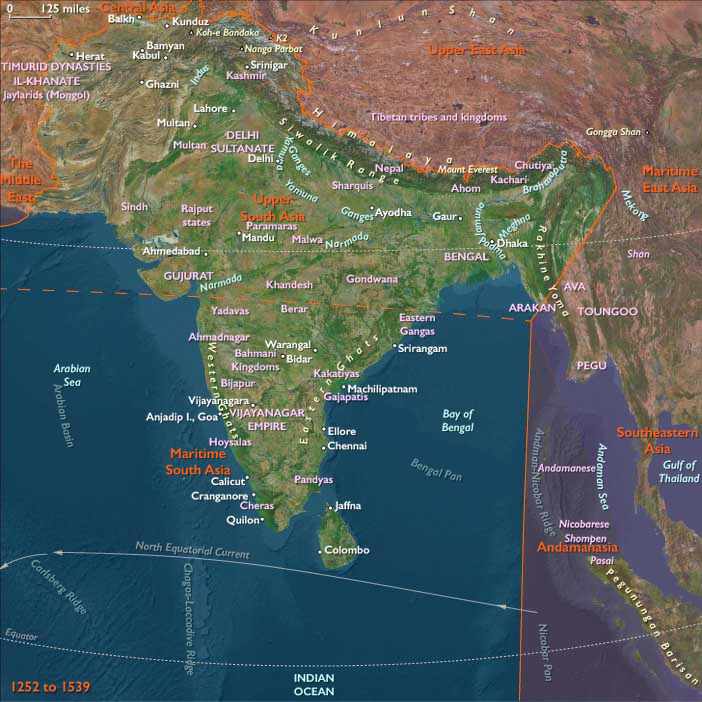
Later, in order to invade Delhi , Hussain Shah had reached the banks of the Yamuna with a very large army in 1478.
Sultan Bahlul Lodi had attempted to secure peace by offering to retain only Delhi and govern it as a vassal of Hussain Shah, but the latter rejected the offer.
As a result, Sultan Bahlul had crossed the Yamuna and defeated him.
Hussain Shah had agreed to a truce but again captured Etawah and marched towards Delhi with a huge army and was again defeated by Bahlul Lodi.
Able to make peace this time also, he again arrives at the banks of Yamuna in March, 1479.
Defeated by Bahlul Lodi, Hussain lose the parganas (administrative units) of Kampil, Patiali, Shamsabad, Suket, Koil, Marhara and Jalesar to the advancing army of the Delhi Sultan.
After successive defeats in the battles of Senha, Rapri and Raigaon Khaga, he is finally defeated on the banks of the Rahab.
Hussain retires to …
Locations
People
Groups
Topics
Commodoties
Subjects
- Commerce
- Architecture
- Performing Arts
- Labor and Service
- Conflict
- Faith
- Government
- Scholarship
- Custom and Law
- Technology
Regions
Subregions
Related Events
Showing 10 events out of 40712 total
Years: 1479 - 1479
Locations
People
Groups
Topics
Commodoties
Subjects
- Commerce
- Architecture
- Performing Arts
- Labor and Service
- Conflict
- Faith
- Government
- Scholarship
- Custom and Law
- Technology
Regions
Subregions