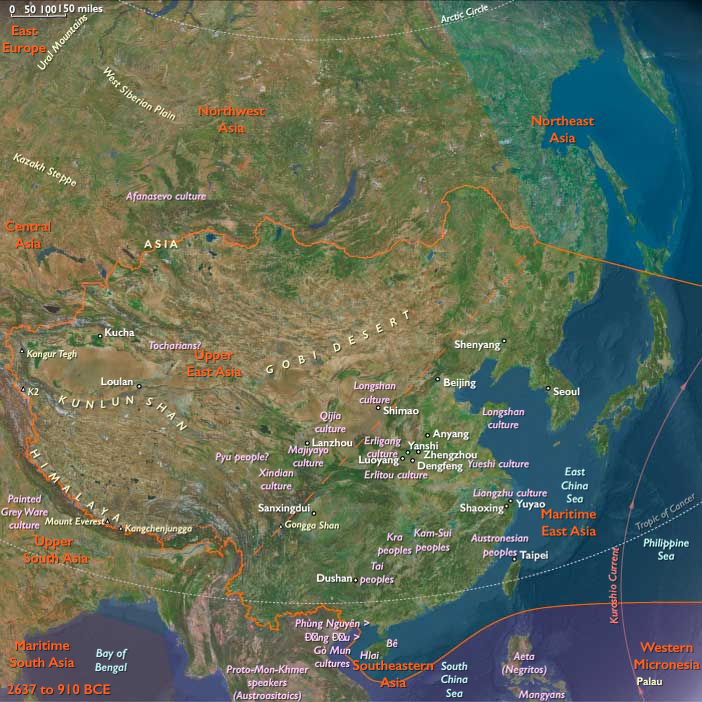
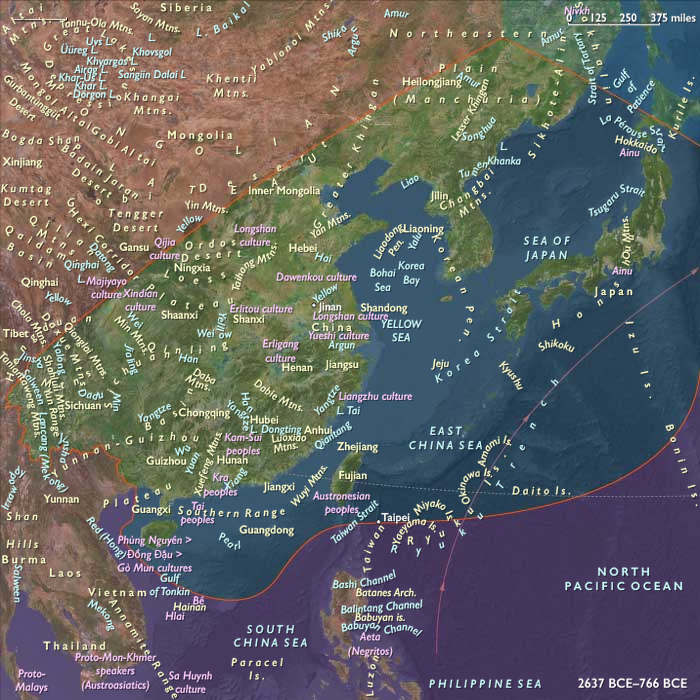
The Shang rule from the city of …
Years: 1341BCE - 1198BCE
The Shang rule from the city of Yin, near modern Anyang, beginning about 1350 BCE.
The new capital city includes defensive walls plus palaces, temples, tombs for the elite, facilities for storage of grain, and army barracks.
Locations
Groups
Topics
Commodoties
Subjects
Regions
Subregions
Related Events
Filter results
Showing 10 events out of 562 total
Northern South Asia (820–1971 CE): Empires, Colonialism, and the Birth of Modern Nations
Medieval Empires and Dynastic Rule
From the early medieval period onward, Northern South Asia experiences significant dynastic changes. Islamic empires begin exerting influence from the 11th century with the Ghaznavids and later the Delhi Sultanate, reshaping cultural and political landscapes through trade, conquest, and cultural exchanges. Simultaneously, Afghanistan becomes a crucial frontier region, witnessing invasions and rule by various Turkic and Persian dynasties, including the Timurids and the early Mughals.
Nepal and Bhutan remain largely isolated, developing distinctive Himalayan cultures and systems of governance. In Nepal, the medieval period is characterized by the rule of various dynasties, such as the Mallas, who foster rich cultural and architectural traditions.
Mughal Ascendancy and Cultural Synthesis
The rise of the Mughal Empire in the 16th century under rulers like Babur, Akbar, and Aurangzeb marks a pinnacle of political and cultural achievement. The Mughals integrate diverse traditions, fostering a unique synthesis of Persian, Indian, and Central Asian cultures. Monumental architecture flourishes, exemplified by the Taj Mahal and the Red Fort. Administrative systems established under Akbar provide stability and governance across the empire, extending influence into modern-day Pakistan, Bangladesh, and parts of Afghanistan.
British Colonial Expansion
The weakening Mughal Empire in the 18th century facilitates the expansion of the British East India Company, climaxing with the pivotal Battle of Plassey in 1757. British dominance consolidates rapidly, leading to direct British rule following the Indian Rebellion of 1857–58. Afghanistan, however, remains fiercely independent, becoming a contested region between British India and Imperial Russia, sparking several Anglo-Afghan wars.
Meanwhile, Nepal under the Shah Dynasty and Bhutan under the leadership of the Wangchuck Dynasty maintain autonomy, though both engage diplomatically and militarily with British India. Bhutan eventually signs treaties with Britain, securing internal sovereignty while ceding some frontier territories.
Rise of Nationalist Movements
Nationalist movements emerge by the late 19th century, notably with the establishment of the Indian National Congress in 1885. Parallel to this, Sir Syed Ahmad Khan spearheads educational reforms for Muslims, founding the Muhammadan-Anglo Oriental College in 1875 (later Aligarh Muslim University), laying the foundation for Muslim political activism.
Afghanistan sees modernization and centralization efforts under leaders like Amir Abdur Rahman Khan (1880–1901), who solidifies borders and establishes the Durand Line with British India, a source of enduring tension.
Independence, Partition, and the Emergence of Modern States
Intense nationalist struggles, notably under Mahatma Gandhi and Muhammad Ali Jinnah, culminate in independence and the partition of British India in 1947, creating the independent dominions of India and Pakistan. The partition triggers massive migrations and communal violence, significantly reshaping the region.
Afghanistan navigates neutrality during this period, balancing relations between emerging global powers, while Nepal and Bhutan maintain independent monarchies, cautiously opening diplomatic relations with neighboring nations and beyond.
Post-Independence Challenges and Conflicts
The new states face immediate challenges, including economic stabilization, integration of princely states, and border disputes, notably over Kashmir. Pakistan experiences internal turmoil, leading to the separation of East Pakistan and the birth of Bangladesh in 1971, following a violent liberation struggle. India maintains democratic governance, embarking on industrialization and social reforms.
Afghanistan becomes a focal point of Cold War rivalry, undergoing rapid modernization, yet experiencing deep internal divisions, leading to instability that intensifies in subsequent decades.
Nepal and Bhutan cautiously engage in modernization while striving to preserve traditional identities. Bhutan introduces controlled development policies under the monarchy, and Nepal gradually opens to external influence.
Legacy of the Epoch
The epoch from 820 to 1971 profoundly shapes Northern South Asia, witnessing transitions from medieval empires to colonial subjugation, culminating in complex realities of independent nation-states. Legacies include cultural syncretism, unresolved regional tensions (particularly over Kashmir and the Durand Line), and socio-political structures inherited from colonial rule. These dynamics continue influencing contemporary geopolitics and societal developments across Northern South Asia.

Indian opium has become a major global commodity under the British, who dominate the trade.
Opium's peculiar properties make it the ideal trade good during this age, combining the reliable demand of a basic food with the logistics of a luxury good.
As an addictive drug, opium requires a daily dose, giving it the inelastic demand of a basic foodstuff.
Long distance sea-trade in bulk foods is beyond the capacity of current maritime technology, but opium has the low weight and high markup of a luxury good like cloves or pepper.
Compounding its extraordinary profitability, China's Yongzheng emperor reacts to the rise of mass addiction by banning opium in 1729 and thus denying China the opportunity to produce opium locally to undercut the high price of Indian imports.
A syndicate of Indian merchants up the Ganges River at Patna holds a monopoly over the Bengal opium trade, making cash advances to peasant farmers and selling the processed opium to Dutch, British and French merchants.
Forces of the British East India Company in 1764 march inland from their port at Calcutta to conquer Bengal.
They soon discover the financial potential of India's richest opium zone.
The Company assumes control of a well-established opium industry involving peasant producers, merchants, and long-distance traders.
British exports of Indian opium to China increase from fifteen tons in 1720 to seventy-five tons in 1773, in which year the British governor-general of Bengal abolishes the Indian opium syndicate at Patna and establishes a colonial monopoly on the sale of opium.
Opium not only solves the fiscal crisis that accompanied the British conquest of Bengal; it remains a staple of colonial finances, providing from six to fifteen percent of British India's tax revenues throughout the nineteenth Century.
More important, opium exports are an essential component of a triangular trade that is the foundation of Britain's status as a world power.
Trade figures for the 1820s show that the triangular trade is large and well balanced: twenty-two million pounds sterling worth of Indian opium and cotton to China; next, twenty million pounds worth of Chinese tea to Britain; then, twenty-four million pounds of British textiles and machinery back to India.
The British East India Company, prizing stability above profit, has for over two decades maintained India's opium exports at four thousand chests—or two hundred and eighty tons tons, just enough to finance its purchase of China's tea crop.
Moreover, the vast profits of Britain's opium trade soon attract competitors.Prithvi Narayan Shah, taking advantage of a quarrel between King Ranajit of Bhadgaon (reigned 1722-69) and King Jayaprakasa of Kathmandu (reigned 1735-68), takes Nuwakot and lays siege to Kirtipur, which is controlled by the king of Patan, Tej Narasimha (reigned 1765-68).
During the fighting, Prithvi Narayan Shah is almost killed, and when his troops fail to take the town, he withdraws.
At this point, he changes direction, as the Gurkhas are to do effectively time and again.
The Gurkhas institute a blockade of the entire valley, close off all trade routes, and begin executing blockade runners.
Gurkha agents remain active in the towns, and the army attempts to starve the valley into submission.
The initial British campaign is an attack on two fronts.
In the eastern theater, two columns totaling about ten thousand troops are supposed to coordinate their attacks in the Makwanpur-Palpa area, but poor leadership and unfamiliarity with hill warfare caused the early collapse of these campaigns.
In the west, another ten thousand troops in two columns are to converge on the forces of Amar Singh Thapa.
One of the western columns fails miserably, but the main force under Ochterlony outmaneuvers the Nepalese army and defeats General Thapa on May 9, 1815, leading to the complete loss of Kumaon by Nepal.
The Nepalese forces have already proved their abilities, so the British East India Company takes no chances the next year, marshaling thirty-five thousand men and more than one hundred artillery pieces under Ochterlony for a thrust toward Makwanpur.
Simultaneous operations by the chogyal, or king, of Sikkim are driving the Nepalese army from the east.
Major battles before Makwanpur in late February 1816 result in the final defeat of Nepalese forces by early March.
Diplomats have already begun preparing a peace treaty, which reached Ochterlony on March 5.
The Anglo- Nepalese War (1814-16) is a total disaster for Nepal.
According to the Treaty of Sagauli, signed in 1816, Nepal loses Sikkim, the territories west of the Kali River (Kumaon and Garhwal), and most of its lands in the Tarai.
The British East India Company is to pay 200,000 rupees annually to Nepal to make up for the loss of revenues from the Tarai.
Kathmandu is also forced to accept a British resident, which is extremely disturbing to the government of Nepal because the presence of a resident has typically preceded outright British conquest throughout India.
In effect, the treaty proves to be less damaging, for the company soon finds the Tarai lands difficult to govern and returns some of them to Nepal later in 1816, simultaneously abolishing the annual payments.
The return of Tarai territory is important for the survival of Nepal because the government relies on the area as a source of land grants, and it is doubtful that the country as it is run at this time could have survived without this source of endowments.
The presence of the resident, too, turns out to be less difficult than first imagined because all later governments in Kathmandu take stringent measures to isolate him by restricting his movements and keeping a close eye on the people he meets.
Nevertheless, the glory days of conquest are over, and Nepal has been squeezed into the boundaries it will still have in the early 1990s.
Civil war ensues in Bhutan when the "first reincarnation" of Ngawang Namgyal, Jigme Dakpa, is recognized as the shabdrung in 1728.
A rival claimant, however, is promoted by opposition forces supported by Tibet.
The Tibetan-backed forces are defeated by Jigme Dakpa's supporters, but the political system remains unstable.
Regional rivalries contribute to the gradual disintegration of Bhutan at the time the first British agents arrive.
Bhutan had successfully developed control over the principality of Cooch Behar in the early eighteenth century.
The raja of Cooch Behar had sought assistance from Bhutan against the Indian Mughals in 1730, and Bhutanese political influence was not long in following.
By the mid-1760s, Thimphu considered Cooch Behar its dependency, stationing a garrison force there and directing its civil administration.
When the druk desi invades Sikkim in 1770, Cooch Behari forces join their Bhutanese counterparts in the offensive.
In a succession dispute in Cooch Behar two years later, however, the druk desi's nominee for the throne is opposed by a rival who invited British troops, and, in effect, Cooch Behar becomes a dependency of the British East India Company.
Under the Cooch Behari agreement with the British, a British expeditionary force drives the Bhutanese garrison out of Cooch Behar and invades Bhutan in 1772-73.
The druk desi petitions Lhasa for assistance from the Panchen Lama, who is serving as regent for the youthful Dalai Lama.
In correspondence with the British governor general of India, however, the Panchen Lama instead castigated the druk desi and invokes Tibet's claim of suzerainty over Bhutan.
The druk desi, failing to receive help from Tibet, signs a Treaty of Peace with the British East India Company on April 25, 1774.
Bhutan agrees to return to its pre-1730 boundaries, pays a symbolic tribute of five horses to Britain, and, among other concessions, allows the British to harvest timber in Bhutan.
Subsequent missions to Bhutan are made by the British in 1776, 1777, and 1783, and commerce is opened between British India and Bhutan and, for a short time, Tibet.
In 1784 the British turn over to Bhutanese control the Bengal Duars territory, where boundaries are poorly defined.
As in its other foreign territories, Bhutan leaves administration of the Bengal Duars territory to local officials and collects its revenues.
Although major trade and political relations fail to develop between Bhutan and Britain, the British have replaced the Tibetans as the major external threat.