
The settlement of Iceland is generally believed …
Years: 868 - 879
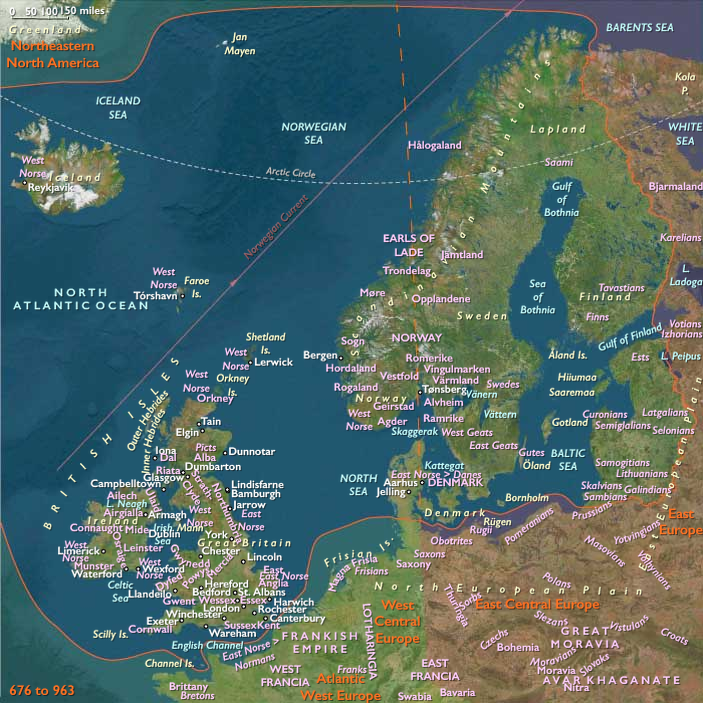
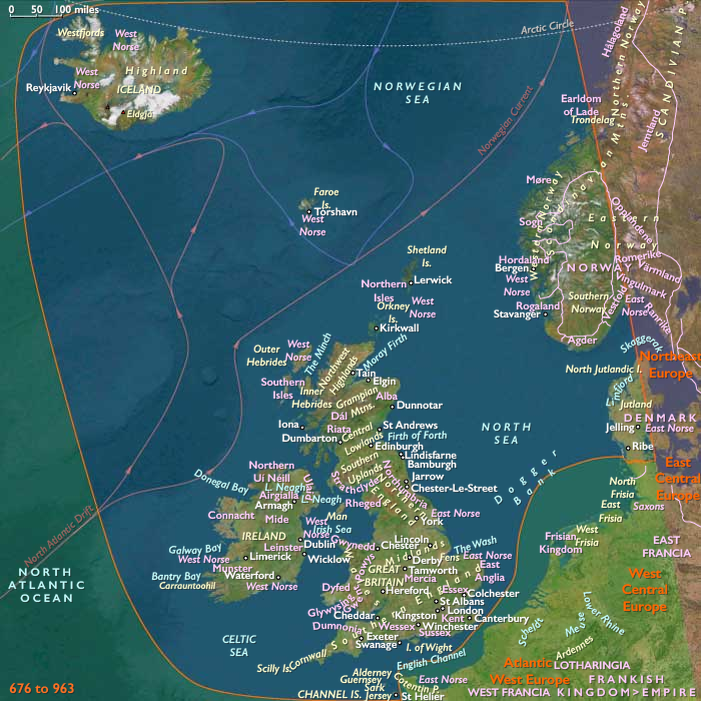
The settlement of Iceland is generally believed to have begun in the second half of the ninth century, when Norse settlers migrated across the North Atlantic.
The reasons for the migration may be traced to a shortage of arable land in Scandinavia, and civil strife brought about by the ambitions of the Norse king Harald the Fair-haired.
Unlike Britain and Ireland, Iceland is unsettled land, and can be claimed without warring on the inhabitants.
Historians typically refer to the year 874 as the first year of settlement.
People
Groups
Topics
Commodoties
Subjects
Regions
Subregions
Related Events
Filter results
Showing 10 events out of 53966 total
King Indravarman II of Champa, a country located in the central region of what is now Vietnam, founds a new dynasty at Indrapura (Quang Nam).
He initiates a building program featuring the Dong Duong Style of Cham art.
The Extent of Muslim Conquests by 875 CE
By 875 CE, Muslim conquests have expanded dramatically, stretching from Spain in the west to the Indus Valley in the east.
- In the west, Al-Andalus remains under Umayyad rule, centered in Córdoba.
- In North Africa, the Aghlabids control much of the region, while Idrisid Morocco remains independent.
- In the east, the Abbasid Caliphate governs vast territories, with its influence extending deep into Persia and Central Asia.
- Muslim expansion reaches the Indus Valley, incorporating Sindh into the Islamic world and solidifying Islamic influence in South Asia.
This period marks the height of early Islamic territorial expansion, establishing an interconnected Muslim world spanning three continents.
Carolingian Goldsmithing and the Codex Aureus of St. Emmeram (c. 870)
The Carolingian Renaissance saw the revival of Roman and Byzantine artistic traditions, particularly in the goldsmith’s craft, which flourished from the 9th to the 11th centuries. The exquisite metalwork of this period, often used for religious artifacts, set the standard for medieval European craftsmanship.
Carolingian Goldsmithing Techniques
- Use of Precious Metals → Objects were crafted in gold and silver, reflecting the imperial grandeur of the Carolingian court.
- Gem-Encrusted Decoration → Reliquaries, book covers, and liturgical objects were adorned with sapphires, garnets, pearls, and other precious stones.
- Embossed Figures and Narrative Scenes → The high-relief repoussé technique (hammering from the reverse side) was used to create detailed biblical scenes and figures of Christ, angels, and saints.
- Influences from Roman and Byzantine Art → Carolingian goldsmiths were inspired by Late Antique ivory carvings, Byzantine enamel work, and classical motifs, incorporating geometric patterns, acanthus leaves, and imperial iconography.
The Codex Aureus of St. Emmeram (c. 870)
One of the finest examples of Carolingian goldsmithing is the Codex Aureus of St. Emmeram, now housed in the Bayerische Staatsbibliothek in Munich.
- Commissioned around 870, possibly under the patronage of Emperor Charles the Bald, the manuscript exemplifies Carolingian luxury book production.
- The book cover is made of gold, encrusted with jewels, and features a central embossed image of Christ in Majesty, flanked by the four Evangelists.
- The meticulous craftsmanship and lavish materials reflect both imperial power and religious devotion, emphasizing the role of books as sacred objects in the Carolingian world.
Legacy of Carolingian Metalwork
- The techniques seen in the Codex Aureus of St. Emmeram and other Carolingian reliquaries and book covers will dominate medieval goldsmithing until the 11th century, influencing later Romanesque and Gothic art.
- Carolingian metalwork traditions will be revived and further developed in the Ottonian period, continuing the emphasis on gold, gems, and religious iconography.
- These objects served as expressions of divine power, reinforcing the connection between the Carolingian monarchy and the Church.
The Codex Aureus of St. Emmeram stands as a masterpiece of Carolingian artistry, showcasing the unparalleled skill of goldsmiths and scribes during a period of cultural revival and imperial ambition.
The Lavish Manuscripts of Charles the Bald (860s–870s): The Revival of Figurative Painting
During the 860s and 870s, a series of extraordinarily decorated manuscripts were commissioned by Charles the Bald, grandson of Charlemagne, from an unidentified scriptorium. These manuscripts mark a high point of Carolingian art, as their artists:
- Freely borrow from Late Antique, Byzantine, Insular, and Italian artistic traditions, creating a richly eclectic style.
- Reintroduce figurative painting and pictorial narrative to northern Europe, bridging the gap between the classical world and the medieval age.
- Use elaborate gold and silver leaf, combined with vivid colors and intricate calligraphy, to produce some of the most luxurious manuscripts of the early medieval period.
Stylistic Influences
- Late Antiquity → Borrowing from Roman imperial art, these manuscripts feature illusionistic depth, naturalistic drapery, and architectural framing, reviving pictorial realism.
- Byzantine Art → The use of gold backgrounds, stylized figures, and elaborate decoration echoes Byzantine icon painting and mosaics.
- Insular Traditions (British Isles) → The intricate interlace patterns, ornamental initials, and carpet pagesreflect influences from Northumbrian and Irish monasteries.
- Italian Renaissance Precursors → Elements of early Carolingian classicism, inspired by manuscripts preserved in Rome and Ravenna, help bridge Late Antiquity and medieval book illumination.
Key Manuscripts from the 860s–870s
- Codex Aureus of St. Emmeram (c. 870, Bayerische Staatsbibliothek, Munich) → Featuring a gold and gem-encrusted cover, it exemplifies the opulence of Carolingian manuscript art.
- Vivian Bible (c. 846, Bibliothèque nationale de France, Paris) → A grand, illuminated Bible presented to Charles the Bald at Tours, with narrative biblical imagery.
- Psalter of Charles the Bald (c. 860, Bibliothèque nationale de France, Paris) → A richly illustrated psalter with classical figures and detailed architectural settings.
- Lothair Crystal (9th century, British Museum, London) → While not a manuscript, this carved rock crystal disk commissioned in the Carolingian court exemplifies the visual storytelling techniques seen in manuscripts.
Impact on European Art
- These manuscripts redefine book illumination, merging northern European, Byzantine, and Roman influences into a new visual language.
- The artistic innovations of Charles the Bald’s court influence the Ottonian and Romanesque manuscript traditions, ensuring the continuation of pictorial narrative and classical imagery in later medieval Europe.
- They help establish Charles the Bald’s court as a leading center of cultural patronage, reinforcing Carolingian authority through artistic grandeur.
The manuscripts of the 860s and 870s commissioned by Charles the Bald represent a culmination of Carolingian artistic achievement, reviving figurative painting and setting the stage for the flourishing of medieval manuscript illumination in the centuries to come.
East Central Europe (868–879 CE): Moravian Cultural Flourishing, Carolingian-Slavic Conflict, and Saxon Dynastic Consolidation
Between 868 and 879 CE, East Central Europe—comprising modern-day Poland, Czechia, Slovakia, Hungary, and eastern portions of Germany and Austria east of 10°E and north of a line from approximately 48.2°N at 10°E to the Austro-Slovenian border near 46.7°N, 15.4°E—witnessed a dynamic interplay of cultural innovation, political realignment, and military tensions. Great Moravia under Rastislav and later his nephew Svatopluk I reached new cultural and political heights. Concurrently, tensions between Carolingian East Francia and Slavic principalities intensified, while Saxon noble families, notably the Liudolfing dynasty, continued to solidify their power, setting the stage for future imperial ascendancy.
Political and Military Developments
Great Moravia: From Rastislav to Svatopluk
-
After the deposition of Rastislav by his nephew Svatopluk I in 870 CE, Great Moravia reached its political apex, effectively resisting Carolingian influence and expanding its territories through strategic military campaigns and diplomatic alliances.
Conflict and Accommodation with Carolingian East Francia
-
Conflicts between Moravian and East Frankish forces intensified, highlighted by significant military engagements and shifting alliances. The complex diplomatic interplay resulted in temporary truces and territorial adjustments, reshaping the regional balance of power.
Consolidation of Liudolfing Saxony
-
In Saxony, the Liudolfing dynasty, led by Otto the Illustrious (d. 912), continued consolidating power, enhancing territorial governance, establishing dynastic prestige, and laying the groundwork for their later imperial significance.
Economic and Technological Developments
Flourishing Trade and Regional Prosperity
-
Trade networks connecting Moravia, Saxony, Bavaria, and Thuringia remained vibrant, facilitating extensive commerce in metals, textiles, livestock, and luxury goods, further promoting regional economic stability and growth.
Advances in Fortification and Infrastructure
-
Increased regional tensions led to enhanced investment in fortifications, roads, and administrative infrastructure, significantly improving defensive capabilities and economic integration across Moravian, Saxon, and Carolingian territories.
Cultural and Artistic Developments
Moravian Cultural Renaissance
-
Great Moravia flourished culturally, notably through the missionary activities of Cyril and Methodius, who further promoted the Glagolitic script and Slavic liturgy, deeply embedding Moravia’s distinct Slavic cultural and religious identity.
Saxon Cultural Integration and Carolingian Influence
-
The Liudolfing dynasty reinforced Saxon cultural integration into the Carolingian sphere through ecclesiastical foundations, artistic patronage, and adoption of Frankish administrative customs, solidifying Saxony’s prominence within East Francia.
Settlement and Urban Development
Expansion of Moravian Political and Ecclesiastical Centers
-
Major Moravian urban centers, such as Mikulčice and Nitra, expanded significantly, serving as key political, administrative, cultural, and religious hubs for Great Moravia’s growing influence.
Stable Growth in Saxon and Bavarian Towns
-
Urban settlements in Saxony and Bavaria remained stable, experiencing growth driven by strong economic networks, effective administration, and continued integration into East Francia’s political framework.
Social and Religious Developments
Strengthened Christian Identity in Moravia
-
Cyril and Methodius’s missions deepened Christianity’s roots across Moravia, fostering a distinctly Slavic Christian tradition and strengthening ecclesiastical institutions, profoundly shaping Moravia’s social and religious fabric.
Dynastic Power and Social Structure Consolidation
-
The continued ascendancy of the Liudolfing dynasty in Saxony and the Mojmirid rulers in Moravia reinforced hierarchical social structures, forming clear patterns of medieval governance and aristocratic power that endured for centuries.
Long-Term Consequences and Historical Significance
The period 868–879 CE proved transformative for East Central Europe, marked by the cultural and political ascendancy of Great Moravia under Rastislav and Svatopluk, escalating tensions with Carolingian East Francia, and the solidification of Saxon Liudolfing dynastic power. These developments significantly shaped regional identities, political structures, and cultural traditions, profoundly influencing the historical trajectory of East Central Europe through the ensuing medieval era.
The Moravian duke Svatopluk creates the Slavic Kingdom of Great Moravia.
Louis the German, King of East Francia, exercises some limited authority over the Slav tribes east of the Elbe River.
Creation of figural art once more becomes important in the churches in 843 after the return to power of the “icon lovers,” as they are called.
A new dynasty, which comes to be called Macedonian, takes the throne of the East Roman Empire in 867, and its forces soon begin to roll back the tide of Islamic expansion.
Antioch, Syria, Georgia, and Armenia are reconquered.
The military conquests of the Macedonian Dynasty initiate a period of economic growth and prosperity and a cultural renaissance.
Agriculture flourishes as conditions stabilize and, as emperors increasingly use land grants to reward military service, the area under cultivation expands.
The prosperity of improved agricultural conditions and the export of woven silk and other craft articles allowed the population to grow.
Expanding commercial opportunities increase the influence of the nearby Italian maritime republics of Venice, Genoa, and Amalfi, which eventually gain control of the Mediterranean trade routes into Greece.
The extension of Greek interests to the Adriatic raises again the question of imperial claims to South Italy and, indeed, to the entire western part of the old Roman Empire.
The physical separation of that empire into East and West had been emphasized by the settlement of the Slavs in the Balkan Peninsula and in Greece, and since the seventh century, the two worlds have developed in their different ways.
Their differences have been manifested in ecclesiastical conflicts, such as the Photian Schism.
The conversion of the Slavs has produced bitterness between the agents of the rival jurisdictions, but the reestablishment of imperial authority in Greece and eastern Europe, added to the gains against the Muslim powers in Asia, reinforces Constantinople’s belief in the universality of the empire, to which Italy and the West must surely be reunited in time.
The fiction is maintained that, until this time comes, the rulers of western Europe, like those of the Slavs, hold their authority by virtue of their special relationship with the one true emperor in Constantinople.
Eastern Southeast Europe (868–879 CE): Byzantine Renaissance and Religious Expansion
Settlement and Migration Patterns
Continued Stability and Cultural Integration
From 868 to 879 CE, Eastern Southeast Europe maintained regional stability and settlement patterns. The period experienced ongoing cultural integration and demographic cohesion, further strengthened by significant political and religious developments.
Political and Military Developments
Macedonian Dynasty and Territorial Reconquests
A new ruling house, the Macedonian Dynasty, ascended the throne of the Byzantine Empire in 867 CE, initiating a revival of Byzantine power. The dynasty’s forces successfully began reclaiming territories previously lost to Islamic expansion, including Antioch, Syria, Georgia, and Armenia, marking a significant resurgence of imperial strength and territorial integrity.
Byzantine Territorial Ambitions
The extension of Greek influence towards the Adriatic revived Byzantine ambitions regarding South Italy and the Western territories of the old Roman Empire. Although practical authority remained limited, Constantinople continued to assert a theoretical claim over these regions, reflecting sustained imperial aspirations of universal rule.
Economic and Technological Developments
Economic Growth and Prosperity
Military successes of the Macedonian Dynasty initiated a period of notable economic prosperity. Agriculture flourished due to stabilizing conditions and increased cultivation driven by land grants awarded for military service. Additionally, trade growth, particularly in woven silk and crafts, expanded economic opportunities and supported population increases.
Influence of Italian Maritime Republics
Expanding trade enhanced the economic influence of Italian maritime republics—Venice, Genoa, and Amalfi. These republics increasingly dominated Mediterranean trade routes into Greece, significantly affecting regional economic dynamics.
Cultural and Artistic Developments
Revival of Figural Art
After 843 CE, the return of the "icon lovers" significantly revitalized figural art within Byzantine churches. This era experienced a flourishing of religious iconography and related artistic endeavors, becoming an integral part of the broader Byzantine cultural renaissance.
Scholarly and Literary Revival
The Macedonian Renaissance fostered increased scholarly activity, marked by expanded manuscript production in scriptoria and renewed interest in classical and theological studies. This intellectual flourishing significantly reinforced cultural resilience and continuity.
Social and Religious Developments
Photian Schism and Ecclesiastical Rivalries
The Photian Schism underscored ongoing tensions between the sees of Rome and Constantinople, primarily centered around jurisdictional authority rather than doctrinal differences. Despite resolution, these disputes influenced regional religious dynamics, intensifying competition for ecclesiastical control in Bulgaria and the wider Balkans.
Conversion and Cultural Integration of the Slavs
The conversion of Slavic peoples significantly impacted Eastern Southeast Europe's religious landscape. Orthodox missionaries, notably Cyril and Methodius, successfully proselytized Bulgaria, Serbia, and eventually Russia. Bulgaria’s acceptance of Eastern Rite Christianity and the establishment of an autocephalous Bulgarian Church in 870 CE permanently united Bulgarian and Slavic cultures through the literary and religious frameworks developed by Cyril and Methodius.
Long-Term Consequences and Historical Significance
The period from 868 to 879 CE witnessed the significant military, economic, cultural, and religious revival under the Macedonian Dynasty, profoundly reshaping Eastern Southeast Europe's historical trajectory. Territorial reconquests, economic prosperity, ecclesiastical dynamics, and the cultural integration of the Slavs had lasting impacts on regional stability and identity, reinforcing Constantinople’s claims to universal empire.
Years: 868 - 879
People
Groups
Topics
Commodoties
Subjects
Regions
Subregions