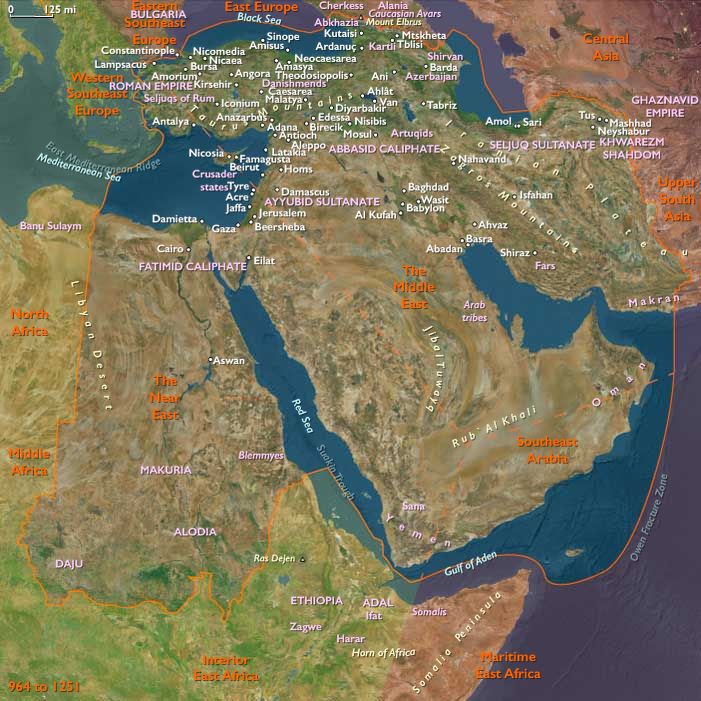
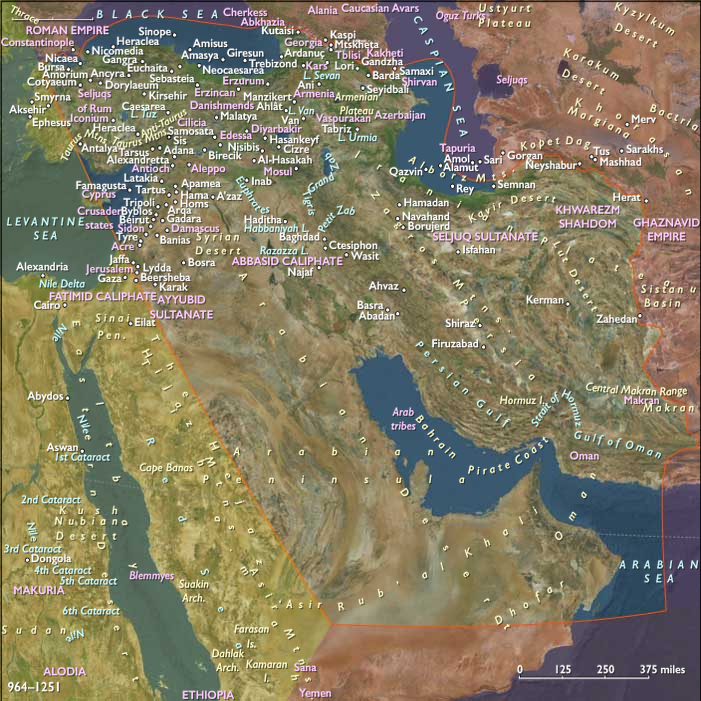
The Seljuqs’ 'Uqaylid allies take Harran from …
Years: 1091 - 1091
The Seljuqs’ 'Uqaylid allies take Harran from the Numayrids, one of five Syrian branches of the Banu Qays, in 1091.
Locations
People
Groups
- Arab people
- Syrian people
- Turkmen people
- 'Uqaylid Dynasty of Mosul
- Numayrids
- Seljuq Empire (Isfahan)
Commodoties
Subjects
Regions
Subregions
Related Events
Filter results
Showing 10 events out of 50325 total
Anawrahta is followed by a line of able kings who will cement Pagan's place in history.
The Pagan Kingdom has entered a golden age that will last for the next two centuries.
Aside from a few occasional rebellions, the kingdom will be largely peaceful during the period.
Kyansittha, who succeeded to the throne of Pagan in 1084, continues to strengthen the foundations of the Pagan Empire that Anawrahta had built.
Although he suppresses a Mon rebellion, he pursues a conciliatory policy towards the Mon.
Having spent seven years in the Mon country in exile, the king has a genuine respect for Mon culture, and maintains Mon scholars at his court.
The language of most of his epigraphs is Mon, likely because the Burmese script is still coming into its own.
The Mon language is widely used among the ruling elite, and the Pyu language continues to be a cultural force as well.
Kyansittha, guided by Shin Arahan, continues Anawrahta's policies of reforming the Buddhism of Pagan, which is a mix of Ari Buddhism, Mahayana Buddhism, Theravada Buddhism and Hinduism.
He gives sanctuary to Buddhists fleeing India (which has just come under Muslim rule).
His policy proves effective.
His reign will see no more rebellions in the south.
Elsewhere will remain largely peaceful.
(He does at some point send an expedition to northern Arakan when the tributary kingdom in the west comes under attack by the lord of southern Arakan.
His troops repel the attack but cannot catch the lord.
King Demetrius Zvonimir of Croatia, whose wife, Helen was Ladislaus's sister, had died in 1089 or 1090.
His successor, Stephen II, had died childless in 1091.
Upon the request of the Dowager Queen Helen, Ladislaus decides to intervene in the conflicts emerging among the different parties of Croatian noblemen.
He informs Abbot Oderizius of Monte Cassino of the conquest of "Sclavonia" in a letter of 1091.
According to the chronicler Thomas the Archdeacon, Ladislaus "occupied the entire land from the River Drava to the mountains called the Iron Alps without encountering opposition" in Croatia.
However, a local nobleman Petar Svačić whom Ladislaus's opponents proclaimed king resisted in the Gvozd Mountains and the neighboring regions.
Ladislaus appointed his younger nephew, Álmos to administer the occupied territory.
Around the same time, Ladislaus also set up a separate diocese for these regions with its see in Zagreb.
The bishop of the new see becomes the suffragan to the archbishop of Esztergom in Hungary.
Ladislaus admits that he could not "promote the cause of earthly dignities without committing grave sins" in his letter of 1091 to Abbot Oderizius.
Ladislaus styles himself as "king of the Hungarians and of Moesia" in his letter to Abbot Oderizius.
No other documents refer to Ladislaus's rule in Moesia, suggesting that even if he occupied this region, the forces of Constantinople reoccupied it in short time.
A group of Qarmatians sack Basr in 1091, while …
…Ismailis under the leadership of Hassan-e Sabbah seize the fortress of Alamut.
Moreover, the succession to the sultanate has been complicated by the death of two of Malik Shah's eldest sons: Dawud (died 1082) and Ahmad (died 1088), whom both were sons of the Kara-Khanid Princess Turkan Khatun, she also has a named Mahmud (born 1087) who she wants to succeed his father, while Nizam and most of the Seljuq army is in favor of Barkiyaruq, the oldest of Malik Shah's living sons and one born to a Seljuq princess.
Turkan Khatun now allies with Taj al-Mulk Abu'l Ghana'im to try to remove Nizam from his post.
Taj even accuses Nizam of corruption before the sultan.
Malik Shah I, however, does not dare to dismiss Nizam.
Nizam later besieges Alamut, but is forced to withdraw.
The Berber Zirids (governors of North Africa under the Fatimids) had in the 1040s declared their independence from the Fatimids and their recognition of the Sunni Abbasid caliphs of Baghdad, which had led the Fatimids to launch devastating Banū Hilal invasions.
The Fatimid hold on the Levant coast and parts of Syria has been challenged after about 1070 by Turkic invasions.
The Fatimids had gradually lost the Emirate of Sicily over thirty years to the Italo-Norman king Roger I, who is in total control of the entire island by 1091.
The reliance on the Iqta system also eats into Fatimid central authority, as more and more the military officers at the further ends of the empire become semi-independent and are often a source of problems.
The Treaty of Rouen and the Outbreak of War Between Henry and His Brothers (1091)
In early 1091, William Rufus invaded Normandy with a large army, forcing Robert Curthose into negotiations. The two brothers, recognizing the need to strengthen their positions, signed a treaty at Rouen, which significantly altered the balance of power in Normandy and England—but at Henry’s expense.
With Henry excluded from the succession and now at odds with both brothers, war broke out between Henry and William Rufus & Robert Curthose.
The Treaty of Rouen (1091): Terms and Consequences
-
William Rufus gains Norman lands and castles
- Robert ceded several key castles and territories in Normandy to William, strengthening his foothold on the continent.
-
William Rufus agrees to help Robert reclaim Maine
- William promised military aid to Robert in reconquering Maine, which had broken away from Norman control in 1089.
-
Both brothers exclude Henry from succession
- William and Robert nominated each other as heirs to both England and Normandy, ensuring Henry would inherit nothing while either one of them lived.
-
Robert and William agree to remove Henry from power
- The treaty included a joint effort to take back Henry’s lands in western Normandy, specifically the Cotentin, where Henry had built a loyal power base.
The War Between Henry and His Brothers (1091)
- Now formally cut out of the succession, Henry became a direct enemy of both William Rufus and Robert.
- The brothers turned their forces against Henry, determined to strip him of his holdings and force him into exile.
- Henry, despite being outnumbered, was a skilled strategist, and this conflict would mark the beginning of his long and patient struggle for power.
Consequences and the Shifting Balance of Power
- The Treaty of Rouen (1091) strengthened William Rufus’ hold over Normandy, increasing his influence in northern France.
- Robert remained weak, relying on William’s support, while Henry was now a landless noble, forced to fight for survival.
- This war set the stage for the eventual showdown between the three brothers, ultimately leading to Henry’s eventual rise to power as King of England and Duke of Normandy.
The war that followed the Treaty of Rouen was the defining conflict of Henry’s early career, as he fought to reclaim his position and eventually surpass both of his brothers.
Henry’s Defeat at Mont Saint-Michel and His Exile (1091)
In March 1091, after being excluded from the Treaty of Rouen, Henry gathered a mercenary army in western Normandy to resist William Rufus and Robert Curthose. However, as their combined forces advanced, Henry’s baronial support collapsed, forcing him to retreat and make a final stand at Mont Saint-Michel.
The siege of Mont Saint-Michel became a pivotal moment in Henry’s struggle, demonstrating both his resilience and the divisions between his brothers. Despite the fortress being easily defensible, Henry ultimately surrendered and went into exile.
The Siege of Mont Saint-Michel (March 1091)
- Henry withdrew to Mont Saint-Michel, a fortress known for its natural defenses, surrounded by tidal waters and cliffs.
- William Rufus and Robert laid siege, trapping Henry and his remaining forces inside.
- The fortress lacked fresh water, creating a serious problem for Henry’s troops.
Robert Curthose’s Act of Mercy
- According to William of Malmesbury, Robert allowed Henry’s forces access to fresh water, an act of chivalric mercy.
- This angered William Rufus, who wanted to force Henry’s complete surrender.
- The brothers began to argue, reflecting their ongoing mistrust and conflicting ambitions.
Henry’s Surrender and Exile
- The final days of the siege are unclear, but it appears that negotiations took place.
- Henry abandoned Mont Saint-Michel, likely as part of a negotiated surrender.
- He fled to Brittany and then crossed into France, where he wandered for over a year with a small group of followers.
Henry’s Time in Exile (1091–1092)
- According to Orderic Vitalis, Henry traveled along the Normandy border in the French Vexin, living as a landless noble with a small retinue.
- During his exile, Henry observed the instability between William Rufus and Robert, waiting for his opportunity to reclaim power.
The Collapse of the Treaty of Rouen (1091–1092)
- By the end of 1091, William Rufus and Robert had fallen out again, leading to the abandonment of the Treaty of Rouen.
- Sensing an opportunity, Henry and his followers seized castles and fortresses in western Normandy, reestablishing his presence in the region.
- This marked the beginning of Henry’s resurgence, as the conflict between his brothers would ultimately work in his favor.
Significance and Consequences
- The Siege of Mont Saint-Michel was a temporary setback for Henry, but it demonstrated his resilience and strategic patience.
- The ongoing tensions between Robert and William Rufus ensured that Henry’s exile would not last long, as he soon regained influence in Normandy.
- The fracturing of the alliance between William and Robert reopened the opportunity for Henry to reclaim his position, setting the stage for his eventual rise to power.
Though Henry’s defeat in 1091 forced him into exile, his patience and opportunism allowed him to seize Normandy again once his brothers turned on each other, marking the next phase in the struggle for the Anglo-Norman throne.
The Normans had begun to make incursions into South Wales from the late 1060s onward, pushing westwards from their bases in recently occupied England.
Their advance has been marked by the construction of castles, frequently on old Roman sites, and the creation of regional lordships.
The reuse of Roman sites produces considerable savings in the manpower required to construct large earth fortifications.
Cardiff Castle is built during this period.
There are two possible dates for the construction; it is possible that William the Conqueror built a castle at Cardiff as early as 1081 on his return from his pilgrimage to St. Davids.
Alternatively, the first Norman fortification may have been constructed around 1091 by Robert Fitzhamon, the lord of Gloucester.
Fitzhamon had invaded the region in 1090, and will use the castle as a base for the occupation of the rest of southern Glamorgan over the next few years.
The site is close to the sea and can be easily supplied by ship, is well protected by the Rivers Taff and Rhymney and also controls the old Roman road running along the coast.
Cardiff Castle is a motte-and-bailey design.
The old Roman walls had collapsed and the Normans used their remains as the basis for the outer castle perimeter, digging a defensive trench and throwing up a 27-foot (8.2 m) high bank of earth over the Roman fortifications.
The Normans further divided the castle with an internal wall to form an inner and an outer bailey.
In the northwest corner of the castle a wooden keep is constructed on top of a forty-foot (twelve meter) tall earth motte, surrounded by a thirty-foot (nine point one) wide moat.
The motte is the largest built in Wales.
The overall size of the castle is around eight and a quarter acres (three point thirty-four hectares), with the inner bailey being around two acres (point eight-one hectares) in size.
Mills are essential to local communities during this period, and the castle mill is located outside the west side of the castle, fed by the River Taff; under local feudal law, the residents of Cardiff are required to use this mill to grind their own grain.
The conquered lands in Glamorgan are given out in packages called knights' fees, and many of these knights hold their lands on condition that they provide forces to protect Cardiff Castle.
Under this approach, called a castle-guard system, some knights are required to maintain buildings called "houses" within the castle itself, in the outer bailey.
Anglo-Saxon peasants settle the region around Cardiff, bringing with them English customs, although Welsh lords will continue to rule the more remote districts almost independently until the fourteenth century.
Cardiff Castle is a Marcher Lord territory, enjoying special privileges and independence from the English Crown.
The medieval town of Cardiff spreads out from the south side of the castle.

When William Rufus became king of England after his father's death, Malcolm III of Scotland had not intervened in the subsequent rebellions by supporters of Robert Curthose.
William Rufus confiscates Edgar Ætheling's lands in England in 1091, and Edgar flees north to Scotland.
Malcolm, in an attempt to enlarge his holdings and protect Scottish independence, marches south in May, not to raid and take slaves and plunder, but to besiege Newcastle, built in 1080 by Robert Curthose.
This appears to have been an attempt to advance the frontier south from the River Tweed to the River Tees.
The threat is enough to bring the English king back from Normandy, where he had been fighting Robert Curthose.
In September, learning of William Rufus's approaching army, Malcolm withdraws north and the English follow.
Malcolm is prepared to fight, unlike in 1072, but a peace is arranged by Edgar Ætheling and Robert Curthose whereby Malcolm again acknowledges the overlordship of the English king.
The London Tornado of 1091 is reckoned by modern assessment of the reports as possibly a T8 tornado (roughly equal to an F4 tornado) which occurs in London, England.
Britain's earliest reported tornado, it occurs on Friday, October 17, 1091, killing two.
The wooden London Bridge is destroyed, and the church of St. Mary-le-Bow in the city of London is badly damaged; four rafters twenty-six feet (seven point nine meters) long are driven into the ground with such force that only four feet (one point two meters) protrude above the surface.
Other churches in the area are demolished, as are over six hundred (mostly wooden) houses.
Years: 1091 - 1091
Locations
People
Groups
- Arab people
- Syrian people
- Turkmen people
- 'Uqaylid Dynasty of Mosul
- Numayrids
- Seljuq Empire (Isfahan)