
The Seleucid Empire, founded in 323 BCE …
Years: 238BCE - 238BCE
The Seleucid Empire, founded in 323 BCE by Seleucus I Nicator, a general of Alexander the Great, stretches from Syria to the Indus River and comprises most of Alexander's realm.
The Seleucid state was the most powerful of the Diadochi kingdoms that sprang up after Alexander's death.
Quickly however, the Seleucids had run into trouble trying to maintain such an extended realm, facing constant warfare against the other Hellenistic states in the west and with unrest among their Iranian peoples in the east.
Diodotus and Andragoras, the Seleucid satraps of Bactria and Parthia respectively, had around 245 BCE declared their remote provinces independent states, taking advantage of the Seleucids' preoccupation with the wars against a Celtic invasion of Asia Minor in the west.
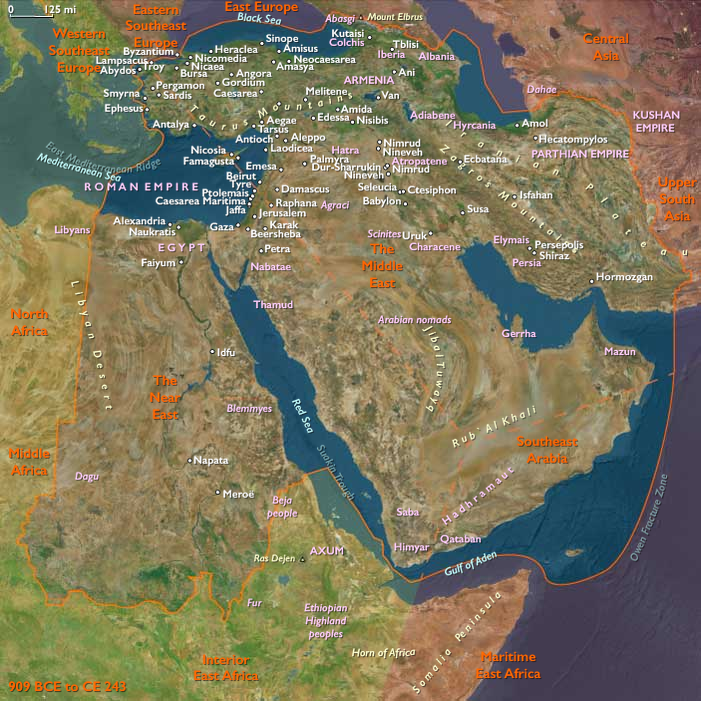
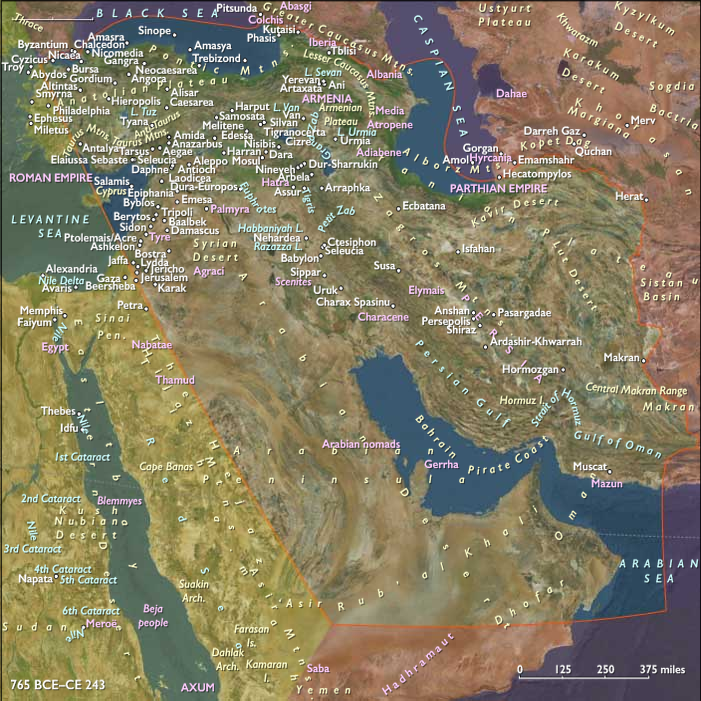
The Parni, one of three nomadic or seminomadic Iranian tribes in the confederacy of the Dahae living east of the Caspian Sea, had apparently moved southward into the region of Parthia after the death of Alexander the Great in 323 BCE and perhaps eastward into Bactria.
They seem to have adopted the speech of the native Parthians, a language loosely related to Scythian and Median, and been absorbed into the settled population.
According to tradition (somewhat disputed), Arsaces, a governor under Diodotus who is of Scythian or Bactrian origin (and may even have been a Bactrian prince), revolts and flees westward to establish his own rule.
The Parni soon become known as the Parthians, taking their name from the Seleucid province that they have conquered.
They now began to try and conquer as much of the eastern Seleucid empire as possible, joined in this by the now independent province of Bactria.
The Seleucid king Antiochus II Theos was at the time too busy fighting a war against Ptolemaic Egypt; thus, the Seleucids had lost most of their territory east of Persia and Media.
With the Parni, Arsaces in about 238 BCE seizes Astauene (or Astabene), i.e., northern Parthia.
Andragoras is killed during his attempts to recover it, which leaves the Parni in control over the rest of Parthia as well.
A recovery expedition by the Seleucids under Seleucus II is unsuccessful, and Arsaces and the Parni will succeed in holding Parthia proper during Arsaces' lifetime. (Some authorities believe that a brother, Tiridates I, succeeded Arsaces about 228 and ruled until 211; other authorities consider Arsaces I and Tiridates I to be the same person.)
Locations
People
Groups
Topics
Commodoties
Subjects
Regions

Subregions

Related Events
Showing 10 events out of 63790 total
Years: 238BCE - 238BCE
Locations
People
Groups
Topics
Commodoties
Subjects
Regions
Subregions