
A general Polish revolt, in a gesture …
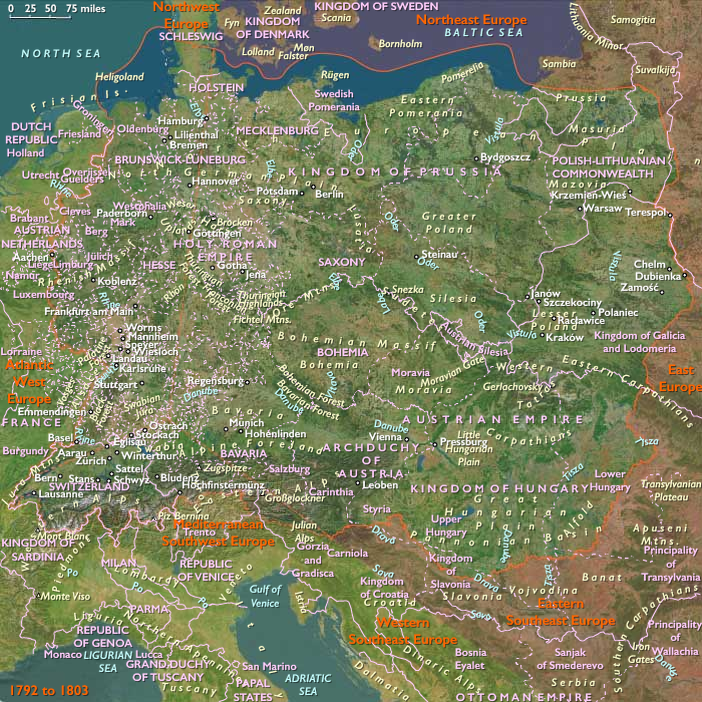
Years: 1792 - 1803
A general Polish revolt, in a gesture of defiance, breaks out in 1794 under the leadership of Tadeusz Kosciuszko, a military officer who had rendered notable service in the American Revolution.
Kosciuszko's ragtag insurgent armies win some initial successes, but they eventually fall before the superior forces of Russian General Alexander Suvorov.
In the wake of the insurrection of 1794, Russia, Prussia, and Austria carry out the third and final partition of Poland-Lithuania in 1795, erasing the Commonwealth of Two Nations from the map and pledging never to let it return.
Much of Europe condemns the dismemberment as an international crime without historical parallel.
Amid the distractions of the French Revolution and its attendant wars, however, no state actively opposes the annexations.
In the long term, the dissolution of Poland-Lithuania upsets the traditional European balance of power, dramatically magnifying the influence of Russia and paving the way for the Germany that will emerge in the nineteenth century with Prussia at its core.
For the Poles, the third partition begins a period of continuous foreign rule that will endure well over a century.
Locations
People
Groups
- Jews
- Germans
- Slavs, West
- Poles (West Slavs)
- Austria, Archduchy of
- Russians (East Slavs)
- Polish-Lithuanian Commonwealth (Commonwealth of the Two Nations)
- Prussia, Kingdom of
- Russian Empire
Topics
Subjects
Regions
Subregions
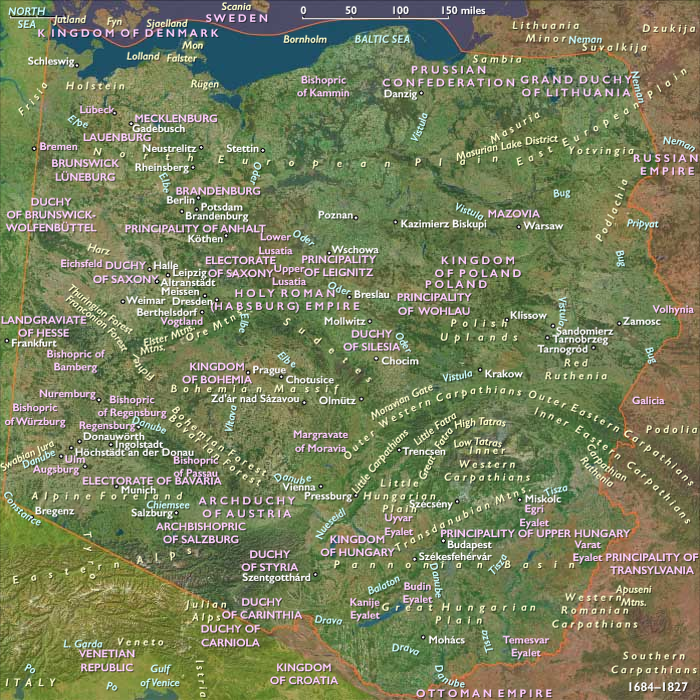
Years: 1792 - 1803
Locations
People
Groups
- Jews
- Germans
- Slavs, West
- Poles (West Slavs)
- Austria, Archduchy of
- Russians (East Slavs)
- Polish-Lithuanian Commonwealth (Commonwealth of the Two Nations)
- Prussia, Kingdom of
- Russian Empire
Topics
Subjects
Regions
Subregions