
Filters:
Hudson River school paintings reflect three themes …
Years: 1840 - 1851
Hudson River school paintings reflect three themes of America in the nineteenth century: discovery, exploration, and settlement.
The paintings also depict the American landscape as a pastoral setting, where human beings and nature coexist peacefully.
Hudson River School landscapes are characterized by their realistic, detailed, and sometimes idealized portrayal of nature, often juxtaposing peaceful agriculture and the remaining wilderness, which was fast disappearing from the Hudson Valley just as it is coming to be appreciated for its qualities of ruggedness and sublimity.
In general, Hudson River School artists believe that nature in the form of the American landscape is an ineffable manifestation of God, though the artists varied in the depth of their religious conviction.
They take as their inspiration such European masters as Claude Lorrain, John Constable and J. M. W. Turner.
Their reverence for America's natural beauty is shared with contemporary American writers such as Henry David Thoreau and Ralph Waldo Emerson.
Several painters are members of the Düsseldorf school of painting, others have been educated by the German Paul Weber.
While the elements of the paintings are rendered realistically, many of the scenes are composed as a synthesis of multiple scenes or natural images observed by the artists.
In gathering the visual data for their paintings, the artists travel to extraordinary and extreme environments, which generally have conditions that will not permit extended painting at the site.
During these expeditions, the artists record sketches and memories, returning to their studios to paint the finished works later.
The paintings also depict the American landscape as a pastoral setting, where human beings and nature coexist peacefully.
Hudson River School landscapes are characterized by their realistic, detailed, and sometimes idealized portrayal of nature, often juxtaposing peaceful agriculture and the remaining wilderness, which was fast disappearing from the Hudson Valley just as it is coming to be appreciated for its qualities of ruggedness and sublimity.
In general, Hudson River School artists believe that nature in the form of the American landscape is an ineffable manifestation of God, though the artists varied in the depth of their religious conviction.
They take as their inspiration such European masters as Claude Lorrain, John Constable and J. M. W. Turner.
Their reverence for America's natural beauty is shared with contemporary American writers such as Henry David Thoreau and Ralph Waldo Emerson.
Several painters are members of the Düsseldorf school of painting, others have been educated by the German Paul Weber.
While the elements of the paintings are rendered realistically, many of the scenes are composed as a synthesis of multiple scenes or natural images observed by the artists.
In gathering the visual data for their paintings, the artists travel to extraordinary and extreme environments, which generally have conditions that will not permit extended painting at the site.
During these expeditions, the artists record sketches and memories, returning to their studios to paint the finished works later.
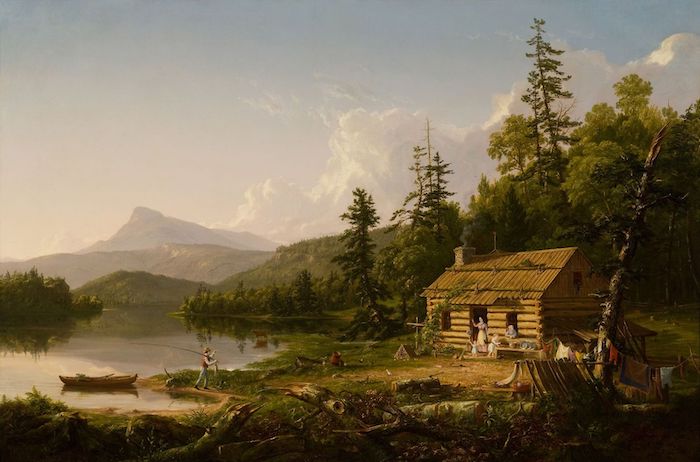
Thomas Cole: Home in the Woods (1847); oil on canvas; 112.7 cm (44.3″)x 168 cm (66.1″); Reynolda House Museum of American Art.
Locations
People
- Albert Bierstadt
- Asher Brown Durand
- Frederic Edwin Church
- George Inness
- Henry David Thoreau
- Jasper Francis Cropsey
- John Frederick Kensettt
- Ralph Waldo Emerson
- Sanford Robinson Gifford
- Thomas Doughty
Groups
Topics
Subjects
Regions
Subregions
Related Events
Showing 1 events out of 1 total
Years: 1840 - 1851
Thomas Cole: Home in the Woods (1847); oil on canvas; 112.7 cm (44.3″)x 168 cm (66.1″); Reynolda House Museum of American Art.
Locations
People
- Albert Bierstadt
- Asher Brown Durand
- Frederic Edwin Church
- George Inness
- Henry David Thoreau
- Jasper Francis Cropsey
- John Frederick Kensettt
- Ralph Waldo Emerson
- Sanford Robinson Gifford
- Thomas Doughty
Groups
Topics
Subjects
Regions
Subregions