
The Romans in the second century BCE …
Years: 6 - 6
The Romans in the second century BCE had subjugated various parts of Illyria, such as Histria in 177 BCE and the Ardaeian kingdom in 168 BCE, when they defeated the army of king Gentius.
Southern Illyriafrom 167 BCE had become a formally independent protectorate of the Romans, for whom the region has considerable strategic and economic importance.
It possesses a number of important commercial ports along its coastline, and has gold mines in its interior regions.
Illyria is also the starting point of the Via Egnatia, the great Roman road that runs from Dyrrachium (modern Durazzo), on the Adriatic, to Byzantium in the east.
Next came the interior of the western Balkans, accumulating in the wars with the Dalmatae in 156BCE and 78 BCE, and in 129 BCE against the Iapydes.
Illyricum in 59 BCE after the Lex Vatinia had been assigned as provincia together with Cisalpine Gaul (zone of responsibility rather than the province as is understood today) to Caesar.
No province had been established until Octavius's wars in Illyricum during 35-33 BCE.
Caesar's assassination had encouraged the Illyrians to regain their liberty.
They refused to pay taxes and destroyed five cohorts of the army commanded by P. Vatinius, also killing the senator Bebius.
The Roman senate had charged Marcus Junius Brutus, one of the assassins of Caesar, to lead the army in Illyria and Macedonia.
He had marched in the winter of 42 BCE from Greece at the head of the army, through roads covered by snow, doubtless coming along the Via Egnatia in order to appear by surprise before the walls of Dyrrhachian, sick with exhaustion and the cold.
Brutus after this took Apollonia and Byllis, pursuing and breaking the power of Gaius Antonius, who withdrew to Buthrotum.
Octavius in 35 BCE had been compelled to revisit Illyrian lands yet again, this time Dalmatia.
At the head of ten legions, he had marched from the north and subjugated the Iyapedes, Liburnians and Pannonians.
The most difficult war proved to be with the Dalmatians, in which the young future emperor was wounded twice, as Suetonius writes, first in the knee with a stone from a slingshot and later when a bridge fell during the siege of the Iapydian city of Metulum.
Octavian in that siege had seen with his own eyes the bravery of the Illyrians.
After managing to conquer the upper part of the city, Octavian had asked the inhabitants to surrender their weapons, but they collected their women and children and locked them in the council building, putting guards around it and ordering them to set the building on fire if the men were to suffer any harm.
After taking these measures they assailed the Romans in desperation, but since they were down below and the Romans above, they were badly broken and all were killed.
The assembly guards then set the building on fire, as they had been ordered, and many women and children were burned to death; and even more threw themselves on the fire, along with their children.
Together with them the city was burned so completely, that although it had been a very large city, not a trace of it remains.
The first mention of the province of Illyricum had occurred in the context of the Augustan settlement of 27 BCE.
The province was subsequently enlarged as the Romans expanded their power in the region through a series of wars known as Pannonian wars (Bellum Pannonicum), fought from 12 BCE -9 BCE against group of peoples known as the Pannonians.
The taxes imposed by the Romans are greatly resented by the native Illyrians, who are frustrated by this new shift of power.
The Romans often treat the their subjects terribly, selling the women and children as slaves and destroying their settlements.
The turn of the millennium has also seen the recruitment of many Illyrian soldiers into the Roman army to fight against the Germanic tribes in the north.
The widening gap between the Roman government and its subjects in Illyricum leads ultimately to the great revolt that begins in the spring of CE 6, when several regiments of Daesitiates, natives of the area that now comprises central Bosnia and Herzegovina, are gathered in one place to prepare to join Augustus's stepson and senior military commander Tiberius in a war against the Germans.
Instead, the Daesitiates, led by Bato the Daesitiate (Bato I), mutiny and defeat a Roman force sent against them.
Locations
People
Groups
- Istria
- Iapydes
- Illyrians
- Pannonians
- Dalmatae
- Daesitiates (Illyrian tribe)
- Breuci (Illyrian tribe)
- Histri
- Roman Principate (Rome)
Topics
- Classical antiquity
- Roman Age Optimum
- Pax Romana
- Roman Eastern Frontier Wars of 20 BCE-CE 19
- Illyrian Revolt, Great
Commodoties
Subjects
Regions
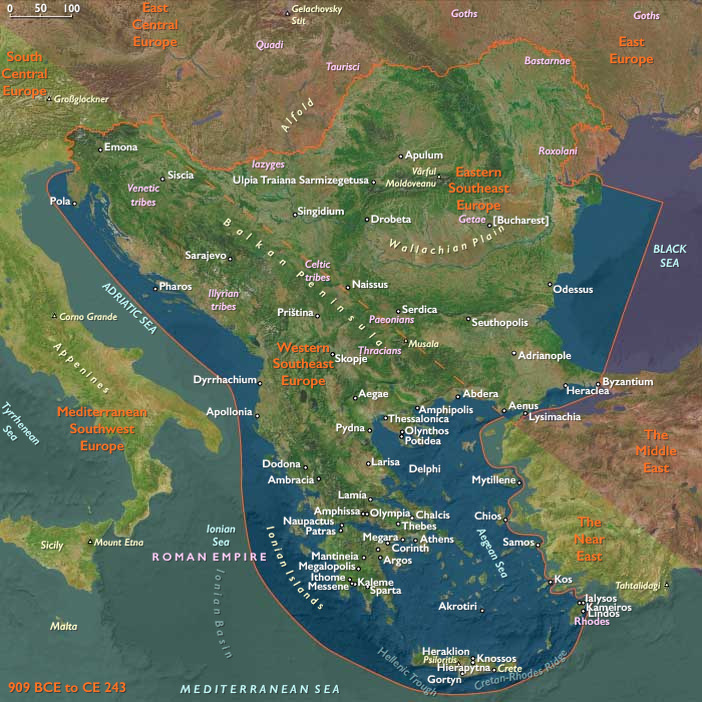
Subregions
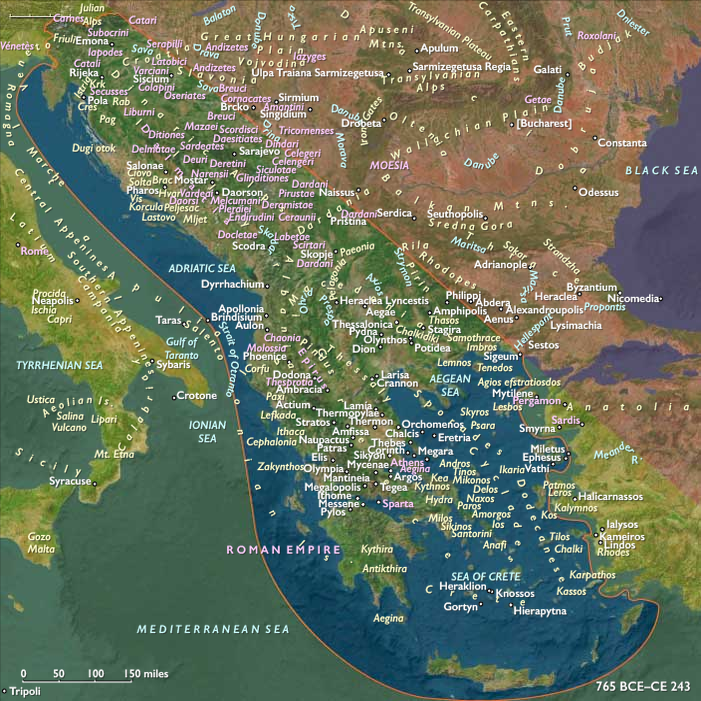
Years: 6 - 6
Locations
People
Groups
- Istria
- Iapydes
- Illyrians
- Pannonians
- Dalmatae
- Daesitiates (Illyrian tribe)
- Breuci (Illyrian tribe)
- Histri
- Roman Principate (Rome)
Topics
- Classical antiquity
- Roman Age Optimum
- Pax Romana
- Roman Eastern Frontier Wars of 20 BCE-CE 19
- Illyrian Revolt, Great
Commodoties
Subjects
Regions
Subregions