
The sea floor just north of the …
Years: 1725 - 1725
The sea floor just north of the Peterhof site and to the east toward St. Petersburg is too shallow for either commercial ships or warships.
However, to the west of Peterhof, the sea floor drops off to be deep enough for sea vessels.
Accordingly, when Peter the Great had decided to build St. Petersburg at the eastern end of the Gulf of Finland, he had first captured the Kotlin Island, clearly visible from the Peterhof site just to the northeast in the middle of the Gulf.
At Kotlin Island, he has built the commercial harbor for St. Petersburg as well as the Kronstadt fortifications across the twenty kilometers of shallow sea to provision and defend the Navy that he has built.
Peter first mentions the Peterhof site in his journal in 1705, during the Great Northern War, as a good place to construct a landing for use in traveling to and from the island fortress of Kronstadt.
Peter had in 1714 begun construction of the Monplaisir ("my pleasure") Palace based on his own sketches of the palace that he wanted close to the shoreline.
This has become Peter's Summer Palace, which he uses on his way coming and going from Europe through the harbor at Kronstadt.
On the walls of this seacoast palace hang hundreds of paintings that Peter has brought from Europe and allowed to weather Russian winters without heat, together with the dampness of being so close to the sea.
In the seaward corner of his Monplaisir Palace, Peter had made his Maritime Study, from which he can see Kronstadt Island to the left and St. Petersburg to the right.
He had later expanded his plans to include a vaster royal château of palaces and gardens further inland, on the model of Versailles.
Each of the tsars after Peter will expand on the inland palaces and gardens of Peterhof, but the major contributions by Peter the Great are completed by 1725.
A grand residence, it has become known as the "Russian Versailles.” A French architect, Nicolas Pineau, had gone to Russia in 1716 and introduced the Rococo style to the newly founded city of St. Petersburg (e.g., Peter's study in Peterhof, before 1721).
The Rococo in Russia has flourished in St. Petersburg under the protection of Peter I and Elizabeth.
Peter's principal architect, Gaetano Chiaveri, who draws heavily on northern Italian models, is most noted for the library of the Academy of Sciences (1725) and the royal churches of Warsaw and Dresden.
Peter had also entertained plans of a similar palace at Strelna, a short way to the east, but these plans are abandoned when, in early January 1725, Peter is struck once again with uremia.
Legend has it that before lapsing into unconsciousness Peter asked for a paper and pen and scrawled an unfinished note that read: "Leave all to...." and then, exhausted by the effort, asked for his daughter Anna to be summoned.
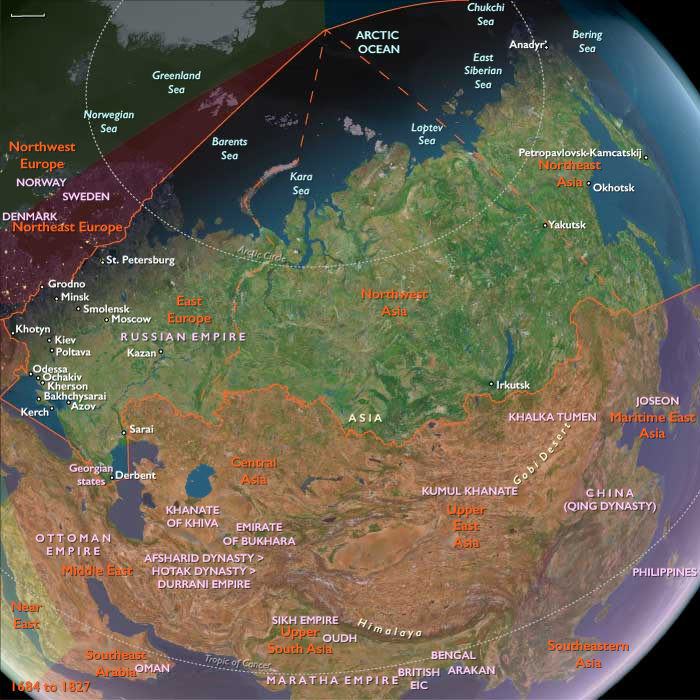
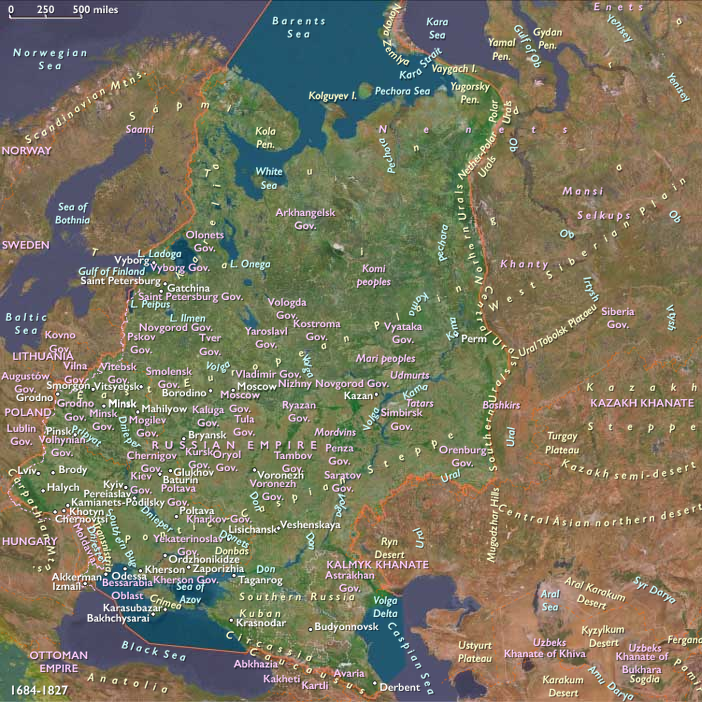
Without having named a successor, Peter dies between four and five in the morning January 28, 1725, leaving an empire that stretches from Arkhangelsk (Archangel) on the White Sea to Mazanderan on the Caspian and from the Baltic Sea to the Pacific Ocean.
He is fifty-two years, seven months old at his death, having reigned forty-two years.
An autopsy reveals his bladder to be infected with gangrene.
Catherine represents the interests of the "new men", commoners who had been brought to positions of great power by Peter based on competence.
A change in government is likely to favor the entrenched aristocrats.
For this reason, during a meeting of a council to decide on a successor a coup is arranged by the late tsar’s best friend, Prince Aleksandr Menshikov, and others in which the guards regiments with whom Catherine is very popular proclaim her the ruler of Russia, giving her the title of Empress.
Menshikov, who is committed to the Petrine system, recognizes that, if this system is to continue, Catherine is the only possible candidate, as her name is a watchword for the progressive faction.
Her placement on the throne means a final victory over ancient prejudices, a vindication of the new ideas of progress, and not least security for Menshikov's person and his ill-gotten fortune.
Supporting evidence is "produced" from Peter's secretary Makarov and the Bishop of Pskov, both "new men" with motivation to see Catherine take over.
The real power, however, lies with Menshikov and with Count Peter Andreyevich Tolstoy, who has materially assisted Menshikov to raise the empress consort to the throne.
The new sovereign makes him a count and one of the six members of the newly instituted Supreme Privy Council.
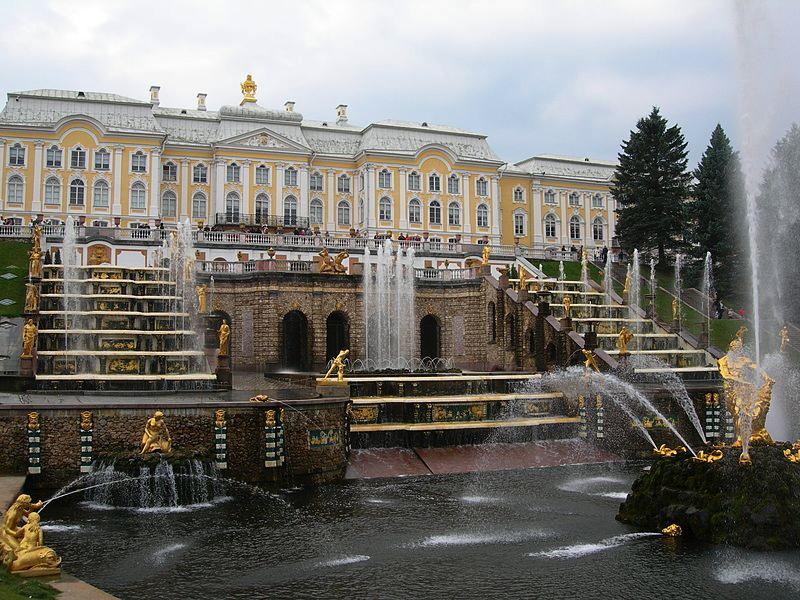
(Photo taken 23 February 2006 by Cottbus)
Locations
People
- Aleksandr Danilovich Menshikov
- Catherine I of Russia
- Gaetano Chiaveri
- Nicolas Pineau
- Peter the Great
- Pyotr Andreyevich Tolstoy
Groups
Topics
Subjects
Regions
Subregions
Related Events
Showing 10 events out of 27816 total
Years: 1725 - 1725
(Photo taken 23 February 2006 by Cottbus)
Locations
People
- Aleksandr Danilovich Menshikov
- Catherine I of Russia
- Gaetano Chiaveri
- Nicolas Pineau
- Peter the Great
- Pyotr Andreyevich Tolstoy
Groups
Topics
Subjects
Regions
Subregions