The Scottish Parliament under James II forbids …
Years: 1455 - 1455
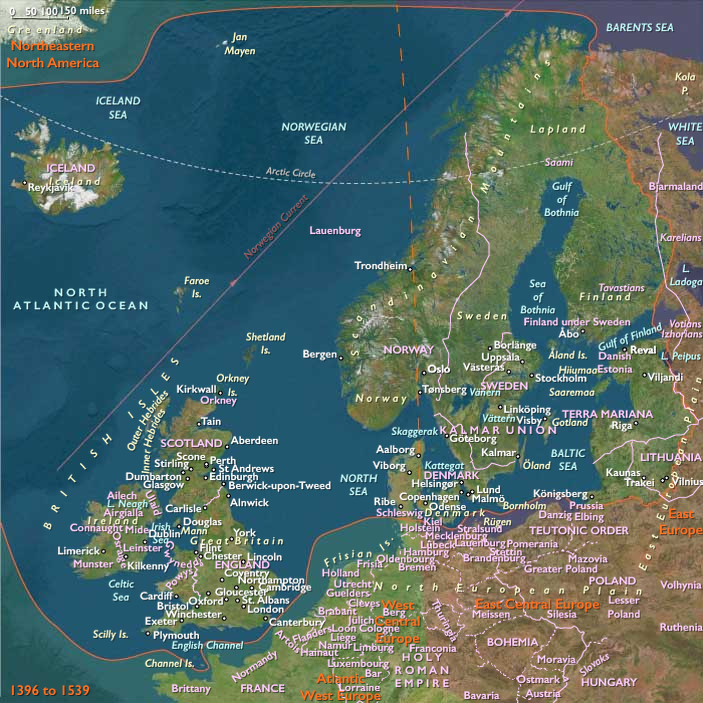
The Scottish Parliament under James II forbids football and golf and ordains the wearing of specific colors by the common people: gray and white for work; red, green and light blue for holidays.
Locations
People
Groups
Subjects
Regions
Subregions
Related Events
Filter results
Showing 10 events out of 41436 total
Yoshiyoshi’s many enemies among the daimyo, the powerful Hosokawa Katsumoto in particular, support rival claimant Hatayama Yasaburo, who raises an army and attacks Yoshiyoshi in 1455.
Yasaburo dies in the battle, but the struggle continues.
Brandenburg had pawned the Neumark to the Teutonic Knights in 1402, and it had passed completely under their control in 1429, although the Order neglected the region as well.
After the Teutonic Knights' defeat in the Battle of Grunwald (Tannenberg) in 1410, the future Grand Master Michael Küchmeister von Sternberg had used the Neumark as a staging ground for an army of German and Hungarian mercenaries which he later used against the forces of King Władysław II Jagiełło of Poland.
This had allowed the Order to retain much of its territory in the First Peace of Thorn in 1411.
The Knights' mismanagement leads in 1454/1455 to their pawning of the Neumark back to Brandenburg, by now led by Elector Frederick II of the Hohenzollern dynasty (Treaties of Cölln and Mewe).
Ladislas, opposed by both Hunyadi and George of Poděbrady, asserts his majority to rule over his Bohemian and Hungarian kingdoms in 1455, but George retains effective control of Bohemia.
The conquest of Constantinople and its transformation into the Ottoman capital of Istanbul marks an important new stage in Ottoman history.
Internally, it means the end of power and influence for the old Turkish nobility, whose leaders are executed or exiled to Anatolia and whose European properties are confiscated, and the triumph of the devshirme and their supporters in Istanbul and the West.
Externally, the conquest makes Mehmed II the most famous ruler in the Muslim world, even though the lands of the old caliphate remain in the hands of the Mamluks of Egypt and Timur's successors in Iran.
Moreover, the possession of Constantinople stimulates in Mehmed a desire to place under his dominion not merely the Islamic and Turkic worlds but also a recreated Eastern Roman Empire and, perhaps, the entire world of Christendom.
To pursue these objectives, Mehmed develops various bases of power.
Domestically, his primary objective is to restore Istanbul, which he had spared from devastation during the conquest, as the political, economic, and social center of the area that it formerly had dominated.
He works to repopulate the city not only with its former inhabitants but also with elements of all the conquered peoples of the empire, whose residence and intermingling there will provide a model for a powerful and integrated empire.
Special attention is paid to restoring Istanbul's industry and trade, with substantial tax concessions made to attract merchants and artisans.
While thousands of Christians and Muslims are brought to the city, Greeks and Armenians are disinclined to accept Muslim Ottoman rule and seek to secure new European crusades.
Mehmed thus gives special attention to attracting Jews from central and western Europe, where they are being subjected to increasing persecution.
The loyalty of these Jews to the Ottomans is induced by that of their coreligionists in Constantinople, who had supported and assisted the Ottoman conquests after the long-standing persecution to which they had been subjected by the Greek Orthodox church and its followers.

Hunyadi provisions and arms the fortress of Semendria, collects a considerable army of mercenaries funded by the first tax ever levied on Hungary's nobles, and is joined by a poorly equipped and ragged army of peasants.
In 1455 also, Moldavia comes under Ottoman rule for the first time.
The Ottoman Turks take the Aegean island of Thasos from Genoa in 1455.
The most powerful Zetan family, the Balšićs, had became sovereigns of Zeta after the collapse of the Serbian Empire in the second half of the fourteenth century.
The province had been annexed to the Serbian Despotate after the death of Balša III in 1421, but after 1455 another noble family from Zeta, the Crnojevićs, become sovereign rulers of the country.
After the disappearance of Gojčin Crnojević from political life in 1451, his brother Stefan had taken over the leadership of the house of Crnojević and become the ruler of a large part of Zeta.
To strengthen his position, he decided to immediately seek foreign protection.
Allying himself with Venice and recognizing its authority over the region, he had subsequently been entitled Duke of Upper Zeta in 1452.
The reasons for the alliance are related to Stefan’s anticipation of the downfall of the Serbian Despot.
Venetan doge Francesco Foscari writes a letter to Stefan in 1455 asking him to return to Budva its territory he had captured.
The near-simultaneous Ottoman invasion of Serbia and conquest of all of its territories south of the Western Morava river completely cuts Zeta off from the core of the Despotate.
Therefore, Duke Stefan Crnojević, together with representatives from all fifty-one municipalities from Upper Zeta, sign an agreement the same year with the Venetians in Vranjina, by which Upper Zeta accepts Venetian rule.
Venice will rule only the cities, while all internal affairs are left to duke Stefan.
The Republic of Venice also binds itself not to meddle in any way with the ecclesiastical authority of the Serbian Orthodox Metropolitan of Zeta.
Herzegovina’s unofficial capital of Mostar had been first mentioned in 1452.
Only a few years later, it is invaded by the Ottomans.
The Ottomans are the first to begin officially using the name Herzegovina for the region, when the beg of Bosnia Isa-beg Ishaković mentions the name in a letter from 1454.
The imperial Greek forces in Imbros had left the island after the Fall of Constantinople in 1453.
In the aftermath of the withdrawal, delegates from the island had gone to İstanbul for an audience with the Ottoman Sultan to discuss terms allowing them to live harmoniously within the Ottoman Empire.
The island becomes Ottoman soil in 1455, and will be administered by Ottomans and Venetians at various times.