The Scots kingdom of Alba in 1011 …
Years: 1011 - 1011
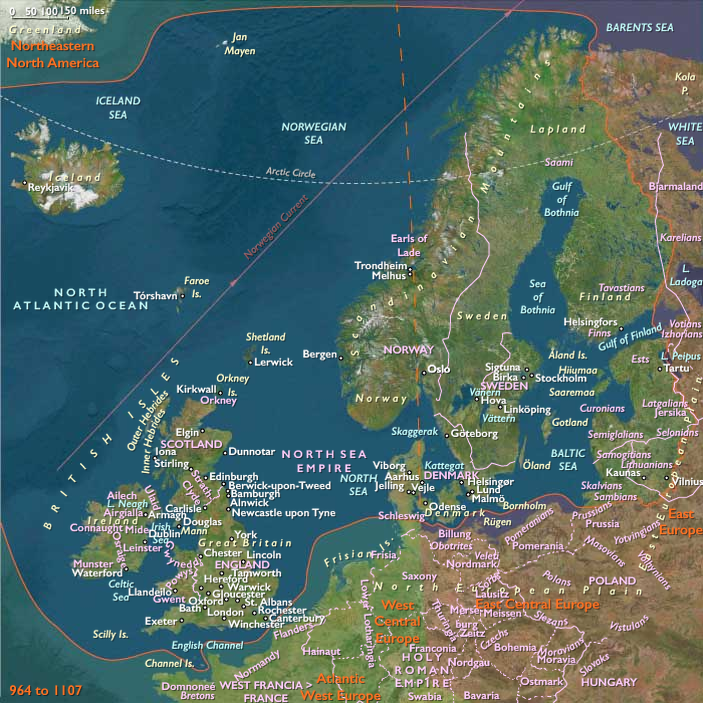
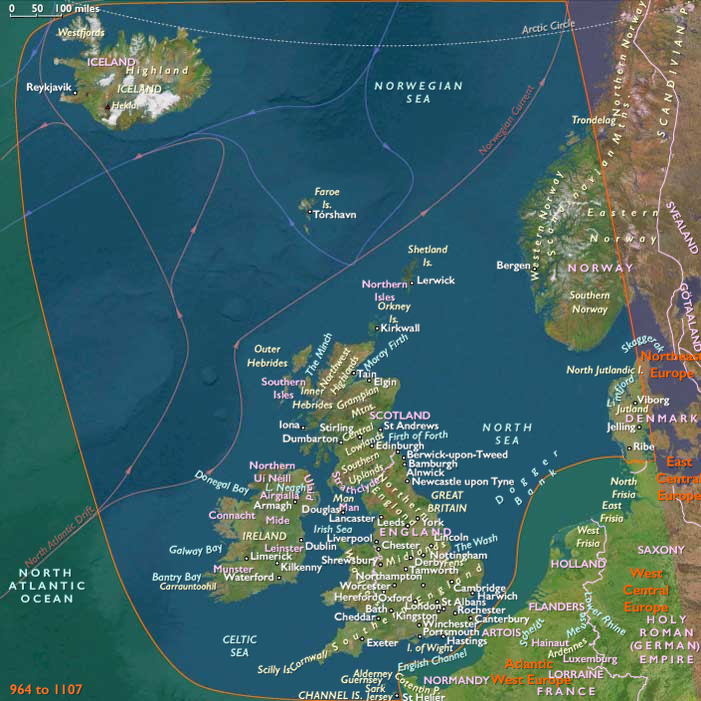
The Scots kingdom of Alba in 1011 incorporates Roxburgh in the southeast, recently a part of the virtually independent Anglo-Saxon earldom and former kingdom of Northumbria.
Locations
People
Groups
Subjects
Regions
Subregions
Related Events
Filter results
Showing 10 events out of 51844 total
The expansion of the Viets had eventually caused the northwestern part of the so-called Khmer Empire to fall from imperial Chinese control.
When the Le emperor Le Long Dinh dies in his twenties, a court general named Ly Cong Uan takes the opportunity to seize the throne.
This event is regarded as the beginning of a golden era in Vietnamese history, with great dynasties following one another.
Ly (commonly called Ly Thai To—the Founding Emperor) changes the country's name to Dai Viet, establishes the capital in present-day Hanoi and calls it Thang Long (Ascending Dragon) under the pretext of seeing a dragon when he was touring the area.
A similar case occurs in the West, where, at the beginning of the eleventh century, Thais had begun to migrate from Southern China.
Lady Murasaki also leaves a diary of the years 1007 to 1010, providing a window into Japanese court life and the history and mores of the period.
Japanese poet and writer Sei Shonagon, a lady-in-waiting to the Empress Sadako and a contemporary of Lady Murasaki, publishes a diary of the years 991—1000.
Entitled “The Pillow-book of Sei Shonagon,” her journal is a miscellany of various witty epigrams, keen observations of people and events, and poetic notes on natural phenomena.
Caliph Al-Qadir, noted for taking the lead in the Sunni struggle against Isma'ili Shi'ism, has helped Sunnis set up their own festivals to rival the Shi'a celebrations and made the Hanbali school the official Muslim position.
Mohammad Arkoun considers his decrees against heresies such as the createdness of the Qur'an, which effectively outlawed the mu'tazila school, as sounding the death knell for philosophy in Islamic thought.
Most Ismailis viewed the Fatimids as their rightful spiritual and political leaders.
In response to the growth of the Fatimid-supporting Ismaili sect of Islam within his borders, and threatened by a possible rebellion within his empire, the Abbasid Caliph asks esteemed scholars and jurists to issue an edict claiming that the Fatimids are not descended from Ali ibn Abi Talib.
With the so-called Baghdad Manifesto, Al-Qadir intends to delegitimize the Ismaili allegiance to the rival Fatimid domain on the basis of their claimed descent.
Sumbat III of Klarjeti, a son of Bagrat (died 988), son of Sumbat II of Klarjeti, had succeeded upon the death of his childless paternal uncle David II as the sovereign of Klarjeti, a position which he had shared with his brother Gurgen.
The tenth-century Georgian chronicler of the Bagratids, Sumbat Davitis-Dze, accords them a royal title—klarjni khelmtsipeni.
Sumbat and Gurgen had ruled over a portion of the hereditary Bagratid territory which remained outside the control of their distant cousin Bagrat III, who had become a king of a unified Georgia in 1008.
In 1011, the brothers are invited by Bagrat to negotiations at the castle of Panaskerti, but are arrested and held captive in the castle of Tmogvi, where they are soon put to death.
Their possessions pass to Bagrat and his progeny.
Their children—Bagrat, son of Sumbat, and Demetre, son of Gurgen—flee to Constantinople, whence they will try to retrieve patrimonial lands with imperial aid, for the last time in 1032, but to no avail.

A mob attacks Jews returning from a funeral in al-Fustat on December 11, 1011, taking prisoner twenty-three Jewish leaders.
They are condemned to be executed, but their release is ordered by al-Hakim, even though he is certainly no friend of the Jews.
The Byzantine Greek-cross church, newly developed and standardized during the "second Golden Age" of Byzantine religious art (often called the Macedonian Renaissance for its ruling dynasty), features consistent mosaic programs, exemplified by the churches of Hosios Loukas in central Greece.
The centralized parallelogram-shaped church of the Theotokos, the oldest in the complex and the only church known to have been built in mainland Greece in the tenth century, is the oldest example of the cross-in-square type in the country; its plan closely follows that of Fenari Isa Cami in Constantinople.
The walls are opus mixtum (part brick, part stone, part marble) and display curious pseudo-kufic patterns.
The Church of the Theotokos adjoins a larger cathedral church, or the Katholikon, tentatively dated to 1011-12.
The Katholikon is the earliest extant domed-octagon church, with eight piers arranged around the perimeter of the naos.
The hemispherical dome (without a drum) rests upon four squinches which make a transition from the octagonal base under the dome to the square defined by the walls below.
The main cube of the church is surrounded by galleries and chapels on all four sides.
Basil's next move is to ally to the Greek Empire as many Lombard principalities as possible.
He visits Salerno in October, where Prince Guaimar III is nominally an imperial vassal.
He then moves on to …
…Monte Cassino, which monastery is sheltering Dattus on its lands, the anti-Greek monks, at the insistence of Pope Benedict VIII, having given him a fortified tower on the Garigliano.
Basil nevertheless confirms all the privileges of the monastery over its property in Greek territory.
The abbot, Atenulf, is a brother of the prince of Capua, Pandulf IV.
The monastery then promptly expels Dattus and he flees to papal territory.
The Greek citizens of Bari negotiate with Basil and force the Lombard leaders, Melus and Dattus, to flee.
Basil enters the city on June 11, 1011 and reestablishes imperial authority.
He does not follow his victory up with any severe reactions.
He simply captures the family of Melus, including his son Argyrus, and sends them to Constantinople.