Angles now establish the kingdoms of East …
Years: 532 - 675
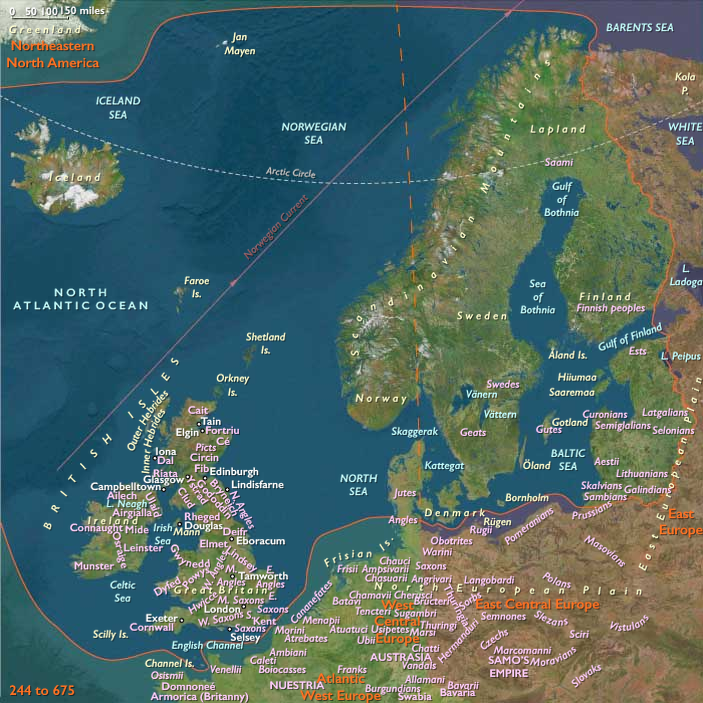
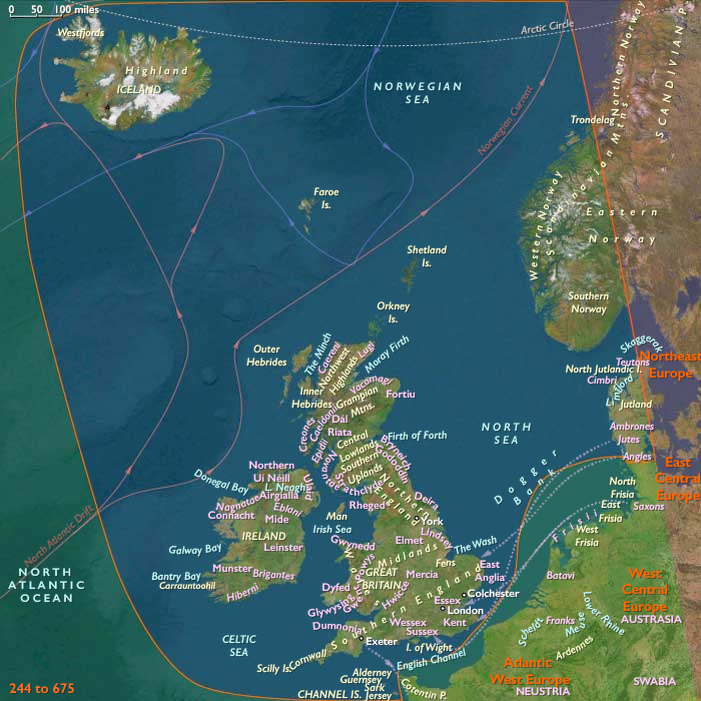
Angles now establish the kingdoms of East Anglia, Mercia, and Northumbria.
Groups
- Polytheism (“paganism”)
- Ireland, ancient
- Britons (historical)
- Saxons
- Angles
- Jutes
- Picts
- Scoti
- Anglo-Saxons
- Britain, Sub-Roman
- Bernicia, Kingdom of
- Christianity, Chalcedonian
- Kent, Kingdom of
- Deira, Kingdom of
- Sussex, Kingdom of
- Wessex, English Kingdom of
- Mercia, Kingdom of
- Essex, Kingdom of
- East Angles, Kingdom of the
- Northumbria, Kingdom of
Topics
Subjects
Regions
Subregions
Related Events
Filter results
Showing 10 events out of 58080 total
The sixth century is an important stage in the Vietnamese political evolution toward independence.
During this period, the Vietnamese aristocracy becomes increasingly independent of Chinese authority, while retaining Chinese political and cultural forms.
At the same time, indigenous leaders arise who claim power based on Vietnamese traditions of kingship.
A series of failed revolts in the late sixth and early seventh centuries increases the Vietnamese national consciousness.
Ly Bi, the leader of a successful revolt in 543 against the Liang dynasty (502-556), is himself descended from a Chinese family that had fled to the Red River Delta during a period of dynastic turbulence in the first century CE.
Ly Bi declares himself emperor of Nam Viet in the tradition of Trieu Da and organizes an imperial court at Long Bien (vicinity of Hanoi).
Ly Bi is killed in 547, but his followers keep the revolt alive for another fifty years, establishing what is sometimes referred to in Vietnamese history as the Earlier Ly dynasty.
Funan had reached its zenith in the fifth century CE.
Beginning in the early sixth century, civil wars and dynastic strife undermine Funan's stability, making it relatively easy prey to incursions by hostile neighbors.
By the end of the seventh century, a northern neighbor, the kingdom of Chenla, has reduced Funan to a vassal state.
While the Ly family retreats to the mountains and attempts to rule in the style of their Chinese overlords, a rebel leader who bases his rule on an indigenous form of kingship arises in the Red River Delta.
Trieu Quang Phuc makes his headquarters on an island in a vast swamp.
From this refuge, he can strike without warning, seizing supplies from the Liang army and then slipping back into the labyrinthine channels of the swamp.
Despite the initial success of such guerrilla tactics, by which he gains control over the Red River Delta, Trieu Quang Phuc is defeated by 570.
According to a much later Vietnamese revolutionary, General Vo Nguyen Giap, Vietnamese concepts of protracted warfare were born in the surprise offensives, night attacks, and hit-and-run tactics employed by Trieu Quang Phuc.
The people of Chenla also are Khmer.
Once they establish control over Funan, they embark on a course of conquest that will continue for three centuries.
They subjugate central and upper Laos, annex portions of the Mekong Delta, and bring what are now western Cambodia and southern Thailand under their direct control.
The new Buddhist religion had swept through India, the Himalayas, and Southeast Asia, but will eventually plant its firmest roots in China and in Japan.
Maritime East Asia (532–675 CE): Imperial Reunification, State Consolidation, and Cultural Innovation
Between 532 CE and 675 CE, Maritime East Asia—comprising lower Primorsky Krai, the Korean Peninsula, the Japanese Archipelago below northern Hokkaido, Taiwan, and southern, central, and northeastern China—witnesses dramatic imperial reunifications, dynamic state interactions, cultural flourishing, and critical technological advancements.
Sui Dynasty Reunification and Grand Projects in China
China is reunified under the short-lived but impactful Sui Dynasty (581–617), often likened to the earlier Qin Dynasty due to its centralized rule and ambitious, ruthless governance. The Sui emperors undertake monumental projects, notably the completion of the Grand Canal, facilitating vital north-south transportation and economic integration. Other extensive construction efforts include rebuilding sections of the Great Wall. However, these accomplishments heavily strain resources, requiring burdensome taxes and compulsory labor, ultimately leading to widespread unrest. Disastrous military campaigns against Goguryeo (Korea) further weaken the dynasty, leading to its collapse by 617.
Tang Dynasty: A Golden Age of Chinese Civilization
The succeeding Tang Dynasty (618–907) marks a zenith in Chinese cultural, political, and territorial expansion, with its capital at Chang'an becoming a cosmopolitan hub of cultural exchange. Tang rulers solidify an extensive imperial territory surpassing the earlier Han Empire, incorporating significant parts of Central Asia. This period sees extraordinary cultural flowering, bolstered by interactions with India and the Middle East.
Buddhism, having entered China centuries earlier, is now fully integrated and sinicized, becoming a cornerstone of traditional Chinese culture. The introduction of block printing revolutionizes access to literature and education, significantly broadening literacy. The Tang period also refines the civil service examination system, creating a meritocratic scholar-official class that maintains political stability and administration, a system enduring in various forms until the twentieth century.
Power Struggles and Alliances on the Korean Peninsula
The Korean Peninsula sees intensified interactions between Silla, Baekje, and Goguryeo, frequently involving Chinese dynasties. In 551 CE, Silla allies with Baekje against Goguryeo, subsequently betraying Baekje to seize territories along the Han River. In response, Baekje recedes and consolidates in the southwestern region, while Silla strengthens its position by aligning with China's Sui and later Tang dynasties against Goguryeo.
The military encounters are notable, particularly the disastrous Sui invasion of Goguryeo in 612 CE, where the revered Goguryeo commander Eulji Mundeok decisively defeats the numerically superior Sui forces. Later, in 645 CE, Tang Emperor Taizong again attempts invasion, only to be repulsed at the famous siege of Ansisong (An Si Fortress), affirming Goguryeo’s formidable military reputation.
Yamato Centralization and Introduction of Buddhism in Japan
In Japan, the Yamato court, based near modern-day Nara, expands its central control significantly during this era. Through a structured administration modeled on Chinese Confucian systems, the Yamato rulers implement extensive public land management, administrative reforms, and promote specialized occupations in farming, fishing, craftsmanship, and religious rituals.
Buddhism officially enters Japan from Korea around 538 CE, profoundly influencing cultural and religious life. The Soga clan, closely aligned with the Yamato court, becomes a significant advocate of Buddhism and Confucian governmental systems. Despite initial resistance from traditional Shintoist factions such as the Nakatomi and Mononobe clans, Buddhism gains royal endorsement under Emperor Kimmei and subsequently through the influential Prince Shotoku, who vigorously promotes foreign learning, Buddhist principles, and Confucian ethics, leading to lasting integration into Japanese culture.
Technological and Cultural Developments
Advances in technology and architecture mark this period. The use of iron and agricultural technologies continues to advance throughout the region. Buddhist-inspired architectural innovations, including prominent pagoda structures, flourish in China, Korea, and Japan, highlighting the shared cultural and religious influences across Lower East Asia.
Legacy of the Age: Imperial Ambitions and Cultural Integration
Thus, the age from 532 to 675 CE represents an era of significant imperial ambition, territorial conflicts, and profound cultural integration, shaping Maritime East Asia’s historical trajectory. The interplay of political authority, cultural exchange, and technological innovation in this age profoundly influences the future historical and cultural dynamics of the region.

China is reunified in 589 by the short-lived Sui dynasty (581-617), which has often been compared to the earlier Qin dynasty in tenure and the ruthlessness of its accomplishments.
The Sui dynasty's early demise is attributed to the government's tyrannical demands on the people, who bear the crushing burden of taxes and compulsory labor.
These resources are overstrained in the completion of the Grand Canal—a monumental engineering feat—and in the undertaking of other construction projects, including the reconstruction of the Great Wall.
Weakened by costly and disastrous military campaigns against Korea in the early seventh century, the dynasty disintegrates through a combination of popular revolts, disloyalty, and assassination.
Silla attacks Goguryeo in 551 in concert with King Song (r. 523-54) of Baekje.
After conquering the upper reaches of the Han River, Silla now turns on Baekje forces and drives them out of the lower Han area.
While a tattered Baekje kingdom nurses its wounds in the southwest, Silla allies with Chinese forces of the Sui and the successor Tang (618-906) dynasties in combined attacks against Goguryeo.
The Sui emperor, Yang Di, launches an invasion of Goguryeo in 612, marshaling more than one million soldiers, only to be lured into a trap by the revered Goguryeo commander, Eulji Mundeok, who destroys the Sui forces.
Perhaps as few as three thousand Sui soldiers survive their eclipse, thus contributing to the fall of the dynasty in 618.
Tang emperor Taizong launches another huge invasion in 645, but Goguryeo forces win another striking victory in the siege of the Ansisong (An Si Fortress), forcing him to withdraw.
The Yamato court, which had been concentrated in Asuka, near modern Nara, by the fifth century, exercises power over clans in Kyushu and Honshu, bestowing titles, some hereditary, on clan chieftains.
The Yamato name becomes synonymous with all of Japan as the Yamato rulers suppress the clans and acquire agricultural lands.
Based on Chinese models (including the adoption of the Chinese written language), they develop a central administration and an imperial court attended by subordinate clan chieftains but with no permanent capital.
By the mid-seventh century, the agricultural lands have grown to a substantial public domain, subject to central policy.
The basic administrative unit is the county, and society is organized into occupation groups.
Most people are farmers; other are fishers, weavers, potters, artisans, armorers, and ritual specialists.
More exchange occurs between Japan and Asian mainland late in the Kofun period.
Buddhism is introduced from Korea, probably in CE 538, exposing Japan to a new body of religious doctrine.
The Soga, a Japanese court family that has risen to prominence with the accession of the Emperor Kimmei about 531, favor the adoption of Buddhism and of governmental and cultural models based on Chinese Confucianism, but some at the Yamato court—such as the Nakatomi family, which is responsible for performing Shinto rituals at court, and the Mononobe, a military clan—are set on maintaining their prerogatives and resist the alien religious influence of Buddhism.
The Soga introduce Chinese-modeled fiscal policies, establish the first national treasury, and consider the Korean Peninsula a trade route rather than an object of territorial expansion.
Acrimony continues between the Soga and the Nakatomi and Mononobe clans for more than a century during which the Soga temporarily emerge ascendant.
Years: 532 - 675
Groups
- Polytheism (“paganism”)
- Ireland, ancient
- Britons (historical)
- Saxons
- Angles
- Jutes
- Picts
- Scoti
- Anglo-Saxons
- Britain, Sub-Roman
- Bernicia, Kingdom of
- Christianity, Chalcedonian
- Kent, Kingdom of
- Deira, Kingdom of
- Sussex, Kingdom of
- Wessex, English Kingdom of
- Mercia, Kingdom of
- Essex, Kingdom of
- East Angles, Kingdom of the
- Northumbria, Kingdom of