
The Satyr and the Peasant, of …
Years: 1615 - 1615
The Satyr and the Peasant, of which Jordaens is to paint many versions, illustrates a moralizing fable from Aesop's book of "Fables", which was developed in the sixth Century BCE in ancient Greece.
The story begins with a man and a satyr.
One cold day, as they talked, the man put his fingers to his mouth and blew on them.
When the satyr asked the reason for this, he told him that he did it to warm his hands.
Later on that day when they sat down to eat, the man raised his dish of hot food towards his mouth and blew on it.
When the satyr again inquired the reason, he said that he did it to cool the food, which was too hot.
The satyr then informs the man, "I can no longer consider you as a friend, a fellow who with the same breath blows hot and cold."
The moral of this story is the duality of human nature, although some believe that Jordaens chose this story not for his interest in its moral lesson, but for his interest in rendering a peasant scene.
The particular moment which Jordaens depicts in his painting is when the satyr declares that he cannot trust the man who blows both hot and cold.
The satyr raises his hand and begins to stand up and leave the man's home.
The man eats his porridge while the satyr rises abruptly addressing him.
Jordaens chooses to place the scene inside a farmhouse, complete with a bull, dog, cat, and rooster integrated around the furniture and figures.
A variety of age groups are represented around the table; a young boy stands behind the man's chair, an old woman holds a young child, while a youthful woman peers over the Satyr's shoulder.
Characteristic of Jordaens’ artistic style all the figures are pushed forward toward the front of the composition, crowded together in this small space.
Also Jordaens uses tenebrism and chiaroscuro to create dramatic lighting, which illuminates certain figures in the scene, such as the baby in the old woman's lap.
Jordaens creates a sense of naturalism with the depiction of the dirty feet of the seated peasant seated in the foreground, linking him with the Caravaggistic tendencies contemporaneous in Flemish art of the time.
Jordaens creates two versions of this subject around 1620-21.
For this version, it seems he may have used the same female sitter for The Satyr and the Peasant as he did for The Adoration of the Shepherds, and it is thought that Jordaens used this painting as instruction for his assistants and pupils, as many versions and copies of the scene have been found which bear the same style, but without the master's stamp.
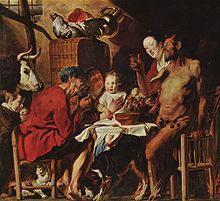
Jacob Jordaens: The Satyr and the Peasant (c. 1620) Oil on canvas, 174 × 204 cm (68.5 × 80.31 in), Alte Pinakothek, Munich
Locations
People
Groups
Topics
Commodoties
Subjects
Regions

Subregions

Related Events
Showing 10 events out of 33194 total
Years: 1615 - 1615
Jacob Jordaens: The Satyr and the Peasant (c. 1620) Oil on canvas, 174 × 204 cm (68.5 × 80.31 in), Alte Pinakothek, Munich
Locations
People
Groups
Topics
Commodoties
Subjects
Regions
Subregions