
The Sarmatians, who had emerged in a …
Years: 117BCE - 106BCE
The Sarmatians, who had emerged in a region of the steppe to the east of the Don River and south of the Ural Mountains in Eastern Europe in the seventh century BCE, have for centuries lived in relatively peaceful coexistence with their Scythian neighbors to the west.
They spill over the Don in the third century BCE to attack the Scythians on the Pontic steppe to the north of the Black Sea: they are to dominate these territories over the next five centuries.
Like the Scythians, Sarmatians are of a Caucasoid appearance, and before the arrival of the Huns (fourth century CE) it is thought that few had Asiatic or Turco-Mongol features.
Sarmatian noblemen often reach one oint seven to one point eight meters (five-feet seven inches to five feet ten inches) as measured from skeletons, and they have sturdy bones, long hair, and beards.
The Sarmatians drive their Scythian kinsmen into the delta of the Danube and the Crimea peninsula in about the second century BCE, at which point the Tauri become subject-allies of the Scythian king Skilurus and vanish from history.
Skilurus controls the ancient trade emporium of Pontic Olbia, where he mints coins.
In order to gain advantage against Chersonesos, he allies himself with the Sarmatian tribe of Rhoxolani.
In response, Chersonesos forges an alliance with Mithridates VI of Pontus.
Skilurus dies during a war against Mithridates, a decisive conflict for supremacy in the Pontic steppe.
His son Palacus succeeds him.
Soon after his death, the Scythians are defeated by by Diophantus, general of Mithridates VI, in about 108 BCE).
Diophantus is active in Mithridates' campaigns in the Bosporan Kingdom and elsewhere around the Black Sea, although their chronology is disputed.
An inscription found during the excavations in Chersonesos glorifies Diophantus as "the first foreign invader to conquer the Scythians".
During his first Crimean expedition, he relieves the siege of Chersonesos by the Scythian king Palacus and subdues his allies, the Tauri.
He finishes this campaign at Scythian Neapolis.
During the second campaign, Diophantus checks another invasion of the Scythians, who had joined their forces with the Rhoxolanoi under Tasius.
At one point during these campaigns he establishes a stronghold at Eupatorium on the eastern shore of the Crimea.
Around 107 BCE, Mithridates dispatches Diophantes to Panticapaeum with the task of persuading the Bosporan king Paerisades V to cede his kingdom to Mithridates.
While he is in the city, the Scythians, led by a certain Saumacus, revolted and kill Paerisades, while Diophantes barely manages to escape to Chersonesos.
Back in Pontus, Diophantes rallies his forces and sails to Crimea with a large fleet.
The Scythian uprising is put down and the Bosporan kingdom is reduced to a dependency of Pontus.
Either Skilurus or his son and successor Palacus are buried in a mausoleum at Scythian Neapolis, used from about 100 BCE to about 100 CE.
Locations
People
Groups
- Scythians, or Sakas
- Tauri
- Bosporan Kingdom
- Sarmatians
- Greeks, Hellenistic
- Pontus, Kingdom of
- Rhoxolani, or Roxolani
Topics
Commodoties
Subjects
Regions
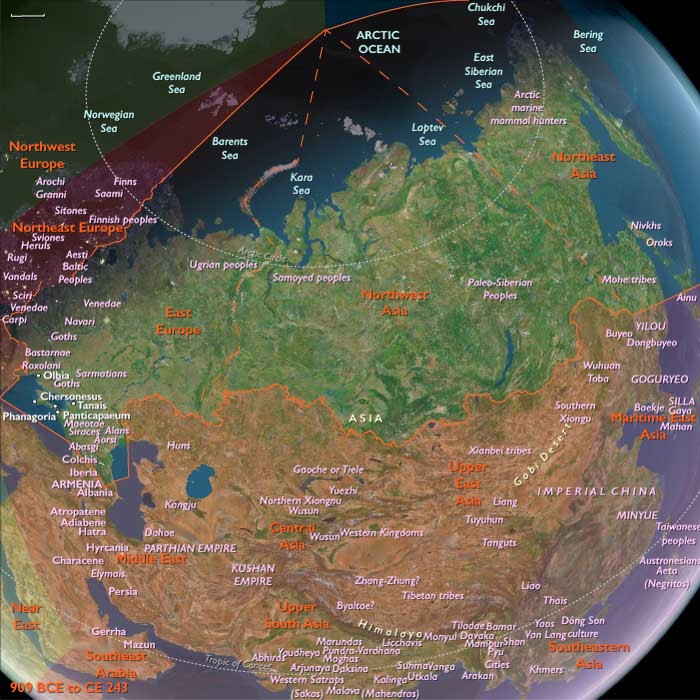
Subregions
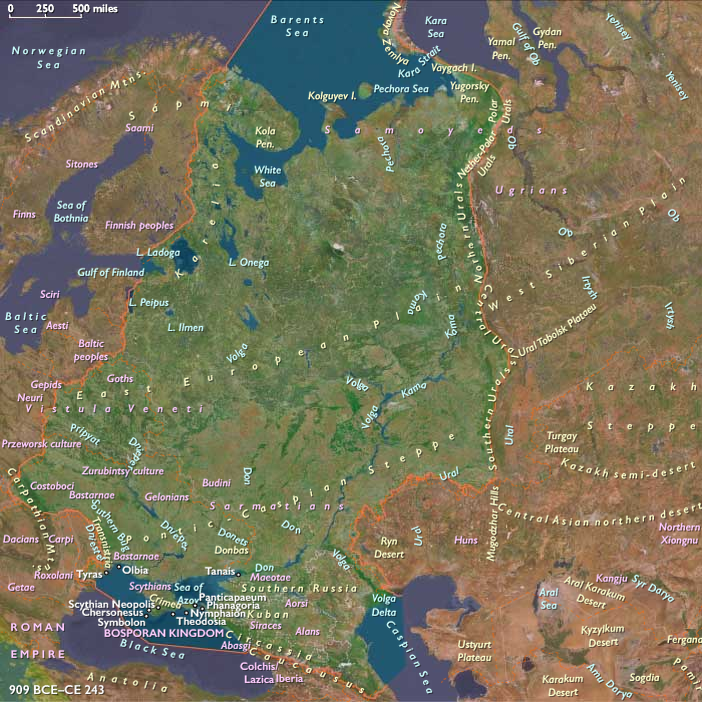
Related Events
Showing 10 events out of 62967 total
Years: 117BCE - 106BCE
Locations
People
Groups
- Scythians, or Sakas
- Tauri
- Bosporan Kingdom
- Sarmatians
- Greeks, Hellenistic
- Pontus, Kingdom of
- Rhoxolani, or Roxolani
Topics
Commodoties
Subjects
Regions
Subregions