
The allies had crossed the Var on …
Years: 1744 - 1744
April
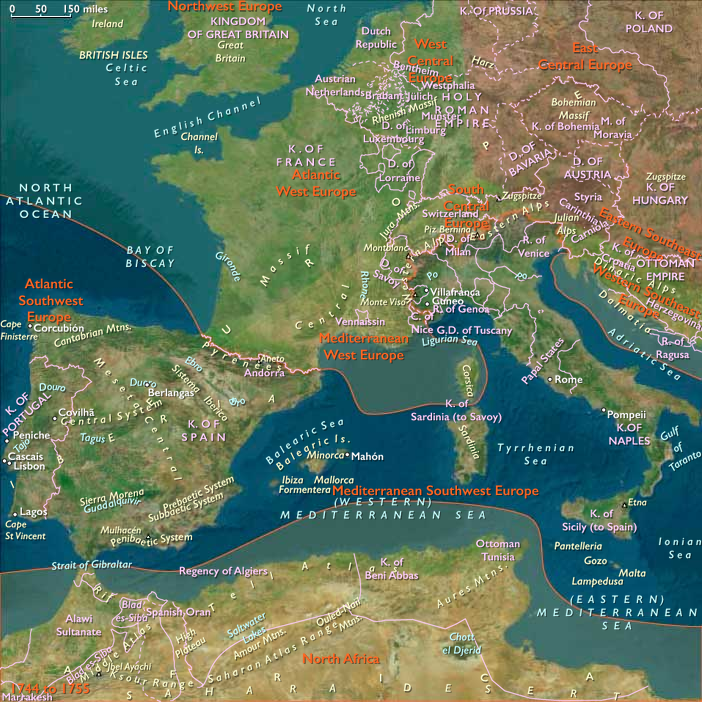
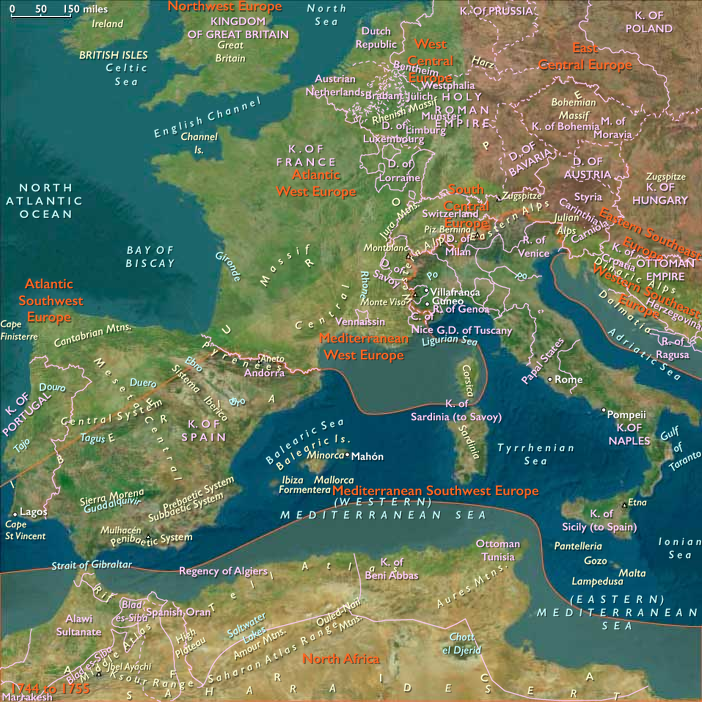
The allies had crossed the Var on April 1 and advanced into Nice, which had fallen without a fight.
The fortified camp of Villafranca now lie before them.
The Sardinians, led by Vittorio Francesco Filippo di Savoia, Marquis of Susa, the brother of the King Charles Emmanuel III, entrench themselves along the heights of Villafranca.
Their natural defenses are formidable: the attackers, hemmed in by cliffs and precipices, face a difficult climb up over rocks and boulders, in plain sight of Sardinian guns.
The fortified camp is equipped with more than eighty guns of all calibers, landed from English ships stationed in the harbor, which are arranged in eleven batteries.
Sardinian forces count fourteen battalions of infantry.
Admiral Matthews, meanwhile, has returned to the area and landed a contingent of British regulars, marines, and artillery specialists to bolster the Sardinian defense.
This force joins the Sardinians on the heights, their guns bearing down on the French against whom they had only recently declared war (Britain had been fighting a war against Spain since 1739).
Voltaire will later quip, "even in the Alps we could still find Englishmen to fight us."
Conti's first attack, launched on April 14, is suspended because of a storm.
Conti finally assaults Villafranca on the night of April 19 to 20, 1744.
In the early stages of the battle, the French and the Spaniards are able to immediately gain the position of the collet de Villefranche, capturing or destroying five Sardinian battalions.
Even the commander in chief, the Marquis of Susa, is taken prisoner and he has to be replaced by the Knight of Cinzano.
The French and Spanish forces move to conquer the positions of Mont Gros, Mont Rouge and Mont Leuze, the keys of the defensive perimeter of Villafranca.
However, led by their new commander, the defenders are able to contain the attack.
In particular, the regiment Kalbermatten, a Swiss unit in Sardinian service, is able to develop a magnificent defensive action to hold the position of Mont Leuze.
The situation is restored at four in the afternoon, and Conti has now exhausted all the forces at his disposal.
The Cinzano has the opportunity to launch an assault on the collective Villefranche and reoccupy the position, which is crucial as it allows the transit of the road to Nice.
This operation, conducted principally by companies of grenadiers, achieves complete success.
In the evening, the Sardinians are again deployed on the positions of the morning.
The defenders have suffered heavy losses.
There are over one thousand dead and wounded and fifteen hundred prisoners, compared to less than three thousand losses of Spaniards and French, who count among their ranks four hundred and thirty-three men held captive.
The Cinzano, with only five thousand men fit to fight, prefers to abandon the fortified camp of Villafranca with the help of the British navy.
On the evening of April 21, in the dock of Villafranca, the garrison is shipped aboard thirty-three ships escorted by four British warships.
The fleet leaves the port at dawn of the 22nd.
The fort of Montalbano has been abandoned, but Cinzano has in the Citadel of Villafranco a garrison of three hundred and forty soldiers, who surrender on April 27.
Locations
People
- Charles Emmanuel III
- Louis François de Bourbon
- Louis XV of France
- Maria Theresa
- Philip V of Spain
- Philip of Spain, Duke of Parma
- Thomas Mathews
Groups
- Austria, Archduchy of
- France, (Bourbon) Kingdom of
- Spain, Bourbon Kingdom of
- Britain, Kingdom of Great
- Sardinia, Kingdom of (Savoy)
Topics
Commodoties
Subjects
Regions
Subregions
Related Events
Showing 10 events out of 27239 total
Years: 1744 - 1744
April
Locations
People
- Charles Emmanuel III
- Louis François de Bourbon
- Louis XV of France
- Maria Theresa
- Philip V of Spain
- Philip of Spain, Duke of Parma
- Thomas Mathews
Groups
- Austria, Archduchy of
- France, (Bourbon) Kingdom of
- Spain, Bourbon Kingdom of
- Britain, Kingdom of Great
- Sardinia, Kingdom of (Savoy)
Topics
Commodoties
Subjects
Regions
Subregions