
The Saale had been the border between …
Years: 1384 - 1395
The Saale had been the border between Germanic regions in the west and Slavic regions in the east until the High Middle Ages.
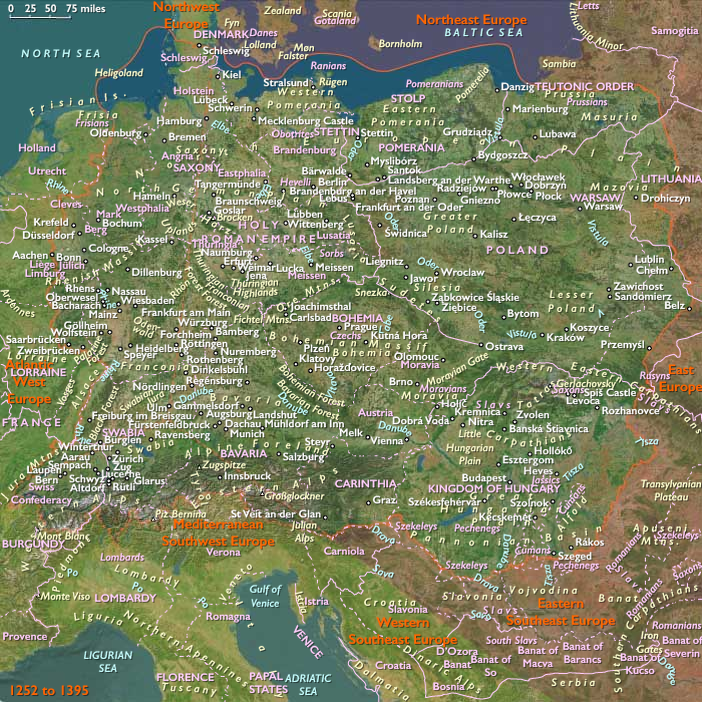
The town of Jena is conveniently located on the river, owing to its function as a river crossing.
Nevertheless, there are also some more important Saale crossings like the nearby cities of Naumburg to the north and Saalfeld to the south, so that the relevance of Jena is more local during the Middle Ages.
The first unequivocal mention of Jena is in an 1182 document.
The first local rulers of the region were the Lords of Lobdeburg with their eponymous castle near Lobeda, roughly six kilometers (four miles) south of the city center on the eastern hillside of the Saale valley; they founded Jena on the west bank.
Jena had received town rights around 1230 and a regular city grid was established between today's Fürstengraben, Löbdergraben, Teichgraben and Leutragraben.
The city had built a marketplace, main church, town hall, council and city walls during the late thirteenth and early fourteenth centuries, making it into a fully fledged town.
In this time, the city's economy is based mainly on wine production on the warm and sunny hillsides of the Saale valley.
The two monasteries of the Dominicans (1286) and the Cistercians (1301) add to Jena's medieval appearance.
Construction begins in 1390 on Saint Michael's Church.
As the political circumstances in Thuringia changed in the middle of the fourteenth century, the weakened Lords of Lobdeburg sold Jena to the aspiring Wettins in 1331.
Jena obtained the Gotha municipal law and the citizens have strengthened their rights and wealth during the fourteenth centuries.
Moreover, the Wettins are more interested in their residence in the nearby city of Weimar, so Jena is developing with relatively autonomy.
Locations
Commodoties
Subjects
Regions
Subregions
Years: 1384 - 1395
Locations
Commodoties
Subjects
Regions
Subregions