The Russians enter Poland but do not …
Years: 1716 - 1716
The Russians enter Poland but do not participate in any major engagements.
They bide their time, as Peter posed as the mediator between the Commonwealth's king and its szlachta.
Crucially, the Russians do not support the Confederates as promised, and instead insist on bringing both sides to the negotiating table.
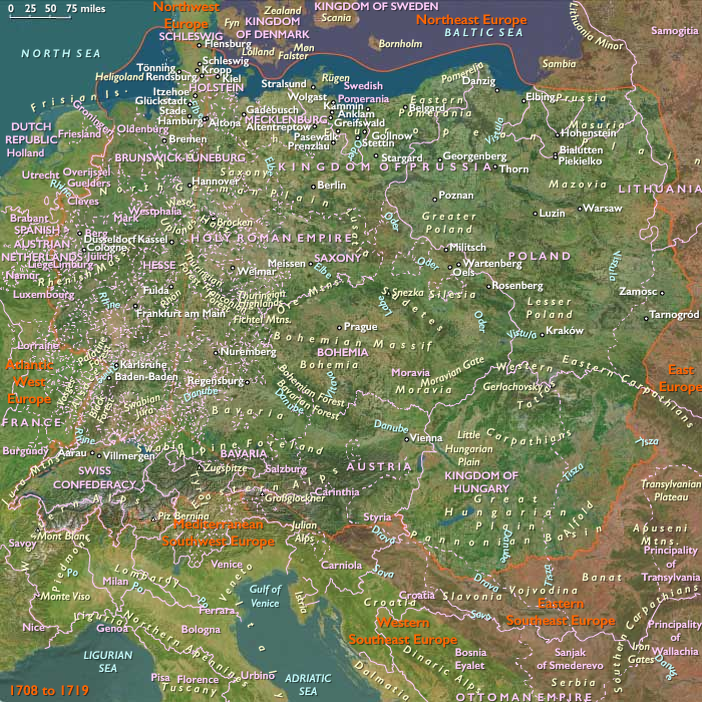
Saxon forces under the command of Jacob Heinrich von Flemming, enjoying military superiority, advance southeastwards and take Zamość, a victory accomplished less through military tactics than through diplomacy and treachery.
Locations
People
Groups
- Saxony, Electorate of
- Russia, Tsardom of
- Polish-Lithuanian Commonwealth (Commonwealth of the Two Nations)
- Tarnogród Confederation
Topics
Subjects
Regions
Subregions
Related Events
Filter results
Showing 10 events out of 28313 total
The Confederates now push back, enter Wielkopolska (Greater Poland), and take Poznań (which leads to further plundering of the city), gaining some support from a local Wielkopolska confederation and from Lithuania.
Russian forces, who had arrives in the region in the same year (they will remain until 1719), accept payment not to enter the city.
Neither side is however posed to achieve victory, and the Russian pressure mounts; eventually, the Russians declare that they will consider any side that refuses to enter into negotiations an enemy, and open hostilities against them.
Unable to defeat the Confederates, many of whom still see Peter as the protector of their rights (and some of whom hope for Augustus to be deposed), Augustus agrees to open the negotiations with Russians acting as arbitrators.
The Russians are represented by a delegation headed by prince Gregory Dolgoruky.
A peace treaty between the Confederates and Augustus is signed on November 3 or 4, 1716, as relations between the Confederates and the Russians deteriorate.
The Russians are making it increasingly apparent that their goals are not wholly benign to the Commonwealth.
A session of the Sjem is finally called for February 1, 1717.
Austria, officially neutral during 1714 but influenced by the brilliant Savoyard strategist, Prince Eugene (1663-1736), makes a defensive alliance with Venice in 1716.
Arguing that the Porte has broken the 1669 Treaty of Karlowitz and endangered Dalmatia (and therefore Austria's Croatian and Styrian territories), Austria mounts an offensive.
Prince Eugene takes advantage of the Ottoman forces’ confusion to capture Temesvár, the last Ottoman fortress in Hungary, and to ...
...besiege Belgrade, the strongest Ottoman fortification in the Balkans.
A large Ottoman army moves rapidly to confront Eugene's Austrian troops, who at first fare badly in battle but a surprise charge by Eugene’s cavalry scatters the Turks and wins victory.
The Abdali (Durrani) of Herat, encouraged by the example of the late Mir Wais Khan, take up arms against the Persians in 1716 and under their leader, Asadullah Khan, successfully liberate their province from Safavid rule.
John Law was born into a family of bankers and goldsmiths from Fife; his father had purchased a landed estate at Cramond on the Firth of Forth and was known as Law of Lauriston.
Law had joined the family business at age fourteen and studied the banking business until his father died in 1688.
Law subsequently neglected the firm in favor of more extravagant pursuits and traveled to London, where he had lost large sums of money in gambling.
Law had on April 9, 1694, fought a duel with Edward Wilson in Bloomsbury Square in London.
Wilson had challenged Law over the affections of Elizabeth Villiers.
Law, having killed Wilson with a single pass and thrust of his sword, had been arrested, charged with murder and tried at the Old Bailey before the infamously sadistic 'hanging-judge', Salathiel Lovell.
Found guilty of murder, and sentenced to death, he had been initially incarcerated in Newgate Prison to await execution.
His sentence was later commuted to a fine, upon the ground that the offense only amounted to manslaughter.
Wilson's brother appealed and had Law imprisoned, but he had managed to escape to Amsterdam.
Law has urged the establishment of a national bank to create and increase instruments of credit and the issue of banknotes backed by land, gold, or silver.
He had published a text entitled Money and Trade Consider'd with a Proposal for Supplying the Nation with Money (1705).
The first manifestation of Law's system had come when he had returned to Scotland and contributed to the debates leading to the Treaty of Union 1707.
Law's propositions of creating a national bank in Scotland were ultimately rejected, and he left to pursue his ambitions abroad.
He has spent the past ten years moving between France and the Netherlands, dealing in financial speculations.
Problems with the French economy present the opportunity to put his system into practice.
He has the idea of abolishing minor monopolies and private farming of taxes.
He would create a bank for national finance and a state company for commerce, ultimately to exclude all private revenue.
This would create a huge monopoly of finance and trade run by the state, and its profits would pay off the national debt.
The council called to consider Law's proposal, including financiers such as Samuel Bernard, had rejected the proposition on October 24, 1715.
The wars waged by Louis XIV have left France completely wasted, both economically and financially.
The resultant shortage of precious metals has led to a shortage of coins in circulation, which in turn limits the production of new coins.
It is in this context that the regent, Philippe d'Orléans, appoints John Law as Controller General of Finances.
As Controller General, Law institutes many beneficial reforms (some of which have lasting effect, others of which are soon abolished).
He tries to break up large landholdings to benefit the peasants; he abolishes internal road and canal tolls; he encourages the building of new roads, the starting of new industries (even importing artisans but mostly by offering low-interest loans), and the revival of overseas commerce—and indeed industry increases 60% in two years, and the number of French ships engaged in export go from sixteen to three hundred.
Since, following the devastating War of the Spanish Succession, France's economy is stagnant and her national debt is crippling, Law proposes to stimulate industry by replacing gold with paper credit and then increasing the supply of credit, and to reduce the national debt by replacing it with shares in economic ventures.
Law sets up the Banque Générale Privée ("General Private Bank") in May 1716.
It is a private bank, but three quarters of the capital consists of government bills and government accepted notes.

The First Natchez War is precipitated by Natchez raiders from White Apple murdering four French traders in 1716.
Bienville, seeking to resolve the conflict, calls a meeting of chiefs at the Grand Village of the Natchez.
The assembled chiefs proclaim their innocence and implicate the war chiefs of White Apple.
The Choctaw assist the French in fighting the 1716 Natchez War.
As part of the peace terms that end the Natchez War of 1716, Bienville requires the Natchez to build a fort by providing materials and labor.
Sited close to the main Natchez settlement, Fort Rosalie serves as the primary French stronghold and trading post among the Natchez.
The present-day city of Natchez, Mississippi develops at this site.
Cadillac has quarreled fiercely with the French colonists here, and in 1716 is recalled to France.
The Cherokee leader Caesar travels throughout the Cherokee towns during the winter of 1715-16, drumming up support for war against the Creek.
Other prestigious and respected Cherokee leaders urge caution and patience, including Charitey Hagey, the Conjurer of Tugaloo, one of the Lower Towns closest to South Carolina.
Many of the Lower Town Cherokee are open to peace with South Carolina, but reluctant to fight anyone other than the Yuchi and Savannah River Shawnee.
The South Carolinians are told that a "flag of truce" had been sent from the Lower Towns to the Creek, and that a delegation of Creek headmen had promised to come.
Charitey Hagey and his supporters seem to be offering to broker peace talks between the Creek and South Carolinians.
They persuade the South Carolinians to alter their plans of war.
Instead, the South Carolinians spend the winter trying to dissuade Caesar and the pro-war Cherokee.
The South Carolinians are summoned on January 27, 1716, to Tugaloo, where they discover that the Creek delegation had arrived and that the Cherokee have killed eleven or twelve of them.
The Cherokee claim that the Creek delegation was in fact a war party of hundreds of Creek and Yamasee, and that they had nearly succeeded in ambushing the South Carolinian forces.
It remains unknown exactly what happened at Tugaloo.
That the Cherokee and Creek met in private without the South Carolinians presents suggests that the Cherokee were still divided on whether to join the Creek and attack South Carolina or join the South Carolinians and attack the Creek.
It is possible that the Cherokee, who were relatively new to trade with the British, hoped to replace the Creek as South Carolina's main trading partner.
Whatever the underlying factors, the murders at Tugaloo probably resulted from an unpredictable and heated debate which, like the Pocotaligo massacre, ended in an impasse resolved through murder.
After the Tugaloo massacre, the only possible solution is war between the Cherokee and Creek and an alliance between the Cherokee and South Carolina.
The Jacobite leaders James Radclyffe, 3rd Earl of Derwentwater and William Gordon, 6th Viscount of Kenmure, who had been taken prisoner at the barricades of Preston, are on February 24, 1716, executed for treason at Tower Hill.
The Earl of Nithsdale had escaped from the Tower the day before.
Radclyffe, on the scaffold, expresses regret at having pleaded guilty, and declares his devotion to his Roman Catholic religion and to James III.
The highlanders are cheered by the prospect of battle, but James's councilors decide to abandon the endeavor and order a retreat to the coast, giving the pretext of seeking a stronger position.
James boards a ship at Montrose and eludes to France on February 4, 1716, leaving a message assigning his Highland adherents to shift for themselves.
Years: 1716 - 1716
Locations
People
Groups
- Saxony, Electorate of
- Russia, Tsardom of
- Polish-Lithuanian Commonwealth (Commonwealth of the Two Nations)
- Tarnogród Confederation