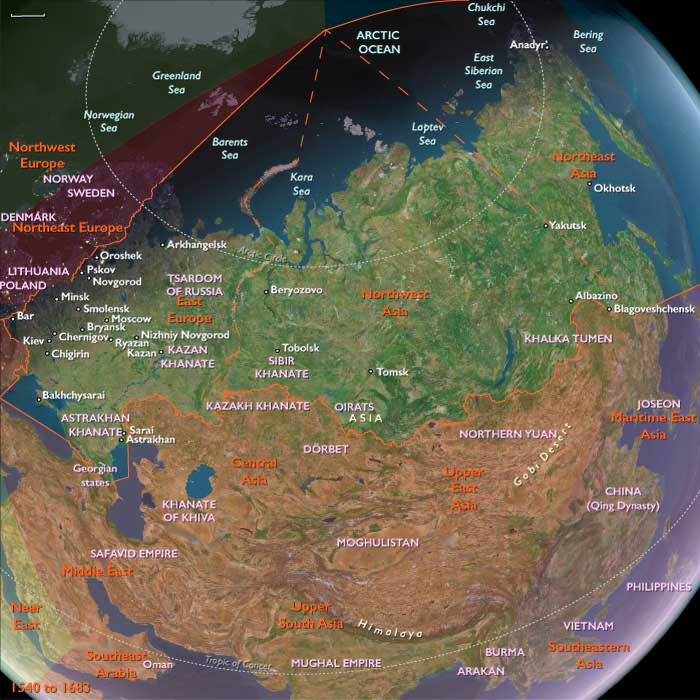
The Russian colonizers at the site of …
Years: 1649 - 1649
The Russian colonizers at the site of present Okhotsk construct the fort of Kosoi Ostrozhok in 1649.
Locations
Groups
Topics
Commodoties
Subjects
Regions
Subregions
Related Events
Filter results
Showing 10 events out of 31816 total
The Lamuts burn Okhotsk in 1653.
Aert Van Der Neer had been living in Gorinchem as a steward to the lords of Arkel, (according to Arnold Houbraken, a Dutch painter and writer from Dordrecht, now remembered mainly as a biographer of artists from the Dutch Golden Age), which would account for the absence of any pictures dating from his early years.
He had become an amateur painter possibly upon contact with the local painters Rafael and Jochem Govertsz Camphuysen, whose sister Lysbeth he had married in 1629.
Van Der Neer and his wife could possibly have moved to Gorinchem, where around 1634 their son Eglon could have been born, and who will become a portrait painter himself.
Van der Neer is in 1640 back in Amsterdam and his five children are baptized in Nieuwe Kerk, not far from where he lives.
The earliest pictures in which Van Der Neer had coupled his monogram of A.V. and D.N. interlaced with a date are a winter landscape in the Rijksmuseum at Amsterdam (dated 1639), and another in the Martins collection at Kiel (1642): immature works both, of poor quality.
Far better is the Winter Landscape (1643) in Lady Wantage's collection, and the Moonlight Scene (1644) in the d'Arenberg collection in Brussels.
Salomon van Ruysdael was, according to Houbraken, the son of a woodworker specializing in making fancy ebony frames for mirrors and paintings.
His father had sent his sons to learn Latin and medicine, and they had both become landscape painters, specializing in ruis-daal, or trickling water through a dale, after their name.
Jacob is registered with the Haarlem Guild of St. Luke and signs his paintings, while Salomon signs them much less often and is not a member for several years.
Johann Glauber had built up a business in Amsterdam manufacturing pharmaceuticals including chemicals such as Glauber's salt, an effective but relatively safe laxative at a time when purging (emptying the digestive tract) was a popular treatment for many diseases.
This had led to both great financial success and in 1649 bankruptcy, which is the reason for his move from Amsterdam to Wertheim.
Glauber in this year first observes and describes the chemical garden (or silica garden) which, in its original form, involves the introduction of ferrous chloride (FeCl2) crystals into a solution of potassium silicate (K2SiO3, water glass).
England experiences great social unrest in 1649.
The Parliamentarians have won the First English Civil War between forces loyal to Charles I and those led by Parliament’s Oliver Cromwell but fail to negotiate a constitutional settlement with the defeated King Charles I.
When members of Parliament and the Grandees in the New Model Army are faced with Charles' perceived duplicity, they try him and execute him.
Cromwell assumes power under Parliament and England is proclaimed a republic.
Cromwell invades Catholic Ireland and tries to clear away the Irish for English settlement.
Sugar prices decline slowly as production becomes multi-sourced, especially through English colonial policy.
Formerly an indulgence of the rich, sugar becomes increasingly common among the poor.
The signing of the Peace of Westphalia has allowed Condé's army to return to aid Louis and his court, and by January 1649, Paris is under siege.
The House of Commons, in response to Charles's defiance of Parliament even after defeat, and his encouraging the second Civil War while in captivity, passes an Act of Parliament in January 1649 creating a court for Charles's trial.
After the first Civil War, the parliamentarians had accepted the premise that the King, although wrong, had been able to justify his fight, and that he would still be entitled to limited powers as King under a new constitutional settlement.
It is now felt that by provoking the second Civil War even while defeated and in captivity, Charles has showed himself incorrigible, dishonorable, and responsible for unjustifiable bloodshed.
His trial on charges of high treason and "other high crimes" begins on January 20, 1649, but Charles refuses to enter a plea, claiming that no court has jurisdiction over a monarch.
Over a period of a week, when Charles is asked to plead three times, he refuses.
It is at this time normal practice to take a refusal to plead as pro confesso: an admission of guilt, which means that the prosecution cannot call witnesses to its case.
However, the trial does hear witnesses.
Fifty-nine of the Commissioners sign Charles's death warrant on January 29, 1649, possibly at the Red Lion Inn in Stathern, Leicestershire.
The Commonwealth of England, a republican form of government, replaces the monarchy as the form of government of England (and later of Scotland and Ireland).
Members of the Long Parliament serve as government.

After the ruling, the King is led from St. James's Palace, where he has been confined, to the Palace of Whitehall, where an execution scaffold has been erected in front of the Banqueting House.
Charles is beheaded on Tuesday, January 30, 1649.
His widow, Henrietta Marie, returns to her native France.
Thus begins the English Interregnum.
Khmelnytsky declares in February 1649, during negotiations with a Polish delegation headed by senator Adam Kysil in Pereiaslav, that he is "the sole autocrat of Rus" and that he has "enough power in Ukraine, Podolia, and Volhynia... in his land and principality stretching as far as Lviv, Chełm, and Halych".
It becomes clear to the Polish envoys that Khmelnytsky has positioned himself no longer as simply a leader of the Zaporozhian Cossacks, but that of an independent state and states his claims to the heritage of the Rus'.
The Parliament of Scotland, immediately following the execution of Charles I, declares Charles II King of Scotland in succession to his father on February 5, 1649, provided he accept certain conditions.
To succeed, Charles is reluctantly induced to make promises that he will abide by the terms of a treaty agreed between him and the Scots Parliament at Breda, and support the Solemn League and Covenant, which authorizes Presbyterian church governance across Britain.
Scotland is the first of the three Kingdoms to recognize Charles II’s claim to the throne.