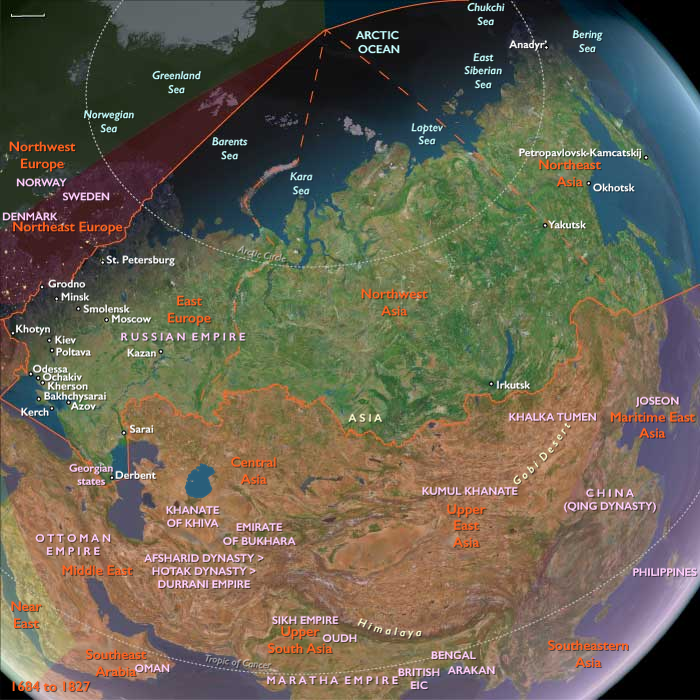
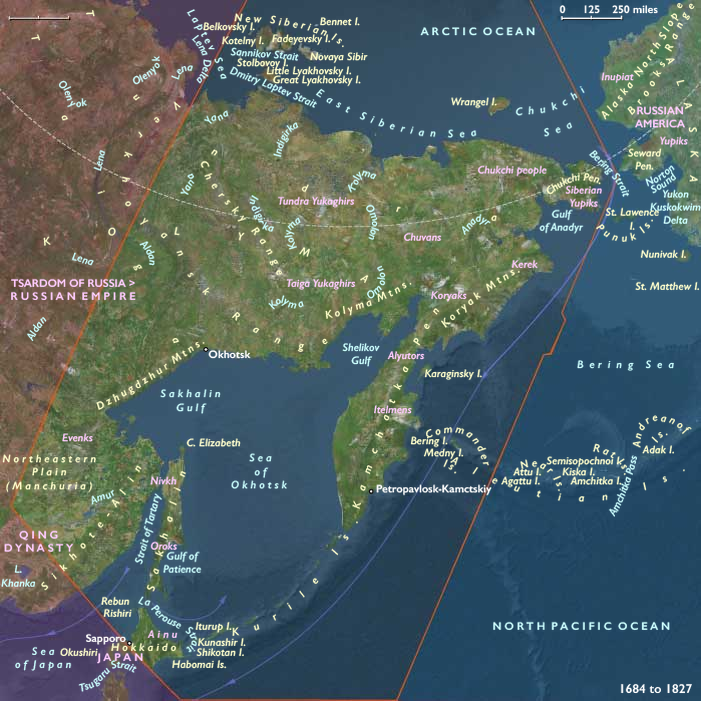
The Russian-America Company is founded in 1799 …
Years: 1799 - 1799
The Russian-America Company is founded in 1799 with its base at Okhotsk, bringing in more money to the region.
Locations
Groups
Topics
Commodoties
Subjects
Regions
Subregions
Related Events
Filter results
Showing 10 events out of 22910 total
Over one hundred private fur trading and hunting voyages have sailed from Kamchatka to North America from 1743 to the founding of the Russian-American Company in 1799.
In total, these voyages garner over eight million silver rubles.
Heshen, who had only gained his position because he was the Emperor's favorite, is known to have embezzled funds and resources earmarked for the defeat of the White Lotus; this accounted for his defeat.
The Jiaqing Emperor, on assuming effective power in 1799, overthrows the Heshen clique and, as a way of restoring discipline and morale, gives support to the efforts of the more vigorous Manchu commanders in suppressing the White Lotus Rebellion.
A systematic program of pacification follows, in which the populace is resettled in hundreds of stockaded villages and organized into militia.
The War of the Second Coalition (1798–1802) – Early Allied Successes and French Resurgence
With Napoleon Bonaparte absent in Egypt, Britain, Austria, Russia, and the Ottoman Empire formed the Second Coalition (1798–1802) to counter French expansion. This alliance launched multiple invasions across Europe, including Italy, Switzerland, and the Netherlands, attempting to reverse French gains from the First Coalition War.
Suvorov’s Campaign in Italy – Crushing the French Advance (1799)
- Russian General Aleksandr Suvorov, recalled to service in early 1799, led a brilliant campaign in northern Italy.
- He inflicted several crushing defeats on the French forces, driving them back to the Alps and liberating Lombardy from French control.
- However, his advance stalled as the French consolidated their forces in Switzerland, setting up a critical confrontation.
Setbacks for the Coalition – Defeats in Switzerland and the Netherlands
While Suvorov was victorious in Italy, the Coalition suffered defeats elsewhere:
-
Switzerland (Second Battle of Zurich, September 25, 1799):
- After initial Russian successes, the French under André Masséna decisively defeated the Russian army.
- Suvorov was forced into a harrowing retreat through the Alps in mid-winter, suffering enormous casualties.
- This defeat shattered Russian momentum, causing the Austrians to retreat from the Rhine.
-
Netherlands (Battle of Castricum, October 6, 1799):
- The Anglo-Russian expedition to the Netherlands was defeated by the French.
- The British withdrew, and the Anglo-Russian presence in Holland collapsed.
Russia Withdraws from the Coalition
- The defeats in Zurich and the Netherlands exposed fundamental flaws in the Coalition’s coordination.
- Further tensions with Britain, particularly over the British insistence on searching shipping in the Baltic Sea, led Russia to withdraw from the Second Coalition.
- With Russia gone, Austria was left alone to fight France on the Continent.
Napoleon’s Egyptian Campaign and Return to Power (1799)
While the war raged in Europe, Napoleon was leading a French expedition in Egypt, where he faced both the Ottomans and the British:
- Learning of the Ottoman Empire’s declaration of war on France (February 1799), he launched an invasion of Syria to preempt a Turkish attack on Egypt.
- However, his siege of Acre failed, as British-led Ottoman forces under Sidney Smith repelled the French.
- Facing heavy losses, plague, and supply shortages, Napoleon withdrew to Cairo (June 1799), where he repelled a British-Turkish invasion.
While in Egypt, Napoleon received news of political and military crises in France. Recognizing an opportunity, he abandoned his army in Egypt, sailing for France in August 1799.
Upon arriving in November, he used his immense popularity and military support to stage a coup, overthrowing the Directory and establishing himself as First Consul, effectively becoming the ruler of France.
The Collapse of the Second Coalition
- Suvorov’s retreat from the Alps and Russia’s withdrawal left Austria exposed.
- The Austrians abandoned their positions along the Rhine, further weakening the Coalition’s grip on Europe.
- The British and Russians evacuated the Netherlands, ending their land campaign against France.
With Napoleon now in power, the Second Coalition was unraveling, setting the stage for a renewed French offensive under his leadership.
Friedrich von Schlegel extols free love in his experimental (and only) novel of 1799, Lucinde, which earns him notoriety.
The defeat of Tipu Sahib in 1799 ends nearly four decades of conflict between Mysore and the British.
Mysore accepts a subsidiary alliance and cedes Coimbatore to Great Britain.
Switzerland becomes a virtual battle-zone between the French, Austrian and Imperial Russian armies in 1799, with the locals supporting mainly the latter two, rejecting calls to fight with the French armies in the name of the Helvetic Republic.
Alexander von Humboldt has devoted his talents to the purpose of preparing himself as a scientific explorer.
With this emphasis, he has studied commerce and foreign languages at Hamburg, geology at Technische Universität Bergakademie Freiberg under A. G. Werner, anatomy at Jena under J. C. Loder and astronomy and the use of scientific instruments under F. X. von Zach and J. G. Köhler.
His researches into the vegetation of the mines of Freiberg had led to the publication, in 1793, of his Florae Fribergensis Specimen.
Long experimentation on muscular irritability, then recently discovered by Luigi Galvani, are contained in his Versuche über die gereizte Muskel- und Nervenfaser (Berlin, 1797) (Experiments on the Frayed Muscle and Nerve Fibres), enriched in the French translation with notes by Blumenbach.
In 1794, Humboldt had gained admission to the famous Weimar coterie and had contributed (June 7, 1795) to Schiller's new periodical, Die Horen, a philosophical allegory entitled Die Lebenskraft, oder der rhodische Genius.
In 1792 and 1797 he was in Vienna; in 1795 he had made a geological and botanical tour through Switzerland and Italy.
He had obtained in the meantime official employment by appointment as assessor of mines at Berlin, February 29, 1792.
Although this service to the state is regarded by him as only an apprenticeship to the service of science, he has fulfilled its duties with such conspicuous ability that not only has he risen rapidly to the highest post in his department, but he has also been entrusted with several important diplomatic missions.
The death of his mother, on November 19, 1796, and a consequent large inheritance, sets him free to follow the bent of his genius, and severing his official connections, he waits for an opportunity to fulfill his long-cherished dream of travel.
In 1799, after obtaining permission from the Spanish government, Humboldt and the French botanist Aime Bonpland sail from Marseille to Spanish colonial lands in South America.