
The Rus of Novgorod seize Kiev in …
Years: 882 - 882
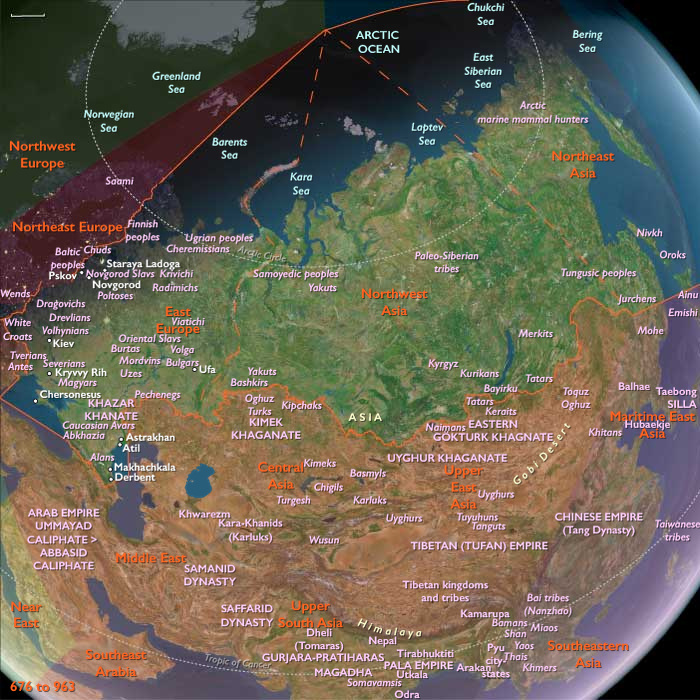
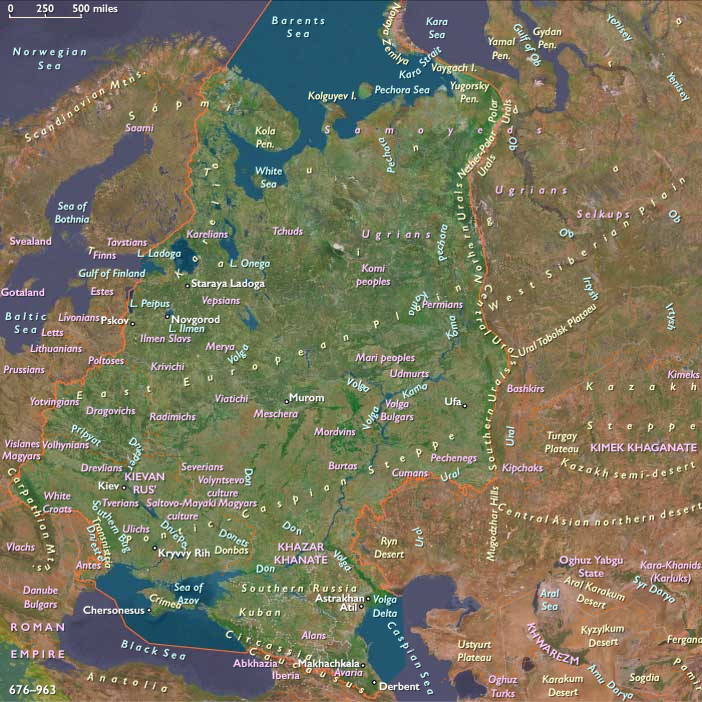
The Rus of Novgorod seize Kiev in 882, uniting the northern and southern Rus'.
According to the Primary Chronicle, Oleg, who was a relative (likely brother-in-law) of the first ruler, Rurik, and was entrusted by Rurik to take care of both his kingdom and his young son Ingvar, or Igor, gradually took control of the Dnieper cities, captured Kiev (previously held by the Varangian warlords, Askold and Dir) and finally moved his capital from Novgorod there.
The new capital would be a convenient place to launch a raid against Tsargrad (Constantinople) in 911.
According to the chronicle, the imperial Greeks attempted to poison Oleg, but the Rus' leader demonstrated his oracular powers by refusing to drink the cup of poisoned wine.
Having fixed his shield to the gate of the imperial capital, Oleg won a favorable trade treaty, which eventually was of great benefit to both nations.
Although Byzantine sources did not record these hostilities, the text of the treaty survives in the Primary Chronicle.
The Primary Chronicle's brief account of Oleg's life contrasts with other early sources, specifically the Novgorod First Chronicle, which states that Oleg was not related to Rurik, and was rather a Scandinavian client-prince who served as Igor's army commander.
The Novgorod First Chronicle does not give the date of the commencement of Oleg's reign, but dates his death to 922 rather than 912.
Scholars have contrasted this dating scheme with the "epic" reigns of roughly thirty-three years for both Oleg and Igor in the Primary Chronicle.
The Primary Chronicle and other Kievan sources place Oleg's grave in Kiev, while Novgorodian sources identify a funerary barrow in Ladoga as Oleg's final resting place.
In the Primary Chronicle, Oleg is known as the Prophet, an epithet alluding to the sacred meaning of his Norse name ("priest"), but also ironically referring to the circumstances of his death.
According to this legend, romanticized by Alexander Pushkin in his celebrated ballad "The Song of the Wise Oleg," it was prophesied by the pagan priests that Oleg would take death from his stallion.
Proud of his own foretelling abilities, he sent the horse away.
Many years later he asked where his horse was, and was told it had died.
He asked to see the remains and was taken to the place where the bones lay.
When he touched the horse's skull with his boot a snake slithered from the skull and bit him.
Oleg died, thus fulfilling the prophecy.
In Scandinavian traditions, this legend lived on in the saga of Orvar-Odd.
According to the Primary Chronicle, Oleg died in 912 and his successor, Igor of Kiev, ruled from then until his assassination in 945.
The Schechter Letter, a document written by a Jewish Khazar, a contemporary of Romanus I Lecapenus, describes the activities of a Rus' warlord named HLGW (Hebrew: הלגו), usually transcribed as "Helgu".
For years, many scholars disregarded or discounted the Schechter Letter account, which referred to Helgu (often interpreted as Oleg) as late as the 940s.
Recently, however, scholars such as David Christian and Constantine Zuckerman have suggested that the Schechter Letter's account is corroborated by various other Russian chronicles, and suggests a struggle within the early Rus' polity between factions loyal to Oleg and to the Rurikid Igor, a struggle that Oleg ultimately lost.
Zuckerman posited that the early chronology of the Rus' had to be re-determined in light of these sources.
Among Zuckerman's beliefs and those of others who have analyzed these sources are that the Khazars did not lose Kiev until the early tenth century (rather than 882, the traditional date, that Igor was not Rurik's son but rather a more distant descendant, and that Oleg did not immediately follow Rurik, but rather that there is a lost generation between the legendary Varangian lord and his documented successors.
Locations
People
Groups
- Slavs, East
- Greeks, Medieval (Byzantines)
- Varangians
- Rus' people
- Novgorod, Principality of
- Roman Empire, Eastern: Macedonian dynasty
- Kievan Rus', or Kiev, Great Principality of
Topics
Commodoties
Subjects
Regions
Subregions
Related Events
Showing 10 events out of 53796 total
Years: 882 - 882
Locations
People
Groups
- Slavs, East
- Greeks, Medieval (Byzantines)
- Varangians
- Rus' people
- Novgorod, Principality of
- Roman Empire, Eastern: Macedonian dynasty
- Kievan Rus', or Kiev, Great Principality of
Topics
Commodoties
Subjects
Regions
Subregions