The Rus'-Byzantine War of 907 is associated …
Years: 907 - 907
The Rus'-Byzantine War of 907 is associated in the Russian Primary Chronicle with the name of Oleg of Novgorod.
The chronicle implies that it was the most successful military operation of the Rus against the East Roman Empire.
Paradoxically, Greek sources do not mention it at all.
Groups
- Greeks, Medieval (Byzantines)
- Rus' people
- Roman Empire, Eastern: Macedonian dynasty
- Kievan Rus', or Kiev, Great Principality of
Topics
Commodoties
Subjects
Regions
Subregions
Related Events
Filter results
Showing 10 events out of 53468 total
The Annamese, or residents of the Chinese-controlled region of Annam (“Pacified South,” a name that the native peoples resent), granted in 906 the right to select their own governor in the anarchy that ensues after the collapse of the Tang dynasty, begin skirmishing with the Chinese of Guangdong province to the north.
Zhu Quanzhong forces Emperor Ai to yield the throne to him in summer 907, ending the Tang Dynasty.
He establishes a new Later Liang Dynasty (as its Emperor Taizu).
Most Tang military governors at least nominally submit to him as emperor, with a few exceptions—Li Keyong, Yang Xingmi's son and successor Yang Wo (titled the Prince of Hongnong), Wang Jian (titled the Prince of Shu), and Li Maozhen (titled the Prince of Qi), all of whom initially continue to use the Tang era names to show refusal to submit to Later Liang.
(Wang, however, soon declares himself emperor of a new state of Shu (commonly known as Former Shu)).
In reality, Li Keyong's state of Jin is now an independent state, although when Wang writes him and suggests that he assume imperial title as well, he refuses, claiming continued loyalty to Tang.
Later in the year, he meets at Yun Prefecture with Yelü Abaoji, the ruler of the Khitan, and tries to enlist Yelü's aid in an alliance against Later Liang.
Yelü initially agrees, but later enters into relations with Later Liang.
Wang, able to expand his holdings into eastern Sichuan, takes the title of emperor as the Tang fall in 907.
The Great Shu, called in retrospect Former Shu, has its capital at Chengdu and controls most of present-day Sichuan, parts of southern Gansu and Shaanxi, part of western Hubei and all of contemporary Chongqing.
Not only dioes it border the Later Liang Dynasty, the successor to the Tang Dynasty in the north, but it also borders the Chinese kingdoms of Nanping and Chu and the non-Chinese peoples to the south (formerly Nanzhao and soon to be the Kingdom of Dali and Amdo Tibet).
The Qian family had been providing military leaders to the Tang Dynasty beginning in 887.
Qian Liu had been named Prince of Yue in 902, with the title of Prince of Wu added two years later.
When the Tang Dynasty falls in 907 and is replaced in the north by the Later Liang Dynasty, military leaders in the south form their own kingdoms.
Qian Liu uses his position to proclaim himself the King of Wuyue.
This signals the beginning of the Five Dynasties and Ten Kingdoms period, which will last until the founding of the Song Dynasty in 960.
Qi is a Chinese kingdom during the Five Dynasties and Ten Kingdoms period in China.
The Qi kingdom’s only ruler is Li Maozhen, who later submits to Later Tang Dynasty.
At its prime Qi overs parts of modern-day Gansu, Shaanxi, and Sichuan provinces, but eventually shrinks to only the immediate area around its capital Fengxiang in Shaanxi.
Its (After Li Maozhen's death in 924, his son Li Congyan will continue to govern Fengxiang until 926, when he is removed by the Later Tang's Emperor Zhuangzong, although he will serve two later stints as governor of Fengxiang.
The Liao Khitan Mongols seize control of Chinese border areas in 907 and establish rulership there.
(Cathay, the ancient name for China, coined by the early travelers from the Middle East, is derived from Khitan or Khitai.)
The Khitan reside on the east slope of the Greater Khingan Mountains (Xing'an).
West of the mountains are other nomadic pastoral tribes such as the Shiwei, and the Xi, along with the Turkic Uyghur tribe, which have intermarried with the Khitan.
East and northeast, all the way to the Amur river, live the Jurchen tribe, residing in small villages and subsisting by hunting and fishing.
Across the Liao River to the east and southeast to the Yalu River are the Bohai people, the majority of which are a settled agricultural society.
The Bohai rule over a population of Koreans and Chinese that they had subjugated.
The Yaolian clan had dominated the leadership of the Khitan tribes since the 750s, maintaining good relations with the Tang Dynasty of China to the south.
However, by the end of the ninth century, leaders of the powerful Yila Tribe were expressing dissatisfaction with the Yaolian khans.
Abaoji's father had been the elected chieftain of the Yila Tribe.
As surnames are considered a marker of Chinese culture, they are not used by the Khitan people outside of the Yaolian imperial clan.
Abaoji had become chieftain of the Yila tribe in 901 and in 903, was named the Yuyue, Commander of all Khitan military forces.
This had the effect of making him second only to the great khan in the hierarchy of the Khitan nation.
He had started making a name for himself in 905, when he led seventy thousand cavalry into Shanxi to in support of Li Keyong against Zhu Wen, demonstrating his willingness to be to be more aggressive than the Great Khan.
He appears at the triennial council in 907 and demands to be named the khaghan, the Khan of Khans.
His successes against the Chinese in the north, who he has been raiding since 901, lead to receiving the support of seven tribal chiefs and even the acquiescence of the last Yaolian Great Khan himself.

The Khazarian Jews of Kiev in the early tenth century write a Hebrew-language letter of recommendation on behalf of one of the members of their community, whose name is Yaakov bar Hanukkah.
The names of the Kievan Jews are of Turkic, Slavic and Hebrew origins, such as Hanukkah, Yehudah, Gostata and Kiabar.
(Scholars disagree as to whether these Jews were Israelites who had merely adopted local names, or whether their local names were a sign of their Turkic Khazarian origin.
The letter, known as the Kievan Letter, was discovered in 1962 by Norman Golb of the University of Chicago.)
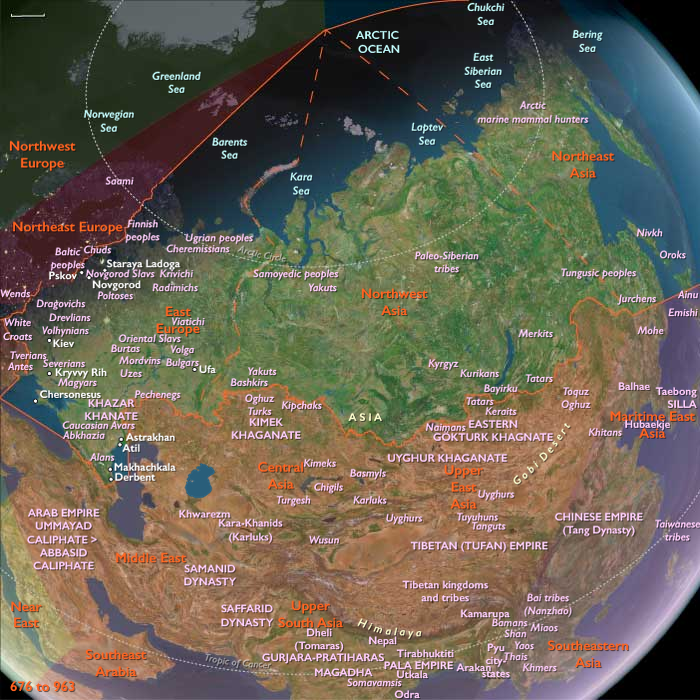
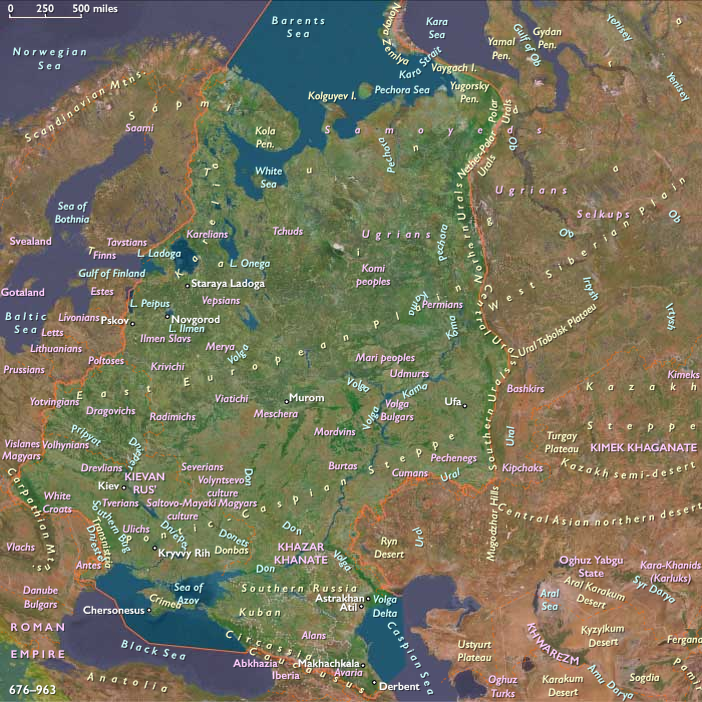
Under Oleg, Kiev has become the center of a federation of strong points controlled by Varangian "dukes."
Oleg leads a large fleet from Kiev down the Dnepr River to the Black Sea.
Arnulf, later known as Arnulf the Bad, was born into the Luitpolding dynasty.
The year of his birth is unknown, but it is said that he was the namesake of other Arnulfs and so would have been born around the time of the reign of Arnulf the seventh century bishop of Metz and the Carolingian king Arnulf of Carinthia.
Arnulf is the son of Margrave Luitpold of Bavaria and Cunigunda, daughter of Berthold I, the count palatine of Swabia.
During the Battle of Pressburg (Bratislava) in 907, the Bavarian lead forces under the command of his father Luitpold are defeated in an attack against the Magyars, who kill Liutpold and many high nobles.
The Hungarian victory stabilizes the situation of the Hungarian state.
The Germans will not attack Hungary for more than a hundred years.
The Hungarian threat to the emerging German kingdom will persist for decades.
Arnulf succeeds his father in Bavaria, becoming the Duke of Bavaria as ruler of the Bavarian estates around Regensburg.
Nicholas Mystikos may have become involved in the revolt of Andronikos Doukas.
He is deposed as patriarch on February 1, 907 and replaced by Euthymios.
Exiled to his own monastery, Nicholas regards his deposition as unjustified and involves Pope Sergius III in the dispute.
The new patriarch attempts a compromise by defrocking the offending priest but recognizing the marriage of Emperor Leo and Zoe.
In 907, Oleg obtains a treaty regulating the position of Russian merchants in Constantinople (which will be formally ratified in 911).
Many of the Rus' remain, becoming members of the emperor's Varangian (as the Greeks call the Swedish and Danish Vikings) guard.
Years: 907 - 907
Groups
- Greeks, Medieval (Byzantines)
- Rus' people
- Roman Empire, Eastern: Macedonian dynasty
- Kievan Rus', or Kiev, Great Principality of