
The ruler of the nomadic Tuoba tribal …
Years: 471 - 471
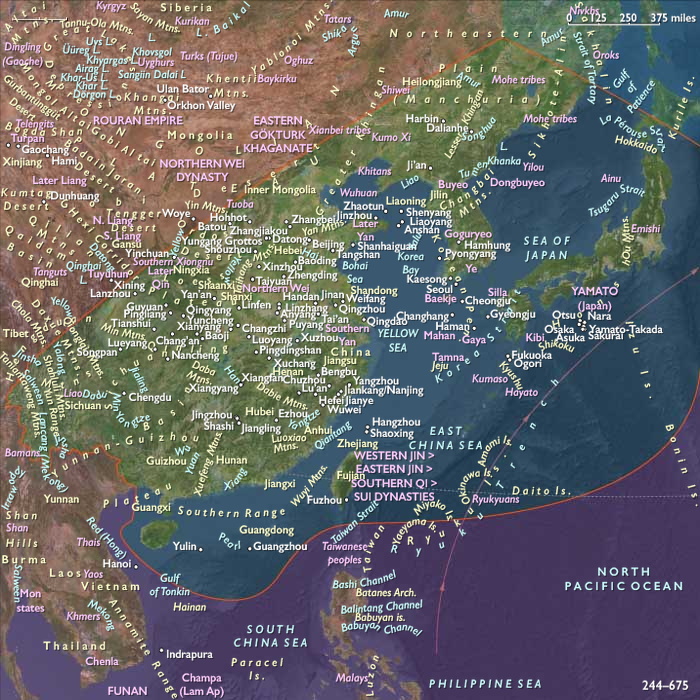
The ruler of the nomadic Tuoba tribal state in Northern China adopts a Chinese surname; he will reign over Northern Wei as emperor Xiao Wen Di until his death in 499.
Locations
People
Groups
Topics
Commodoties
Subjects
Regions

Subregions
Related Events
Filter results
Showing 10 events out of 58562 total
Aspar, with Zeno far from Constantinople, has increased his influence by having his son Julius Patricius appointed Caesar and married to Leo I's younger daughter, Leontia, in 470.
Sources are contradictory on the causes, but clearly state that in 471, Leo I had Aspar and Ardabur treacherously killed, certainly with Zeno's and Basiliscus' approval, as in the eve of the murders, the two generals had moved closer to Constantinople (Zeno was at Chalcedon).
Zeno returns to Constantinople after their death and is appointed magister militum praesentalis.
This event marks the consequent end of German domination over Eastern Roman policy.
The Goths, led by Theodoric Strabo, revolt in Thrace after the assassination of Aspar.
Leo I sends Basiliscus to suppress the uprising.
Zeno, while living in Antioch with his family, sympathizes with the Monophysite views of Peter the Fuller, and supports him against his opponent, the Chalcedonian bishop Martyrius.
Zeno allows the arrival in Antioch from nearby monasteries of monks who increase the number of Peter's followers, and does not repress effectively their violence.
Martyrius goes to Constantinople, to ask Emperor Leo for help, but returning to Antioch, he is informed that Peter had been elected bishop; Martyrius resigns.
Leo reacts, ordering the exile of Peter and on June 1, 471, addressing to Zeno a law that forbids the monks to leave their monasteries and to promote rebellion.
In 470/471, Zeno has also to deal with an invasion of Sanni, who attack Roman Armenia.
Peter the Fuller, a non-Chalcedonian Christian churchman, had received his surname from his former trade as a fuller of cloth.
Tillemont (Empereurs, tome vi.
p. 404) considers that Peter was originally a member of the convent of the Akoimetoi, which he places in Bithynia on the Asiatic side of the Bosphorus, at Gomon, "The Great Monastery" and being expelled thence for his behavior and heretical doctrine, passed over to Constantinople, where he courted persons of influence, through whom he was introduced to Zeno, the son-in-law of Leo I and future emperor whose favor he had secured, obtaining through him the chief place in the church of St. Bassa, at Chalcedon.
Here his Non-Chalcedonian beliefs had quickly become apparent, resulting with his flight to Zeno, who was then setting out for Antioch as commander of the East (Magister Militum per Orientem).
Arriving at Antioch 463, Peter had greatly desired the patriarchal throne, then filled by Martyrius.
He quickly befriended the populace, with whom he raised suspicions against Martyrius as a concealed Nestorian, thus causing Martyrius' tumultuous expulsion and his own election to the throne.
Theodorus Lector dates this to 469 or 470.
When established as patriarch, Peter at once declared himself openly against the Council of Chalcedon, and added to the Trisagion the words "Who was crucified for us," which he imposed as a test upon all in his patriarchate, anathematizing those who declined to accept it.
According to the Synodicon, he summoned a council at Antioch to give synodical authority to this novel clause (Labbe, iv.
1009).
The deposed Martyrius went to Constantinople to complain to the Emperor Leo, by whom, through the influence of the Patriarch Gennadius, he was courteously received; a council of bishops found in his favor, and his restoration was decreed (Theodorus Lector p. 554).
But despite the imperial authority, Peter's personal influence, supported by the favor of Zeno, was so great in Antioch that Martyrius's position was rendered intolerable and he soon left Antioch, abandoning his throne again to the intruder.
Leo was naturally indignant at this audacious disregard of his commands, and he dispatched an imperial decree for the deposition of Peter and his banishment to the Oasis (Labbe, iv.
1082).
According to Theodorus Lector, Peter fled, and Julian was unanimously elected bishop in his place (471).
The Visigothic Conquest of Provence and the Siege of Clermont (c. 470 CE)
As the Western Roman Empire collapses, the Visigothic Kingdom, under King Euric, takes advantage of Rome’s growing weakness to expand its dominion deeper into Gaul. Around 470 CE, Euric launches a major campaign into Provence, seizing vast territories that had remained under nominal Roman control.
The Visigothic Invasion of Provence
- Euric's forces overrun much of Provence, securing key cities such as Arles and Marseille, vital for Mediterranean trade and defense.
- By doing so, the Visigoths strengthen their hold on southern Gaul, cutting off one of the last remaining Roman strongholds in the region.
- This conquest further isolates Syagrius’ Domain of Soissons in northern Gaul, leaving it as the only significant Roman enclave left.
The Siege of Clermont-Ferrand in Auvergne
- Euric then turns his attention to Clermont-Ferrand, a strategic city in Auvergne that still holds out under Roman rule.
- The city is besieged, likely facing intense pressure from Visigothic forces intent on securing all of central Gaul.
- Sidonius Apollinaris, the bishop of Clermont and a prominent Gallo-Roman aristocrat, plays a key role in organizing resistance against the Visigoths. His letters and accounts provide firsthand testimony of the deteriorating situation.
The Decline of Roman Gaul
The fall of Provence and the siege of Clermont mark a critical turning point in the collapse of Roman authority in Gaul:
- The Visigoths emerge as the dominant power in southern Gaul, effectively supplanting Roman rule in the region.
- The last remaining Roman forces in Gaul are confined to Soissons, under Syagrius, and parts of the Rhône Valley, which will soon fall.
- The Franks, still consolidating power in the north, watch as the Visigoths expand uncontested, setting the stage for future conflicts between these two rising barbarian kingdoms.
Though Clermont resists for some time, it eventually falls to the Visigoths, solidifying their control over Auvergneand bringing an end to yet another Roman outpost in Gaul.
The first Shinto religious shrines begin to be built in Japan around 478.
The great bells and drums, Kofun burial mounds, and the founding of the imperial family are important to this period, in which developed the Japanese feudal state, and the Yamato and Izumo cultures.
Both of these dominant cultures have a large and central shrine which still exists today, Ise Shrine in the southwest and Izumo Taisha in the northeast.
This time period is defined by the increase of central power in Naniwa, now Osaka, of the feudal lord system.
Also there is an increasing influence of Chinese culture, which profoundly changes the practices of government structure, social structure, burial practices, and warfare.
The Japanese also hold close alliance and trade with the Gaya confederacy in the south of the Korean peninsula.
The Baekje, one of the Three Kingdoms of Korea, has political alliances with Yamato, and in the fifth century has seen the importation of the Chinese writing system to record Japanese names and events for trade and political records.
East Central Europe (472–483 CE): Theodoric the Great, Ostrogothic Consolidation, and Regional Stability
Between 472 and 483 CE, East Central Europe—including Poland, Czechia, Slovakia, Hungary, and those portions of Germany and Austria lying east of 10°E and north of a line stretching from roughly 48.2°N at 10°E southeastward to the Austro-Slovenian border near 46.7°N, 15.4°E—experienced the consolidation of Ostrogothic and Gepid power. This era was particularly marked by the rise and expanding influence of Theodoric the Great, who increasingly dominated Ostrogothic politics and asserted authority over broad territories formerly controlled by Rome and the Huns. Amid these developments, the Rugii retained their independence through skillful diplomacy, while proto-Slavic communities continued their enduring cultural resilience and steady adaptation.
Political and Military Developments
Rise of Theodoric the Great
-
Theodoric the Great emerged prominently during this period as the leading figure of the Ostrogoths following the death of his father, Theodemir (474 CE). His strong leadership swiftly strengthened Ostrogothic authority, notably in territories corresponding to modern-day Austria, eastern Germany, Czechia, and western Hungary.
-
Theodoric secured dominance by successfully negotiating alliances, confronting rival groups, and initiating military actions, thus significantly stabilizing Ostrogothic influence across the region.
Gepid Territorial Consolidation
-
Concurrently, the Gepids under their king continued to solidify their presence in the eastern parts of former Roman Pannonia, extending their control over central Hungary and adjacent territories, frequently interacting diplomatically and militarily with the Ostrogoths and Rugii.
Rugian Diplomatic Neutrality
-
The Rugii maintained their stable autonomy along the upper Tisza, carefully balancing diplomatic relationships with Theodoric’s Ostrogoths, the Gepids, and surrounding tribal factions, thereby ensuring their continued independence and regional significance.
Economic and Technological Developments
Stabilization of Localized Economies
-
Ostrogothic and Gepid dominance contributed to a measure of regional economic stability, allowing limited revival of trade networks, particularly along strategic routes connecting settlements such as Augusta Vindelicorum (Augsburg) and former Roman provincial centers.
-
Local economies remained primarily agricultural and pastoral but benefited from increased security and trade facilitated by stable tribal governance.
Infrastructure Adaptation
-
Although large-scale infrastructure improvements ceased, existing roads and fortifications were maintained to support regional governance and security, reflecting stable Ostrogothic and Gepid control.
Cultural and Artistic Developments
Ostrogothic and Gepid Cultural Expression
-
The period saw further refinement of Ostrogothic and Gepid material culture, with distinctive artistic styles emerging clearly in jewelry, weaponry, and decorative metalwork, blending Germanic traditions, residual Roman influences, and elements inherited from Hunnic styles.
Proto-Slavic Cultural Stability
-
Proto-Slavic populations maintained traditional customs and community cohesion, demonstrating cultural resilience and cautious integration of external influences within a context of regional stability under dominant Ostrogothic and Gepid influence.
Settlement and Urban Development
Strengthened Importance of Regional Urban Centers
-
Settlements such as Augusta Vindelicorum (Augsburg) continued as significant regional hubs, benefiting from increased political stability and revived regional trade.
-
Former Roman towns (Carnuntum, Vindobona, Aquincum) maintained their strategic significance, albeit in reduced forms, serving as military and administrative outposts for the ruling tribes.
Rugian Settlements as Anchors of Stability
-
Rugian communities along the upper Tisza continued thriving economically and politically, reinforcing their role as stable centers amidst broader regional realignments.
Social and Religious Developments
Ostrogothic and Gepid Leadership Structures
-
Tribal structures among Ostrogoths and Gepids further solidified around powerful warrior elites, emphasizing traditional Germanic cultural practices and reinforcing internal unity.
Rugian Diplomatic Adaptation
-
Rugian leaders continued their skilled diplomacy, adeptly managing alliances and neutrality with dominant regional powers, ensuring autonomy and preserving traditional cultural identities.
Proto-Slavic Social Cohesion
-
Proto-Slavic communities maintained their internal social structures, traditional religious practices, and communal resilience, facilitating continuity in cultural and social traditions despite ongoing geopolitical changes.
Long-Term Consequences and Historical Significance
The era 472–483 CE represented a key transitional phase in East Central Europe, characterized by the decisive consolidation of Ostrogothic power under Theodoric the Great and strengthened Gepid territorial control. The continued stability of Rugian autonomy, alongside the cultural resilience of proto-Slavic communities, provided a framework of enduring local continuity. These developments significantly shaped subsequent regional dynamics, laying essential foundations for the transition from late antiquity into the medieval societies that would define East Central Europe’s historical trajectory.
Eastern Southeast Europe (472–483 CE): Consolidation Amidst Transition
Settlement and Migration Patterns
Stability and Regional Settlements
Between 472 and 483 CE, Eastern Southeast Europe experienced relative stability following previous decades of intense migrations and invasions, particularly those associated with the disintegration of Attila’s Hunnic Empire. This allowed for further consolidation of existing settlements, particularly among Slavic populations, and steady urban growth.
Fortification and Urban Planning
Major urban centers, including Constantinople and Philippopolis, continued reinforcing fortifications and improving infrastructure. These strategic enhancements provided urban resilience and preparedness for future threats, significantly boosting the region’s overall stability.
Economic and Technological Developments
Economic Resilience and Growth
Regional economies showed sustained resilience and incremental growth, supported by stable agricultural production and consistent trade activities. Constantinople remained the critical economic hub, securing robust commercial linkages throughout the Mediterranean and Black Sea regions.
Technological Progress and Defense
Technological advancements continued, focusing predominantly on military infrastructure, fortification refinements, logistical systems, and military preparedness. These developments supported regional security and ongoing economic activities, reflecting a sustained defensive posture.
Cultural and Artistic Developments
Artistic and Cultural Continuity
Cultural life flourished, blending classical traditions with Christian motifs. Artistic production included significant developments in religious architecture, public monuments, mosaics, and decorative arts, all reinforcing regional cultural identity and resilience.
Intellectual and Educational Preservation
Educational institutions and scholarly communities persisted actively in preserving classical and theological knowledge. Intellectual activities continued, maintaining cultural continuity and adapting traditions to reflect shifting regional dynamics.
Social and Religious Developments
Strengthening Administrative Structures
Administrative and governance structures solidified further, enhancing provincial management, local governance, and civic oversight. Improved administrative efficiency contributed significantly to the region’s overall stability and cohesion.
Expansion of Christian Institutions
Christianity continued deepening its influence, significantly shaping social, cultural, and political life. Expansion and strengthening of religious institutions, including churches and monastic communities, reinforced Christianity's pivotal role in community cohesion and societal stability.
Long-Term Consequences and Historical Significance
The period from 472 to 483 CE was marked by regional consolidation, stable economic growth, and reinforced cultural and administrative frameworks. These developments had lasting impacts on Eastern Southeast Europe's stability and historical trajectory, providing essential groundwork for subsequent Byzantine resilience and cultural continuity.
Barbarian Migrations and the Reshaping of Post-Roman Europe
As the Western Roman Empire crumbles, large-scale barbarian migrations reshape the political and social order of Europe. The movement of various Germanic and non-Germanic tribes creates a patchwork of new kingdoms, permanently altering the balance of power on the continent.
A Third Wave of Devastation in the Balkans
The Balkans, already weakened by earlier invasions, endure a third wave of destructive raids from eastern Germanic tribes, including:
- The Ostrogoths, who push further into Roman-held lands.
- The Gepids, consolidating their presence in Dacia and Pannonia.
- Other nomadic groups, who exploit the continued weakness of the Eastern Roman (Byzantine) Empire.
These invasions destabilize the region, accelerating the decline of Roman authority outside of Constantinople's core territories.
The Anglo-Saxon Invasions of Britain
Meanwhile, in the west, the islands of Britain experience a major wave of migration from continental Germanic tribes:
- The Jutes, from the Jutland Peninsula.
- The Angles, from present-day Denmark and northern Germany.
- The Saxons, from the northern German coastline.
Arriving in small raiding parties, they gradually settle, displacing or assimilating the native Romano-British population. This marks the beginning of the Anglo-Saxon era, eventually leading to the formation of early medieval England.
The Formation of Barbarian Kingdoms on the Continent
As Roman power collapses, major Germanic groups establish permanent territories, replacing the old imperial provinces:
- The Franks and Alemanni – Settle beyond the Rhine, with the Franks gradually expanding southward into Gaul.
- The Burgundians – Establish a kingdom along the Rhône Valley, in what is now eastern France and western Switzerland.
- The Visigoths – Having already taken control of southern Gaul, they now expand into nearly all of Hispania, reducing Roman authority there to a few isolated strongholds.
The Collapse of Rome and the Rise of Feudalism
With the Western Roman Empire gone, the social and economic structure of Europe transforms:
- Small farmers, unable to protect themselves from raiders and warlords, seek protection from local nobles or Germanic chieftains.
- In return for military defense, they surrender their lands or become bound to estates, leading to the rise of a system that will eventually evolve into feudalism.
- Power centralizes around local lords, as urban centers decline and the old Roman administration disappears outside of the Byzantine-controlled east.
The Dawn of the Early Medieval World
The migrations and conquests of the fifth century mark the end of Roman rule in the West and the beginning of the Medieval Era. The once-unified Roman world is now divided into barbarian successor kingdoms, each with its own evolving laws, cultures, and political structures.
This new order, shaped by Germanic warriors, displaced Roman elites, and shifting alliances, will define the political and social fabric of medieval Europe for centuries to come.
The Middle East: 472–483 CE
The Completion of the Babylonian Talmud
The period from 472 to 483 CE is notable for significant cultural and religious achievements, particularly within the Jewish communities of Babylonia. Ravina II, who had succeeded Ashi as head of the school of Sura, completes the monumental edition of the Talmud known as the Babylonian Gemara in 475 CE. This vast and intricate compilation, the Talmud Babli, emerges as the definitive commentary and interpretation of Jewish law, second only to the Bible in religious authority and importance for Jewish life.
Structure and Content of the Talmud
The Babylonian Talmud combines the Hebrew text of the Mishnah with extensive Aramaic commentary known as the Gemara. While the Mishnah, finalized around 200 CE, predominantly uses Hebrew, the Gemara of the Babylonian Talmud—like its Palestinian counterpart—employs Aramaic, reflecting the everyday language of Babylonian Jewry. Together, these texts provide comprehensive discussions of civil, criminal, domestic, and ritual law, alongside rich narrative materials known as Haggadah. These Haggadic sections encompass moral guidance, theological reflections, scriptural interpretations, parables, and legendary as well as historical anecdotes.
Religious Dynamics and Persian Tolerance
Within the Sassanian Empire, the period also briefly sees a renewal of religious tensions. Although the Sassanians officially uphold Zoroastrianism, the reign of Yazdegird II and his successors exhibits variable degrees of tolerance towards minority faiths, including Christianity and Judaism. Nevertheless, the empire generally maintains a pragmatic stance, enabling Jewish scholars to pursue their religious and intellectual activities, thereby facilitating the significant scholarly accomplishment represented by the completion of the Babylonian Talmud.
Persian Political Context
The completion of the Talmud occurs against a backdrop of relative political stability under Persian rule. The Sassanian administration focuses largely on consolidating control and managing occasional internal dissent rather than expansive military campaigns. This stability, even if punctuated by periodic religious and social pressures, allows intellectual and cultural life in Babylonia to thrive, directly contributing to the scholarly achievements of Jewish communities.
Thus, the years from 472 to 483 CE represent a critical era of cultural consolidation and religious scholarship, marked prominently by the enduring legacy of the Babylonian Talmud and the ongoing complexities of religious coexistence within the Persian Empire.
Ravina II, who had succeeded Ashi as head of the school of Sura in Babylonia, completes the Talmud edition known as the Babylonian Gemara (Aramaic for "learning" or "tradition"), in 475.
A work of enormous scope, the “Talmud Babli,” as the Babylonian Talmud is known, is for traditional Jews the final authority on the law.
The Mishnah is predominantly in Hebrew; the Gemara, like the Palestinian Gemara of the third and fourth centuries CE, is largely in Aramaic.
Both Talmuds contain, in addition to comprehensive and subtle discussions of civil, criminal, domestic, and ritual law, materials called haggadah ("narration")—positions on morals and faith, explanations of Bible verses, parables, and legendary and historical narratives.
The Talmud, in covering every aspect of daily life, fulfills a role in Jewish life second in importance only to the Bible.
Years: 471 - 471
Locations
People
Groups
Topics
Commodoties
Subjects
Regions
Subregions