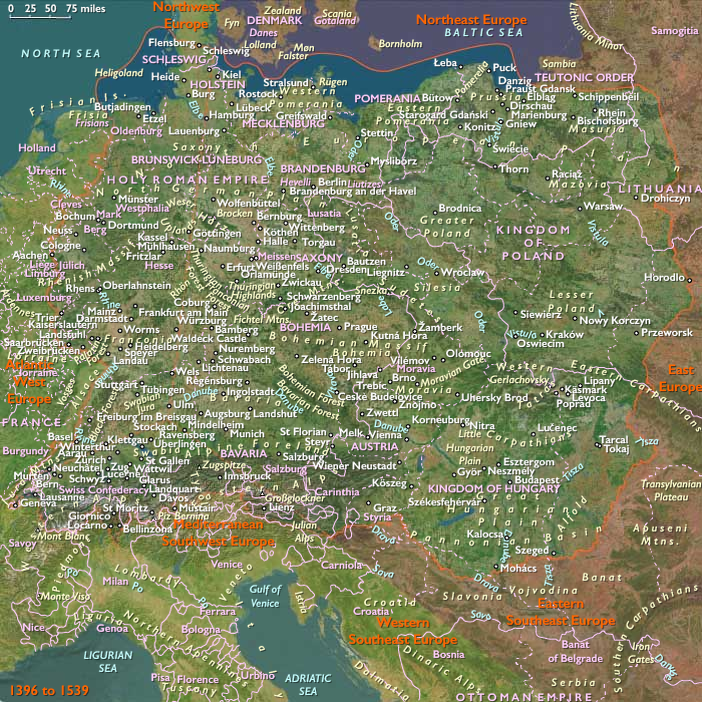
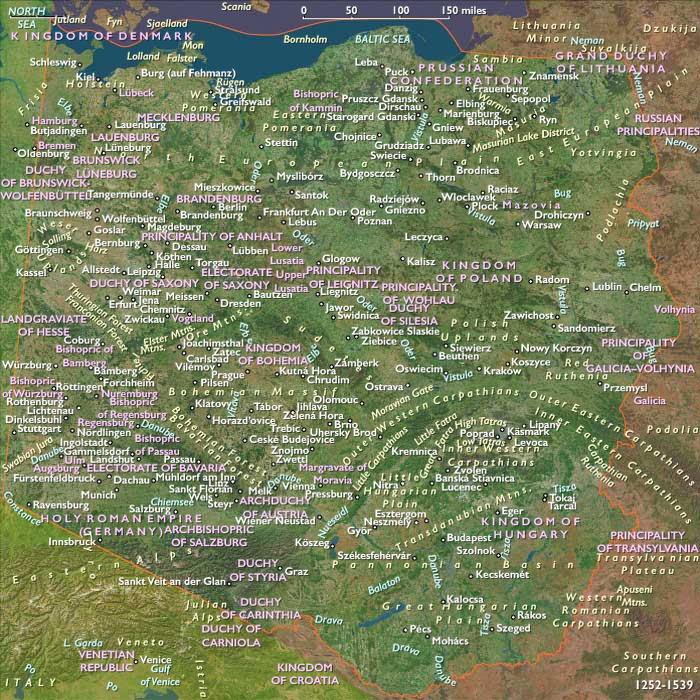
…the royal Saxon towns of Kezmarok/Käsmark and …
Years: 1412 - 1412
…the royal Saxon towns of Kezmarok/Käsmark and …
Locations
Groups
- Croatia, Kingdom of
- Hungary, Kingdom of
- Saxony, Electorate of
- Poland of the Jagiellonians, Kingdom of
Topics
Subjects
Regions
Subregions
Related Events
Filter results
Showing 10 events out of 42384 total
The Mons of Pegu again attack Prome in 1412, and Ava’s King Minhkaung responds by dispatches two armies, one by land and one by river, against them.
Minhkaung’s forces are victorious until interrupted by an invasion of Shan troops from the north, forcing a redeployment of Burmese forces to counter this threat.
The Shans, defeated by forces under Crown Prince Minyekyawswa, withdraw.
Hungary-Croatia sells to Poland sixteen towns in Slovakia’s northern Spis region (Spisz/Szepesség/Zips) in 1412, near to but not including …
…Levoca/Leutschau.
Jan Hus, excommunicated in 1411 for siding with the wrong pope in the Great Schism, is successively abandoned by archbishop, king, and university, and driven from Prague in 1412.
Mûsa sets his forces to besieging Constantinople, but loses his fleet in the effort.
Still supreme but not officially named sultan, Mûsa musters a large army by falsely charging Greek emperor Manuel II Palaiologos with soliciting Timurid aid.
He uses it to punish the Serbians for their 1406 desertion, then moves against Salonika in 1412.
Following his capture of this city and blinding of its ruler, the son of his murdered brother Süleyman, Mehmed declares himself sultan in both Anatolia and Rumelia, with his capital at Edirne, and sets himself to reuniting and restoring the shattered Ottoman empire.
The Turkish notables, in order to deprive the sultan of the only military force he can use to resist their control, require him to abandon the Kapikulu (Palace Guard), justifying the action on the basis of the Islamic tradition that Muslims cannot be kept in slavery.
Ceylon’s emergent Kotte kingdom has been waging a war against the Jaffna kingdom.
Alakeshvara, the King of Kotte, has gained military prestige in the war, eventually coming to power and ruling Kotte under a puppet king from the previous royal dynasty.
However, he had eventually usurped the royal throne of the kingdom.
During the so-called treasure voyages launched by the Yongle Emperor of China’s Ming Dynasty, Admiral Zheng He and his fleet arrive in local waters nearby to establish Chinese control and stability along the maritime routes in the waters of Ceylon and southern India.
However, Alakeshvara poses a threat to the region by committing piracy and hostilities around the local waters.
Alakeshvara had been hostile to the Chinese presence of the fleet on arrival to Ceylon during the first treasure voyage.
Admiral Zheng He had decided to leave Ceylon for the time being and traveled further to other destinations.
During the third treasure voyage, the treasure fleet returns to the Kotte kingdom.
However, this time they have come to dispose Alakeshvara by military force.
Dreyer (2007) states that the confrontation in Ceylon against Alakeshvara most-likely happened during the outward journey in 1410 rather than the homeward journey in 1411.
However, he also notes that most authorities think that the confrontation happened during the homeward journey in 1411.
(Dreyer, Edward L. (2007).
Zheng He: China and the Oceans in the Early Ming Dynasty, 1405–1433.
New York: Pearson Longman.)
When the Chinese return to Ceylon, they are overbearing and contemptuous, considering the Sinhalese people rude, disrespectful, and hostile.
They also resented that the Sinhalese are committing hostilities towards neighboring countries who have diplomatic relations with Ming China.
Admiral Zheng He and a few of his troops are traveling overland into Kotte, because Alakeshvara has lured them into his territory.
Alakeshvara cuts off Admiral Zheng He and his two thousand accompanying troops from the treasure fleet anchored at Colombo.
He also plans to launch a surprise attack on the treasure fleet.
In response, Admiral Zheng He and his troops invade Kotte, thus conquering its capital, and taking Alakeshvara, his family, the rest of the leadership, and dependents captive.
The Sinhalese army hastily return and surround the capital, but they are repeatedly defeated in battle against the invading Chinese troops.
Eventually, the Yongle Emperor decides to free Alakeshvara and return him.
He also requests the Ministry of Rites to recommend someone to serve as the new king.
However, the previous legitimate dynasty has already reestablished themselves in Kotte by the time the Chinese embassy arrives.
From this point forward, the treasure fleet will encounter no hostilities and will make port on Ceylon during all subsequent treasure voyages.

Vincent Ferrer, born in Valencia, was the fourth child of the nobleman Guillem Ferrer, who had come from Palamós, and his Spanish wife, Constança Miquel.
He had begun his classical studies at the age of eight, his study of theology and philosophy at fourteen.
Ferrer four years later, at the age of eighteen, had entered the Order of Preachers, commonly called the Dominican Order.
As soon as he had entered the novitiate of the Order, though, he had experienced temptations urging him to leave.
Even his parents had pleaded with him to do so and become a secular priest.
He prayed and practiced penance to overcome these trials.
Thus he succeeded in completing the year of probation and advancing to his profession.
He read solely Sacred Scripture for a period of three years, and eventually committed it to memory.
He published a treatise on Dialectic Suppositions after his solemn profession, and in 1379 had been ordained a Catholic priest at Barcelona.
Eventually becoming a Master of Sacred Theology, he had been commissioned by the Order to deliver lectures on philosophy.
He was then sent to Barcelona and eventually to the University of Lleida, where he earned his doctorate in theology.
He will later claim that the Great Schism had such a depressing effect on his mind that it caused him to be seriously ill at the age of forty.
The Western Schism had divided Christianity first between two popes: Clement VII, who lived at Avignon in France, and Urban VI, in Rome.
Vincent Ferrer had become convinced that the election of Urban was invalid though Catherine of Siena had been just as devoted a supporter of the Roman pope.
In the service of Cardinal de Luna, Vincent had worked to persuade Spaniards to follow Clement.
When Clement died in 1394, Cardinal de Luna had been elected at Avignon and became Benedict XIII.
Vincent was loyal to Benedict XIII, better known as "Papa Luna" in Castile and Aragon, and had worked for him as apostolic penitentiary and Master of the Sacred Palace.
Vincent had returned in 1409 to Avignon from his decade long preaching tour through France, Spain, Switzerland, Italy, and the Low Countries, having converted great numbers of heretics, Jews, and Muslim, sand gained a reputation as a worker of wonders.
Having already attempted unsuccessfully to persuade Benedict to resign, Ferrer begins to denounce him publicly from about 1412 and draws support away from the Avignon papacy.
The situation in Italy turns more favorable to Ladislaus in 1412: his condottiere Carlo I Malatesta occupies part of the March of Ancona, and, above all, Muzio Attendolo joins Ladislaus.
A peace is eventually signed on June 14, 1412, by which the Antipope pays seventy-five thousand florins, invests Ladislaus with the Neapolitan crown and names him as Gonfalonier of the Church.
Ladislaus promises in turn to abandon the cause of Gregory XII, who is ousted from Gaeta and moved to Rimini.
The peace, however, has been only a means to gain time for both John XXIII, who does not want to pay the seventy-five thousand florins, and Ladislaus, who fears intervention in Italy by Sigismund of Hungary.
The duchy of Milan had been divided among the captains of Facino Cane at his death in 1412, but Gian Galeazzo's son and heir, Filippo Maria, has determined to reconquer it by force of arms.
With Cane dead, Visconti applies to Carmagnola, now in his thirtieth year, and gives him command of the army.
Years: 1412 - 1412
Locations
Groups
- Croatia, Kingdom of
- Hungary, Kingdom of
- Saxony, Electorate of
- Poland of the Jagiellonians, Kingdom of