
Filters:
The 1783 Treaty of Paris recognizes American …
Years: 1684 - 1827
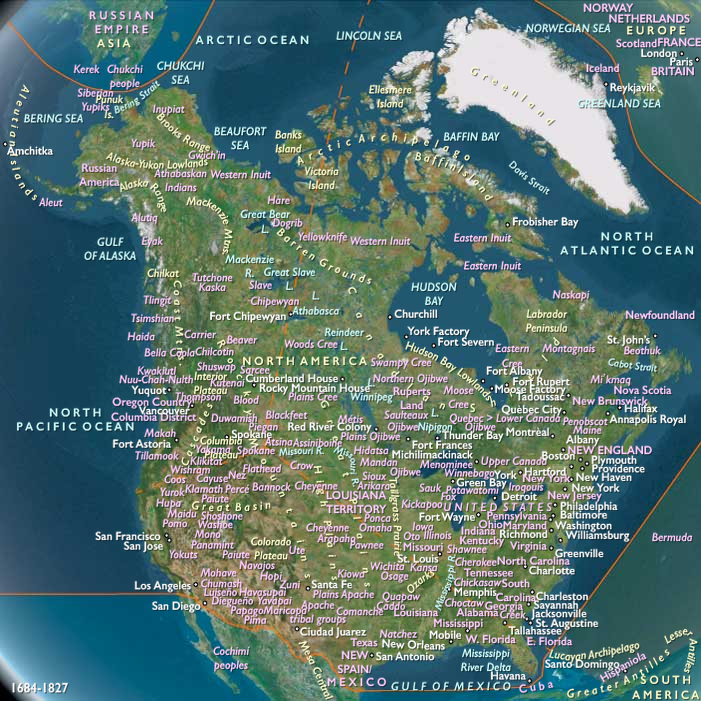
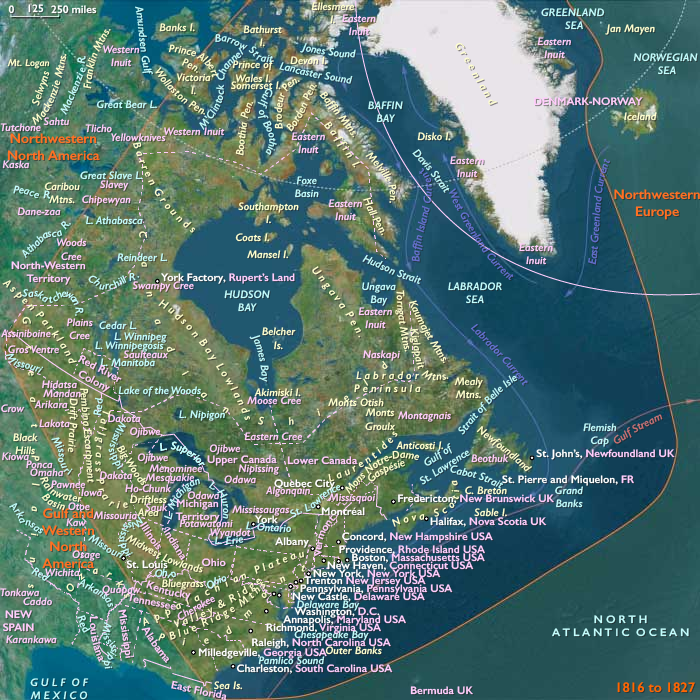
The 1783 Treaty of Paris recognizes American independence and cedes the newly added territories south (but not north) of the Great Lakes to the new United States.
New Brunswick is split from Nova Scotia as part of a reorganization of Loyalist settlements in the Maritimes.
To accommodate English-speaking Loyalists in Quebec, the Constitutional Act of 1791 divides the province into French-speaking Lower Canada (later Quebec) and English-speaking Upper Canada (later Ontario), granting each its own elected legislative assembly.
New Brunswick is split from Nova Scotia as part of a reorganization of Loyalist settlements in the Maritimes.
To accommodate English-speaking Loyalists in Quebec, the Constitutional Act of 1791 divides the province into French-speaking Lower Canada (later Quebec) and English-speaking Upper Canada (later Ontario), granting each its own elected legislative assembly.
Groups
- Iroquois (Haudenosaunee, also known as the League of Peace and Power, Five Nations, or Six Nations)
- French people (Latins)
- English people
- New France (French Colony)
- France, (Bourbon) Kingdom of
- French Canadians
- Newfoundland (English Colony)
- Acadia, (restored) French colony of
- British people
- Britain, Kingdom of Great
- Nova Scotia (British Colony)
- Quebec (British Province)
- British North America
- United States of America (US, USA) (Philadelphia PA)
- New Brunswick, British colony of
- Canada, Lower, (British province)
- Canada, Upper, (British province)
- Prince Edward Island (British colony)
Topics
Subjects
Regions
Subregions
Years: 1684 - 1827
Groups
- Iroquois (Haudenosaunee, also known as the League of Peace and Power, Five Nations, or Six Nations)
- French people (Latins)
- English people
- New France (French Colony)
- France, (Bourbon) Kingdom of
- French Canadians
- Newfoundland (English Colony)
- Acadia, (restored) French colony of
- British people
- Britain, Kingdom of Great
- Nova Scotia (British Colony)
- Quebec (British Province)
- British North America
- United States of America (US, USA) (Philadelphia PA)
- New Brunswick, British colony of
- Canada, Lower, (British province)
- Canada, Upper, (British province)
- Prince Edward Island (British colony)
Topics
Subjects
Regions
Subregions