The royal faction, after a month's fighting, …
Years: 822 - 822
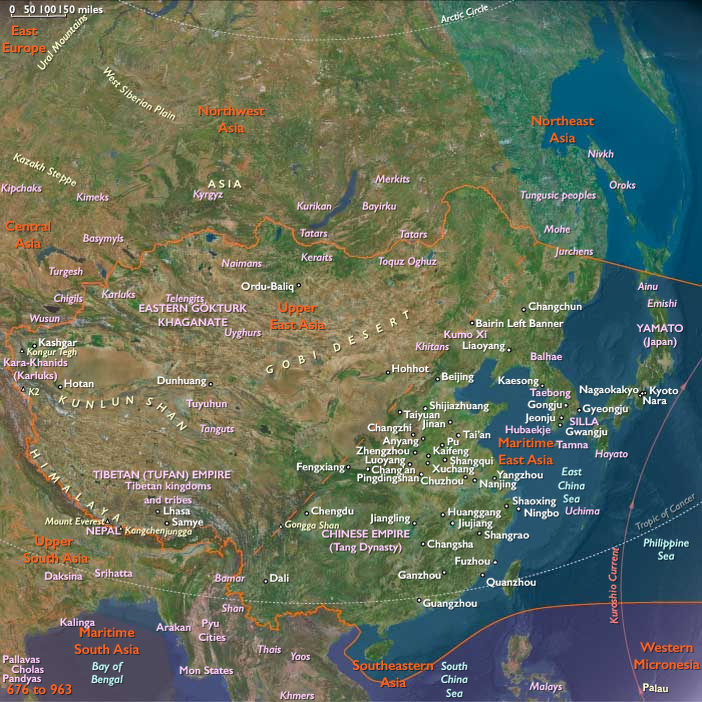
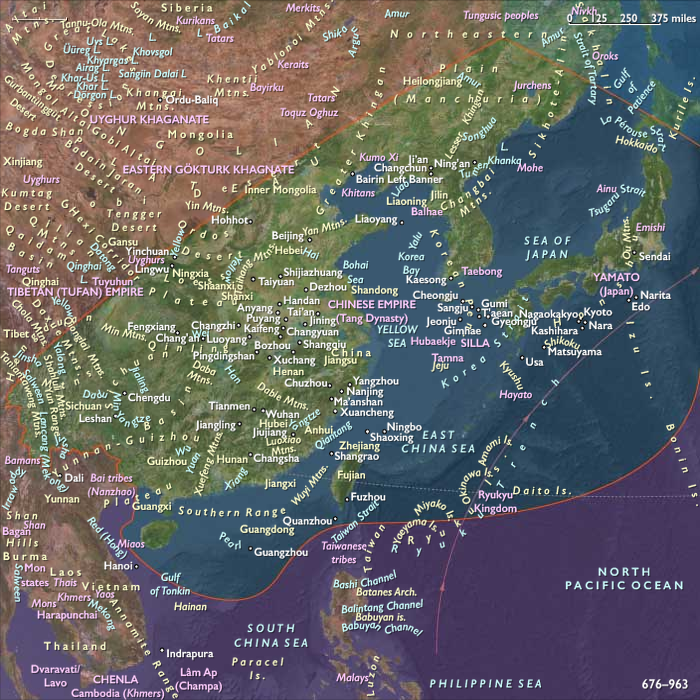
The royal faction, after a month's fighting, is in 822 able to regain much of the territory that Kim Heon-chang's forces had taken.
After the fall of Gongju, which had been the center of the rebellion, Kim Heon-chang takes his own life.
Locations
People
Groups
Topics
Commodoties
Subjects
Regions
Subregions
Related Events
Filter results
Showing 10 events out of 54430 total
Caliph Al-Ma'mun, showing himself to be a judicious sovereign, closely controls his ministers and does not again appoint an all-powerful vizier.
He also tries to maintain strict control over the provincial governors but is forced to allow a relative degree of autonomy to his former general, Tahir, who had been named governor of Khurasan.
He rules independently of Baghdad, not even mentioning the caliph's name in Friday prayers in recognition of caliphal authority.
Thomas unsuccessfully attacks Constantinople, while his fleet is destroyed by Michael's navy using Greek fire.
His army unable to breach the walls of the great city, Thomas is forced to retreat due to weather and a Bulgar army attacking him.
The many tribes—Danes, Obotrites, Slovenes, Bretons, Basques—that inhabit the frontier lands at the start of the reign of Louis the German over Eastern Francia had remained in awe at the power of the Frankish emperor and dared not stir up any trouble.
The Sorbs in 818 had rebelled, however, and had been quickly followed by Slavomir, chief of the Obotrites, who had been captured and abandoned by his own people, being replaced in 818 by Ceadrag.
Soon, Ceadrag too had turned against the Franks and allied with the Danes, who will shortly become the greatest menace of the Franks.
A greater Slavic menace is gathering on the southeast, where, Ljudevit Posavski, the Croat Prince of Savia from about 810, is harassing the border at the Drava and Sava rivers.
As the ruler of the Pannonian Croats, his successful resistance of Frankish domination is an important precursor to the eventual unification of Croatian duchies in Dalmatia and Pannonia into the Kingdom of Croatia.
The margrave of Friuli, Cadolah, had been sent out against him, but he had died on campaign and in 820 his margarvate had been invaded by Slovenes.
An alliance had been made in 821 with Borna, duke of Dalmatia, and in 822 Ljudevit is brought to heel.
After being forced to flee, Ljudevit becomes a ruler over the Serbs, maintaining close ties with the Carantanians and Timokians (the Slavs, or Vlachs, in the Timok River valley).

Abd ar-Rahman II, who succeeds his father, al-Hakam I, as Emir of Córdoba in 822, will spend much of his thirty-year reign in nearly continuous warfare against Alfonso II of Asturias.
The Tragic Fate of Bernard of Italy and Emperor Louis the Pious’ Penance (810–822)
In 810, Bernard, the illegitimate son of King Pepin, Charlemagne’s third son, is appointed King of Italy, ruling as a vassal to the Carolingian Emperor. However, after Charlemagne’s death in 814, his successor, Louis the Pious, restructures the empire, prioritizing his own legitimate sons.
Bernard’s Rebellion and the Aftermath (817–818)
- In 817, Louis issues the Ordinatio Imperii, a succession plan that grants Italy to his eldest son, Lothair I, effectively disinheriting Bernard.
- Feeling his position endangered, Bernard rebels with the support of Bishop Theodulf of Orléans, fearing loss of autonomy under Lothair’s rule.
- Louis, acting swiftly, marches into Italy, forcing Bernard to submit.
- Bernard, trusting a safe-conduct guarantee, meets with the emperor but finds himself convicted without realizing he was on trial.
The Blinding and Death of Bernard (818)
- Louis orders Bernard blinded, a common Byzantine-inspired punishment meant to disable political rivals without executing them outright.
- The blinding procedure proves fatal, and Bernard dies in Milan soon after.
- This event deeply grieves Louis, who, as a devout Christian, recognizes the cruelty of his actions.
Louis the Pious’ Penance at Attigny (822)
Tormented by guilt, Louis performs public penance at his palace in Attigny, near Vouziers in the Ardennes, before:
- Pope Paschal I,
- A council of ecclesiastics, and
- The Frankish nobility.
As part of his atonement, he reconciles with Bernard’s three younger half-brothers:
- Hugo, later Abbot of St-Quentin,
- Drogo, soon made Bishop of Metz,
- Theodoric, whose career remains less well-documented.
The Political Consequences of Penance
Louis’ act of contrition, modeled after Theodosius the Great’s penance after the Massacre of Thessalonica (390), severely undermines his prestige as emperor:
- Frankish rulers were expected to be strong and decisive, not to confess their failures publicly.
- His humility is perceived as weakness, emboldening his sons and noble factions to challenge his authority.
- His public admission of minor offenses, unnecessary for a secular ruler, further damages his reputation among the aristocracy.
The Long-Term Impact
Louis’ penance at Attigny contributes to the later revolts against his rule, as dynastic strife and noble resistance weaken his hold on the empire. The event symbolizes the increasing power of the Church over secular rulers, foreshadowing future conflicts between emperors and religious authorities in medieval Europe.
Rabanus Maurus, a Frankish Benedictine monk born of noble parents in Mainz, had in 822 become abbot of the Monastery at Fulda.
The author of the encyclopaedia On the Nature of Things, he has also written treatises on education and grammar and commentaries on the Bible; he will be remembered as one of the most prominent teachers and writers of the Carolingian age.
The name Frankfurt first appears in writing in the year 794, when a letter from the Emperor to the bishop of Toledo contained "in loco celebri, qui dicitur Franconofurd," which reads "that famous place, which is called Frankfurt."
Emperor Louis makes the city of Frankfurt-am-Main his headquarters, and has a large palace erected there in 822. (Today a European banking metropolis, Frankfurt is the largest city in the German state of Hesse and the fifth-largest city in Germany.)
Michael, assisted by Omurtag and relying upon the defenses of Constantinople, succeeds in suppressing the revolt of Thomas the Slav at the end of 823, dealing Thomas a final defeat at Diabasis in Thrace.
Thomas and his supporters flee to Arcadiopolis, where they are blockaded by imperial troops.
After five months, Thomas is surrendered to Michael by his supporters and executed.
However, the revolt has so weakened the resources of the empire that it will be unable to resist later Arab onslaughts.
The episode suggests the tensions beneath the surface of society within the empire: the social malaise, the ethnic hostility, and the persisting discord created by Iconoclasm.
Emperor Louis, returning in 818 from a campaign to Brittany, had been greeted by news of the death of his wife, Ermengarde, the daughter of Ingerman, the duke of Hesbaye.
Louis had been close to his wife, who had been involved in policymaking.
It is rumored that she had played a part in the death of her nephew Bernard and Louis himself believes her own death is divine retribution for that event.
It had taken many months for his courtiers and advisors to persuade him to remarry, but eventually he did, in 820, to Judith of Bavaria, daughter of Welf, count of Altdorf.
Judith in 823 gives birth to a son, who is named Charles.
The birth of this son damages the Partition of Aachen, as Louis's attempts to provide for his fourth son will eventually met with stiff resistance from his older sons, and the last two decades of his reign will be marked by civil war.
Heondeok of Silla, troubled by threats from the north in 824, orders three hundred-ri-long wall built near the Taedong River, which is at this time the country's northern border.