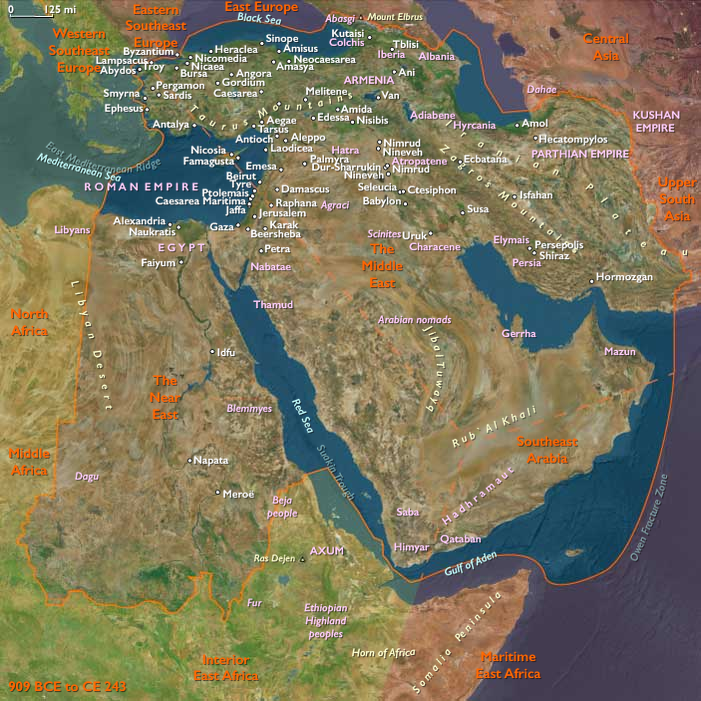
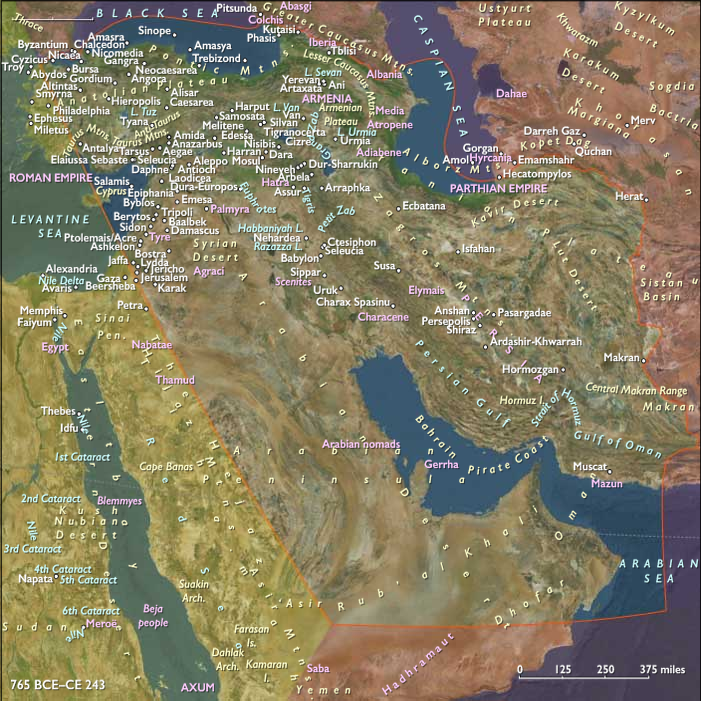
The royal dominions of Pontus had been …
Years: 104BCE - 104BCE
The royal dominions of Pontus had been considerably diminished after the death of Mithridates V: Paphlagonia had freed itself, and Phrygia had been linked to the Roman province of Asia around 116.
Pontine monarch Mithridates VI, moving carefully to avoid unduly provoking Rome, has, by 104, occupied …
Locations
People
Groups
Topics
Subjects
Regions
Subregions
Related Events
Filter results
Showing 10 events out of 15 total
Baldomero Espartero has proven a disappointment to the radical progresistas, who now ally with his conservative opponents under his military and political rival, Ramón María Narváez.
In a pronunciamiento led by Generals Narváez, Juan Prim and Francisco Serrano, an alliance of Moderates, Progressives, and Republicans moves against Espartero.
Narváez, representing the new alliance, seizes Madrid on July 15, obliging Espartero to flee to England.
Narváez is asked to form a government under Isabella II, who, thirteen years old on October 10, 1843, is declared of age, and Narváez becomes Lieutenant General of the Kingdom, inaugurating what will be known as the Moderate Era.
The Revolution of 1868 and the Fall of Isabella II
In 1868, a Spanish army revolt, led by exiled officers determined to depose Isabella II, set the stage for one of the most turbulent political periods in Spain’s history. The uprising brought General Juan Prim, a military hero and popular Progressive leader, to power, effectively ending Isabella’s reign.
Faced with widespread opposition and the collapse of her support base, Isabella abdicated, marking the beginning of a political experiment that cycled through multiple forms of government:
- A Liberal Monarchy (1870–1873) – The search for a new monarch led to the ill-fated reign of Amadeo I of Savoy, whose foreign origins and lack of political backing led to his swift abdication.
- A Federal Republic (1873–1874) – Attempting to decentralize power, Spain briefly became a republic, but internal divisions and regional uprisings rendered it ungovernable.
- A Military Dictatorship (1874–1875) – As instability spiraled, the army intervened once again, paving the way for the Bourbon Restoration under Alfonso XII in 1875.
The Revolution of 1868 not only ended Isabella’s rule but also exposed the deep fractures within Spanish society, as the country struggled to find a stable political system before ultimately returning to monarchy.
The Search for a New Monarch and the Short Reign of Amadeo I (1870–1873)
Following the exile of Isabella II, Spanish Prime Minister Juan Prim embarked on a European search for a suitable monarch to lead Spain. His efforts to secure a Hohenzollern candidate briefly ignited an international crisis—the Franco-Prussian War (1870–1871)—before he ultimately settled on Amadeo of Savoy, the son of King Victor Emmanuel II of Italy.
A Doomed Monarchy: Amadeo I’s Struggle for Stability
-
Assassination of Prim and Political Isolation
- Shortly after Amadeo's arrival in Spain, Prim was assassinated, leaving the inexperienced king without a mentor and vulnerable to political intrigue.
- Spanish factional leaders, deeply mistrustful of a foreign monarch, refused to cooperate or offer guidance, further isolating Amadeo.
-
A Constitution That Weakened the Monarchy
- The constitution inherited by Amadeo granted him insufficient authority to supervise the formation of a stable government.
- Political divisions and shifting alliances made governance virtually impossible, as Spain remained in a state of chronic instability.
-
Abdication and the Fall of the Monarchy
- Abandoned even by the army, Amadeo abdicated in 1873, leaving a powerless parliament to declare Spain a federal republic.
The brief and tumultuous reign of Amadeo I (1870–1873) underscored Spain’s deep political fractures, as neither a constitutional monarchy nor a parliamentary system could provide lasting stability. His abdication paved the way for the short-lived First Spanish Republic (1873–1874), a government that would soon succumb to military intervention and monarchical restoration.
Spain's progressive politicians, who had feared losing their left wing to the Democrats, are now excluded from power by the government of Isabella II.
The queen had taken a more active role in government after coming of age, but she is immensely unpopular throughout her reign.
She is viewed as beholden to whoever is closest to her at court, and the people of Spain believe hat she cares little for them.
As a result, there had been a fourth bourgeois revolutionary insurrection in 1854, led by General Domingo Dulce y Garay and General Leopoldo O'Donnell y Jarris.
Their coup had overthrown the dictatorship of Luis Jose Sartorius, 1st Count of San Luis.
As the result of the popular insurrection, the Partido Progresista (Progressive Party) had obtained widespread support in Spain and had come to power in the government in 1854.
In 1856, Isabella had attempted to form the Union Liberal Party, a pan-national coalition under the leadership of Leopoldo O'Donnell, who had already marched on Madrid that year and deposed another Espartero ministry.
Isabella's plan had failed and cost Isabella more prestige and favor with the people.
In 1860, Isabella launched a successful war against Morocco, waged by generals O'Donnell and Juan Prim y Prats, that had stabilized her popularity in Spain.
Prim, (a pharmacist's grandson and a striking example of the social mobility of the liberal army) had been the only member of the Progressive Party elected to the Cortes in 1857.
He had distinguished himself in the war between Spain and Morocco (1859-60) and in 1861 had been appointed to command the joint English, French, and Spanish expedition to Mexico.
Upon his return to Spain, Prim had resumed his political career and, as one of the leaders of the Progressive Party, opposes Isabella.
When Isabella's court ministers alienate Prime Minister O'Donnell's followers, a powerful coalition forms, and Prim drops his alliance with the Democrats.
General Ramón María Narváez, supported by reactionaries, returns briefly as premier.

Censorship is restored in Spain and political clubs dissolved, forcing the Progressives to withdraw formally from political life and to contemplate a revolution led by their “sword”, General Prim.
Leopoldo O'Donnell, having resumed office as Spanish premier in 1865, had at first attempted a conciliatory policy but in 1866 has to suppress two insurrections led by Juan Prim, who is driven into exile.
Queen Isabella again replaces O'Donnell with the more repressive Ramón María Narváez.
Liberal army oligarchs led by Marshal Francisco Serrano and Progressive conspirators behind Juna Prim plot revolution in Spain.
Isabella II has spent the past twenty-five years attempting to impose despotic rule on an increasingly liberal-minded nation.
During Spain’s Moderate Era, which began with Isabella’s majority in 1843, several military men have become prominent in party leadership positions and the government has adopted three more constitutions.
Socialist ideas have begun to circulate and peasant anarchism has begun to attract adherents.
O'Donnell's death on November 6, 1867, in Biarritz had deprived Isabella of one of her strongest allies.
Ramón María Narváez, another of Isabella's staunchest supporters, dies on April 23.
The agreements made by Liberals and republican exiles abroad at Ostend in 1866 and Brussels in 1867 have laid the framework for a major uprising, this time not merely to replace the Prime Minister with a Liberal, but to overthrow Isabella herself, whom Spanish liberals and republicans have begun to see as the source of Spain's inefficacy.
Her continual vacillation between liberal and conservative quarters has, by 1868, outraged the moderates, the progressives and the members of the Unión Liberal, and enabled a front that crosses party lines.
Leopoldo O'Donnell's death in 1867 had caused the Unión Liberal to unravel; many of its supporters, who had crossed party lines to create the party initially, join he growing movement to overthrow Isabella in favor of a more effective regime.
Naval forces under Admiral Juan Bautista Topete mutiny on September 18 in Cadiz, the same place that Rafael del Riego had launched his coup against Queen Isabella's father a half-century before.
A slump caused by bad harvests, the series of mediocre ultraconservative governments, and a growth in democratic agitation among university intellectuals (whose main concern is the hold of the church over education) gives wide support to the military rising against Isabella, which rapidly spreads throughout Spain.
Prime Minister Luis González Bravo is one of the few politicians who have remained consistently faithful to Queen Isabella II throughout her ruling years, standing by her from the beginning of her effective monarchy, to the very last days of her reign in 1868.
In September 1868, however, upon facing the first battle of the revolution, he advises the Queen to substitute him in the country's presidency for an experienced army general as Prime Minister, to better fight the ready to strike armed forces organized against her government.
Generals Juan Prim and Francisco Serrano denounce the government and much of the army defects to the revolutionary generals on their arrival in Spain.
The queen makes a brief show of force at the Battle of Alcolea, where her loyal moderado generals under Manuel Pavia are defeated by General Serrano on September 28.
Juan Prim reenters the country in triumph.
Isabella, whose armies will no longer defend her, flees to France and is declared deposed on September 29, ending Spain’s Moderate Era.
Her eldest surviving son, the eleven-year-old Alfonso, whose presumed father is her consort, the Duque de Cádiz, accompanies his mother into exile.
She retires from Spanish politics to Paris, whence she will she formally abdicate on June 25, 1870, and where she will remain until her death in 1904.