
…the royal Abyssinian court at Axum, where …
Years: 330 - 330
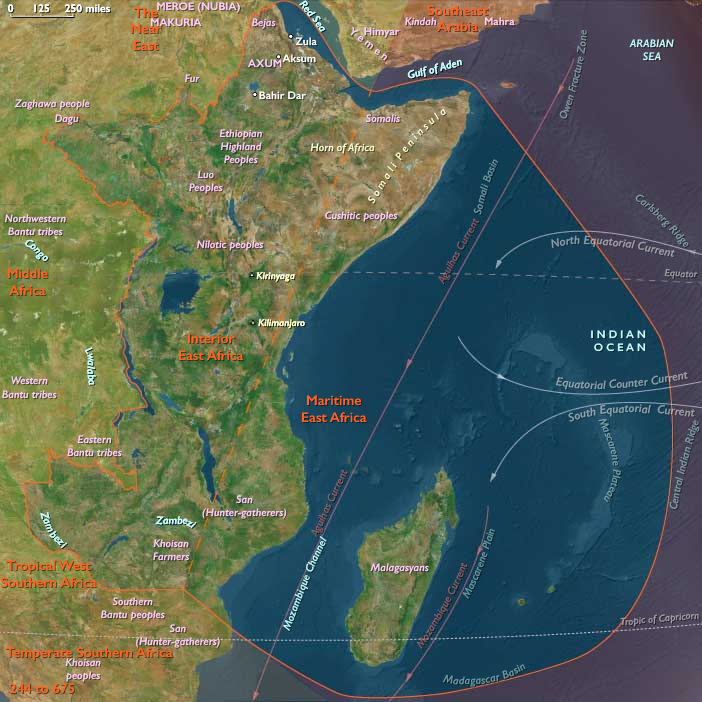
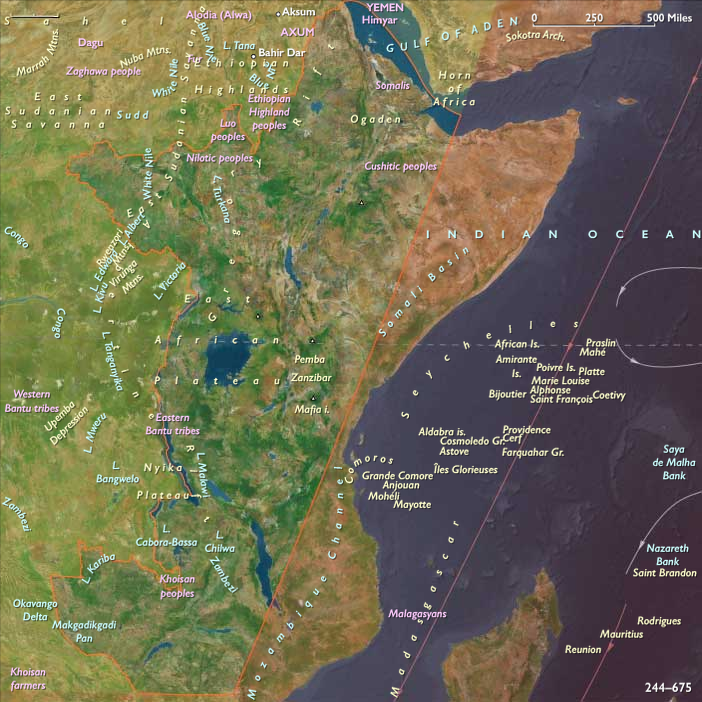
…the royal Abyssinian court at Axum, where they commence missionary activities; they eventually become court officials (The church later canonizes both; Saint Frumentius is called the Apostle of the Abyssinians).
The Ethiopian royal court embraces Coptic, or Egyptian Monophysite, Christianity in 330, thus becoming both politically and religiously linked to Roman Egypt.
At the same time, the Axumites extend their authority into southern Arabia.
Locations
Groups
- Aksum (or Axum), Kingdom of
- Christianity, Arian
- Christianity, Nicene
- Roman Empire: Constantinian dynasty (Constantinople)
Topics
Subjects
Regions
Subregions
Related Events
Filter results
Showing 10 events out of 59879 total
Constantine had decided, after his defeat of Licinius at Chrysopolis, to make nearby Byzantium his capital, and within three weeks of his victory, the foundation rites of New Rome had been performed.
Immediately upon his return from the West, he had begun to rebuild the city on a greatly enlarged pattern, as his permanent capital and the “second Rome.”
The dedication of Constantinople on May 11, 330, confirms the divorce, which has been in the making for more than a century, between the emperors and Rome.
Constantine's interest in church building is expressed also at Constantinople, particularly in churches of the Holy Wisdom (the original Hagia Sophia) and of the Apostles.
The deposed Lakhmid ruler Imru' al-Qais had escaped to Bahrain and then to Syria, seeking the promised assistance from the Romans, which never materializes.
Remaining there until he dies, he is entombed at al-Nimarah in the Syrian desert.
His funerary inscription claims the title "King of all the Arabs" and states that he had campaigned successfully over the entire north and center of the Arabian Peninsula, as far as the border of Najran.
Two years after his death, in the year 330, a revolt takes place in which the ruler, Aus ibn Qallam, a puppet of the Persians, killed and succeeded by 'Amr, the son of Imru' al-Qais.
Eustathius of Antioch, a native of Side in Pamphylia, had been bishop of Beroea from around 320, and had become patriarch of Antioch shortly before the Council of Nicaea in 325.
In that assembly he had distinguished himself zealously against the Arians, but his anti–Arian polemic against Bishop Eusebius of Caesarea have made him unpopular among his fellow bishops in the East.
Eustathius opposes the growing influence of Origen and his practice of an allegorical exegesis of scripture, seeing in his theology the roots of Arianism.
Having reproached Eusebius for deviating from the Nicene faith, Eustathius is in turn charged with Sabellianism, and a synod convened at Antioch in 330 accuses him, condemns him, and passes a sentence of deposition, which is confirmed by the emperor.
The people of Antioch rebel against this action, while the anti-Eustathians propose Eusebius as the new bishop, but he declines.
The Axumite Red Sea port of Adulis had been described in the anonymous Greek travel book Periplus Maris Erythraei, written in the first century CE, as an “open harbor” containing a settlement of Greco-Roman merchants.
It is through such communities, established for the purposes of trade, that the Monophysite Christianity of the eastern Mediterranean reaches Ethiopia during the reign of Emperor Ezanas.
According to tradition, Frumentius, a Christian youth of Tyre, is attacked and shipwrecked with a companion, Aedesius, on the Ethiopian coast.
The two are taken as captives to …
Constantine lavishly endows Rome's great church of St. Peter, begun in the later 320s, with plate and property.
Churches at Trier, Aquileia, Cirta in Numidia, Nicomedia, Antioch, Gaza, Alexandria, and elsewhere owe their development, directly or indirectly, to Constantine's interest.
Rome has long been unsuited to the strategic needs of the empire: it is now to be left in splendid isolation, as an enormously wealthy and prestigious city—still the emotional focus of the empire—but of limited political importance.
Italy's administrative autonomy is lost shortly after Constantine’s transfer of the imperial capital from Rome to Constantinople, when two dioceses are joined with that of Africa to form a single prefecture.
The route of the Oregon Trail, one of the main overland migration routes on the North American continent, had begun to be scouted out as early as 1823 by fur traders and explorers.
The trail has begun to be regularly used by fur traders, missionaries, and military expeditions in the 1830s
At the same time, small groups of individuals and the occasional family have attempted to follow the trail, and some have succeeded in arriving at Fort Vancouver in Washington.
On May 1, 1839, a group of men from Peoria, Illinois, sets out with the intention to colonize the Oregon Country on behalf of the United States of America and drive out the British fur trading companies operating there.
The men of the Peoria Party, who are among the first pioneers to blaze the Oregon Trail, are led by Thomas J. Farnham and call themselves the Oregon Dragoons.
They carry a large flag emblazoned with their motto "OREGON OR THE GRAVE.”
Although the group will split up on the trail, several of their members will reach the Oregon Country to become among the prominent early pioneers of this region.
Constantine had decided in 324 to move the seat of the government from Rome to Byzantium, which he had renamed Nova Roma (New Rome).
This name failed to impress and the city had soon become known as Constantinople, the City of Constantine.
Constantine has greatly enlarged the city, and one of his major undertakings has been the renovation of the Hippodrome.
It is estimated that the Hippodrome of Constantine was about four hundred and fifty meters long and one hundred and thirty meters wide; its stands capable of holding one hundred thousand spectators.
To raise the image of his new capital, Constantine has brought works of art from all over the empire to adorn it, as will his successors.
Among these is the Tripod of Plataea, now known as the Serpent Column, cast to celebrate the victory of the Greeks over the Persians during the Persian Wars in the fifth century BCE.
Constantine orders the Tripod to be moved from the Temple of Apollo at Delphi, and set in middle of the Hippodrome.
The top is adorned with a golden bowl supported by three serpent heads.
(The bowl will be destroyed or stolen during the Fourth Crusade.
The serpent heads will be destroyed as late as the end of the seventeenth century, as many Ottoman miniatures show they were intact in the early centuries following the Turkish conquest of the city.
Parts of the heads were recovered and are displayed at the Istanbul Archaeology Museum.
All that remains of the Delphi Tripod today is the base, known as the "Serpentine Column".)
The Sarmatians, having settled in Dacia, find themselves increasingly pressured by Gothic intruders and other tribes.
Answering their appeal for help, Emperor Constantine dispatches his eldest son at the head of a force that crosses the Danube and joins the Sarmatians to rout the Goths and their allies in 332—33.
The ungrateful Sarmatians, having used Rome to dispatch the Goths, begin to raid across the border into the Roman Empire.
Constantine, therefore, encourages the Goths to crush the Sarmatians, doing nothing this time to aid them.
After the Goths overwhelm the Sarmatians, who, he allows about three hundred thousand survivors to settle within the empire.
Constantine proclaims his fourth (or fifth) son Constans a caesar in 333.
The Vatican Hill’s huge Basilica of Saint Peter, dedicated by Constantine in about 333, is the first church designed expressly for the Christian liturgical emphasis on the altar as the site for the Christian sacrifice (communion).
Christian Basilicas of the period, closely modeled after the Roman basilica, or civil assembly hall, are typically fronted by a square atrium, or forecourt (reserved for penitents prohibited from entering the church itself) and a narthex (porch) leading to the nave, crossed by a transept (transverse aisle) that separated the nave from the apse, wherein lies the sanctuary.
The semicircular apse of Saint Peter’s Basilica marks the tomb of Peter, over which rises the high altar.
The basilicas’ cruciform plan provides for the worshiper a powerful longitudinal perspective focused on the altar, reinforced by rows of aisle columns.
Sylvester, pope from 314 to 335, is held by Christian tradition to have established the first schola cantorum (literally, "choir school") in Rome; among the first Christian chants are the psalms used in worship, sung in response as two choirs, or as a priest and congregation sing alternate verses.
Years: 330 - 330
Locations
Groups
- Aksum (or Axum), Kingdom of
- Christianity, Arian
- Christianity, Nicene
- Roman Empire: Constantinian dynasty (Constantinople)
