
The Romans under Trajan add parts of …
Years: 111 - 111
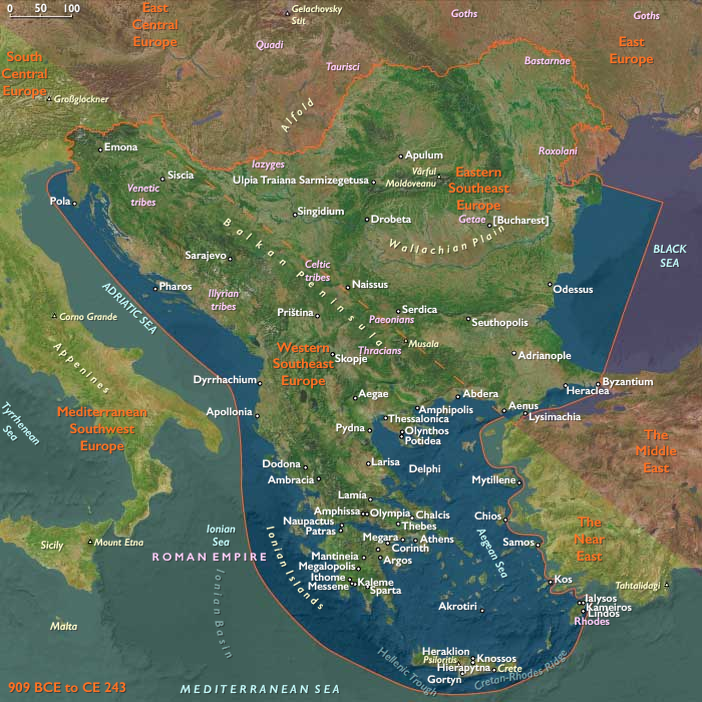
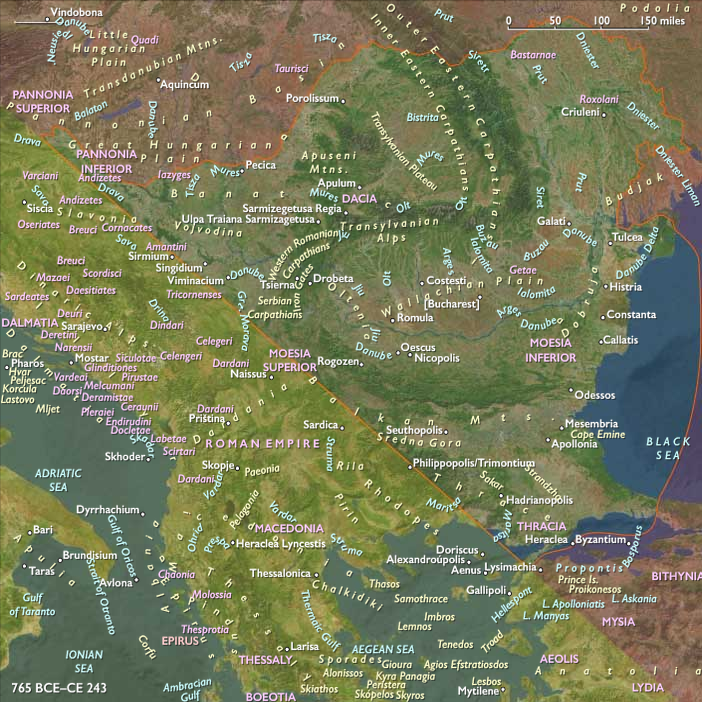
The Romans under Trajan add parts of present Romania to Moesia Inferior.
Because Moesia is a frontier region, the area must be garrisoned by Roman troops, whose legionary camps are built along the Danube River.
Several Greek cities spring up near the mouth of the Danube, and the other principal cities of Moesia grow out of the legionary camps along the Danube; these, too, have sizable Greek elements in their population, given the predominantly Greek composition of the legions here.
Locations
People
Groups
- Dacians, or Getae, or Geto-Dacians
- Greeks, Hellenistic
- Moesia Inferior (Roman province)
- Roman Empire (Rome): Nerva-Antonine dynasty
- Dacia, Roman
Topics
Commodoties
Subjects
Regions
Subregions
Related Events
Filter results
Showing 10 events out of 61264 total
Gaius (or Caius) Plinius Caecilius Secundus, better known as Pliny the Younger, is a remarkable writer.
A maternal nephew of the celebrated author and naturalist Pliny the Elder, he has served the empire as consul (with Cornutus Tertullus, in 100), Propraetor of Bithynia from 103, publicly elected Augur in 103-104, Superintendent for the banks of the Tiber (curator alvei Tiberis) in 104-106, been three times a member of Trajan's judicial council from 104 to 107, and had been made the Emperor's ambassador (legatus Augusti) in Bithynia-Pontus in 110.
Pliny is over fifty in 111 when he becomes governor of Bithynia.
The only oration of Pliny’s that now survives is the Panegyricus Trajani.
Pronounced in the Senate in 100, it is a description of Trajan's figure and actions in an adulatory and emphatic form, especially contrasting him with the much-detested Emperor Domitian.
The largest body of Pliny’s surviving work is his Letters (Epistulae), a series of personal missives directed to his friends and associates.
These letters are a unique testimony of Roman administrative history and everyday life in the first century.
The style is very different from that in the Panegyricus and some commentators affirm that Pliny is the initiator of a new particular genre: the letter written for publication.
In one, not written until 112, he asks the Emperor for instructions over the policy to follow with the Christians; in another, he describes the eruption of the Vesuvius that interred his uncle and to which he attended when he was eighteen years old.
The Epistulae are usually treated as two halves: those in Books 1 to 9, which Pliny had prepared for publication between 100 and 109, and those in Book 10, all of which are written to or by the Emperor Trajan during Pliny's governorship of Bithynia-Pontus, which position he will hold until his sudden death in 113.
This final book is, significantly, not intended for publication.
Trajan has ruled as a civilian emperor in the years since the final Dacian campaign, to the same acclaim as before.
One of his notable acts is the sponsorship of a three-month gladiatorial festival in the great Colosseum in Rome (the precise date of this festival is unknown).
Combining chariot racing, beast fights and close-quarters gladiatorial bloodshed, this gory spectacle reputedly leaves eleven thousand dead (mostly slaves and criminals, plus the thousands of beasts killed alongside them) and attracts a total of five million spectators over the course of the festival.
It is during this time that he corresponds with Pliny the Younger on the subject of how to deal with the Christians of Pontus, telling Pliny to leave them alone unless they are openly practicing the religion.
He builds several new buildings, monuments and roads in Italia and his native Hispania.
His magnificent complex in Rome raised to commemorate his victories in Dacia (and largely financed from that campaign's loot)—consisting of a forum, Trajan's Column, and a shopping center—still stands in Rome today.
He is also a prolific builder of triumphal arches, many of which survive, and rebuilder of roads (Via Traiana and Via Traiana Nova).
Hadrian’s Military Strategy and Defensive Policies (117–138 CE)
Unlike his predecessor Trajan, who pursued an expansionist policy, Emperor Hadrian (r. 117–138 CE) took a more defensive approach to Rome’s frontiers. He renounced most of Trajan’s eastern conquests, making no attempt to reclaim Parthian territories briefly occupied by Roman forces. However, he retained the province of Dacia, recognizing its strategic and economic importance.
Hadrian’s Defensive Strategy and Military Reforms
Hadrian’s "peace through strength" policy focused on fortifying Rome’s borders (limites) rather than expanding them.
1. Hadrian’s Wall: Defending Britain’s Northern Frontier
- The most famous of Hadrian’s defensive projects was Hadrian’s Wall in Britain, constructed to mark the empire’s northernmost boundary.
- Built around 122 CE, it stretched 73 miles (117 km) across northern England, featuring:
- Stone walls and ditches to prevent incursions.
- Forts and milecastles housing Roman garrisons.
- Watchtowers and roads for rapid communication.
2. Strengthening the Danube and Rhine Frontiers
- In continental Europe, Hadrian reinforced the Danube and Rhine borders, constructing:
- Fortified camps and wooden palisades to control movement.
- Outposts and watchtowers for early warning and security.
- Improved communication networks to facilitate troop movements.
3. Military Discipline and Readiness
- Hadrian was deeply involved in military affairs, frequently touring the provinces to inspect Rome’s legions.
- He implemented:
- Rigorous drill routines to maintain discipline.
- Strategic deployments to respond quickly to threats.
- Reforms ensuring better training, supply chains, and troop welfare.
Hadrian’s Military Image and Propaganda
Despite his defensive policies, Hadrian projected an image of military strength and preparedness:
- His imperial coinage often depicted:
- Victorious soldiers to symbolize Rome’s military power.
- Fortified cities and provinces, reinforcing his commitment to defense.
- Images of Hadrian in military attire, maintaining his connection with the army.
Hadrian’s approach balanced military pragmatism with imperial propaganda, ensuring that Rome remained secure without overextending itself.
The Legacy of Hadrian’s Defensive Policies
- His fortifications and strategic reforms helped stabilize Rome’s borders for much of the 2nd century CE.
- His policy of consolidation rather than expansion marked a shift in imperial military doctrine, influencing later emperors.
- Hadrian’s Wall and other fortifications became enduring symbols of Roman engineering and military organization.
By prioritizing defense and stability over conquest, Hadrian preserved the strength of the Roman Empire, ensuring that it remained resilient in an era of growing external threats.
The Reign of Trajan (98–117 CE): Expansion, Administration, and Legacy
Emperor Trajan, renowned for his military prowess and administrative reforms, pursued an aggressive expansionist policy, extending Rome’s borders to their greatest extent. At the same time, he enacted progressive domestic policies, particularly benefiting the provinces and lower classes.
1. Military Expansion: Conquering Beyond the Danube
- Trajan led successful campaigns north of the Danube, creating the new province of Dacia (106 CE).
- The Dacian Wars (101–102, 105–106 CE) brought vast gold and silver resources into the Roman economy, enriching the empire.
- His eastern campaigns secured Armenia, Mesopotamia, and parts of Parthia, pushing Roman control deeper into the Near East than ever before.
2. Administrative Reforms and Support for the Provinces
A provincial himself, Trajan prioritized provincial interests, enacting policies to lower tax burdens and elevating provincial elites to high-ranking imperial positions.
- His governance fostered stronger ties between Rome and its provinces, ensuring greater political and economic stability.
- He invested heavily in infrastructure, building roads, bridges, aqueducts, and public buildings, particularly in Italy and the provinces.
3. The Alimenta: Social Welfare for Impoverished Children
- Trajan introduced the alimenta, a state-funded program providing financial aid to poor children, particularly in rural areas.
- This initiative strengthened the population base, ensuring a stable labor force and future military recruits.
- His philanthropic policies earned him widespread admiration, reinforcing his reputation as an emperor who cared for his people.
4. The Persecution of Christians
- Despite his progressive domestic policies, Trajan continued the official persecution of Christians.
- At the time, Christianity was still considered a Jewish sect and a potential threat to Roman order.
- His correspondence with Pliny the Younger revealed a policy of moderation: Christians were not to be actively hunted but were punished if they openly refused to worship Roman gods.
5. Trajan’s Death and His Lasting Legacy
- Trajan died in 117 CE after a 19-year reign, leaving behind an empire larger than ever before.
- His conquests in the East were later abandoned by Hadrian, who focused on consolidation rather than expansion.
- Despite this, Trajan’s administrative reforms, military achievements, and public welfare programs ensured his place as one of Rome’s most respected emperors.
His reign was so highly regarded that later emperors were officially wished "more fortunate than Augustus and better than Trajan"—a testament to his enduring legacy as a model ruler of Rome.
East Central Europe (112–123 CE): Economic Prosperity, Germanic Consolidation, and Cultural Integration
Between 112 and 123 CE, East Central Europe—including Poland, Czechia, Slovakia, Hungary, and those portions of Germany and Austria lying east of 10°E and north of a line stretching from roughly 48.2°N at 10°E southeastward to the Austro-Slovenian border near 46.7°N, 15.4°E—continued to benefit from stable conditions along the Roman frontier. Under Emperors Trajan (98–117 CE) and Hadrian (117–138 CE), the Roman provinces of Pannonia and Noricum prospered economically, influencing surrounding Germanic communities. The era saw increased cultural integration, further tribal consolidation, and ongoing technological and economic exchanges, which collectively strengthened regional stability.
Political and Military Developments
Continued Stability of Roman Frontier
-
Under Emperor Hadrian, frontier defenses along the Danube were further fortified and reorganized, reinforcing peace and security in the provinces of Pannonia and Noricum.
-
Diplomatic interactions with Germanic tribes remained generally peaceful, focusing primarily on trade, diplomacy, and mutual benefits rather than conflict.
Germanic Tribal Consolidation
-
The major tribal confederations—particularly the Marcomanni and Quadi—strengthened their territorial control and influence in regions corresponding to modern Czechia, Slovakia, and parts of southern Poland.
-
Tribes like the Langobardi (Lombards), settled mainly north and northeast of the Roman frontier, consolidated their territories and expanded diplomatic and economic contacts with Roman frontier towns.
Economic and Technological Developments
Increased Regional Trade
-
Economic prosperity continued, with intensified trade between Roman provinces and Germanic territories. Roman imports—such as ceramics, glassware, textiles, and metals—exchanged for local products like amber, animal hides, grain, and iron tools.
-
Roman coinage circulated widely, deepening the monetization of trade and local economies.
Agricultural and Metallurgical Advances
-
Germanic groups increasingly adopted Roman agricultural innovations, improving crop yields and livestock productivity.
-
Metallurgy, particularly ironworking, advanced through the adaptation of Roman tools and techniques, strengthening regional economies.
Cultural and Artistic Developments
Deepening Cultural Integration
-
Material culture across East Central Europe increasingly reflected combined Germanic-Roman traditions. Artifacts from this period—ceramics, jewelry, weapons, and household goods—exhibited distinctive blends of Roman and Germanic motifs.
Artistic and Cultural Synthesis
-
Local artisans, influenced by Roman craftsmanship, produced sophisticated metal objects, jewelry, pottery, and weaponry, reflecting an emerging hybrid cultural identity along the Roman frontier.
Settlement and Urban Development
Roman Frontier Towns and Settlements
-
Roman settlements such as Carnuntum and Vindobona continued to flourish as critical administrative, economic, and cultural hubs. These urban centers expanded significantly, serving as markets and meeting places for Roman and Germanic merchants and traders.
Germanic Villages and Agricultural Communities
-
Germanic tribal villages north of the frontier expanded, characterized by larger clusters of timber dwellings, communal agriculture, and specialized craft activities. Stability allowed communities to grow and develop economically and socially.
Social and Religious Developments
Germanic Social Structures and Leadership
-
Tribal societies retained hierarchical structures dominated by warrior elites and chieftains whose authority was reinforced by wealth from trade, military reputation, and political alliances with Roman authorities.
Religious Continuity and Emerging Syncretism
-
Germanic communities maintained traditional religious practices involving nature worship, ancestor veneration, and communal rites. Increasing interactions with Roman culture introduced elements of Roman religious practice, creating early examples of religious syncretism.
Long-Term Consequences and Historical Significance
The era from 112 to 123 CE marked continued stability, economic prosperity, and deepening cultural integration in East Central Europe. Peaceful relations along the Roman frontier fostered economic growth, technological exchange, and further consolidation of Germanic tribes. This stability and cultural synthesis laid essential foundations for subsequent historical developments, particularly influencing regional identities and setting the stage for more complex interactions between Rome and East Central Europe's tribal societies in the following decades.
The Middle East: 112–123 CE
The Second Jewish Revolt and Imperial Turmoil
This era witnesses a significant wave of unrest across the eastern Roman Empire, most dramatically manifested in the Second Jewish Revolt (also known as the Kitos War, 115–117 CE). Sparked by longstanding religious tensions, social unrest, and Roman administrative practices, the revolt erupts violently in regions densely populated by Jews, rapidly engulfing provinces such as Cyrenaica, Alexandria, Judea, Mesopotamia, and Cyprus.
The uprising coincides with the final years of Emperor Trajan and the beginning of Hadrian’s reign, representing one of the bloodiest chapters in Roman–Jewish relations. Initially successful, Jewish rebels unleash devastating attacks, resulting in the slaughter of hundreds of thousands of Greek and Roman citizens. Cities across the eastern Mediterranean, notably Cyrene, Alexandria, and Salamis on Cyprus, suffer catastrophic damage, profoundly destabilizing these once-prosperous urban centers.
Roman retribution is swift and brutal. Under Trajan’s orders and later continued by Hadrian, imperial forces systematically suppress the revolt, killing hundreds of thousands of Jews in reciprocal violence. The devastation significantly alters the demographics and cultural landscapes of affected areas, notably on Cyprus, where Jewish settlement is virtually eradicated, and subsequent restrictions severely limit Jewish presence for generations.
The failure of the revolt also reshapes Rome’s eastern policies, prompting Hadrian to adopt a more cautious administrative and military stance. This recalibration contributes to his later decisions to consolidate rather than expand Rome’s eastern territories, marking a clear departure from Trajan’s expansive ambitions.
Thus, the tumultuous events of 112–123 CE significantly impact Roman–Jewish relations, profoundly affecting the socio-political fabric of the eastern Roman provinces, and influencing imperial policies for decades to come.
The second Jewish revolt, which spans the end of Trajan’s reign and the beginning of Hadrian’s, is a two-year conflict in which hundreds of thousands of Greek and Roman citizens are slaughtered in Cyrenaica, Alexandria, Judea, Mesopotamia, and Cyprus, soon followed by the reciprocal slaughter of hundreds of thousands of Jews.
Kushan ruler Kanishka, who flourishes about 120, builds the city of Sirsukh, located about one mile (1.6 kilometers) northeast of Sirkap, with fortifications that differ markedly from those of Sirkap.
Near East (112–123 CE): Second Jewish Revolt, Roman Repression, and Religious Identity
This era is notably marked by the Second Jewish Revolt, also known as the Kitos War (115–117 CE), which erupts across Jewish communities within the Roman Empire, particularly in Cyrene (Libya), Egypt, Cyprus, and Mesopotamia. Driven by tensions rooted in Roman oppression, religious conflict, and socioeconomic grievances, widespread violence leads to heavy casualties on both sides.
The Roman response under Emperor Trajan is swift and ruthless. Roman forces brutally suppress the revolts, resulting in catastrophic destruction in Jewish population centers. Alexandria sees violent pogroms, and the significant Jewish presence in Cyprus is effectively eradicated, with survivors forbidden to resettle there under penalty of death.
Concurrently, Christianity continues to spread steadily despite these tumultuous events, carefully navigating the volatile landscape shaped by Jewish unrest and Roman suspicion. The movement increasingly defines its theological and communal identity separately from Judaism, creating a more distinctively Gentile-Christian profile.
In Judea, Pharisaic leadership intensifies efforts to stabilize Jewish communities, emphasizing adherence to rabbinical teachings and reinforcing the spiritual and social cohesion necessary to endure Roman oppression. The redaction of traditions that will later become part of the Mishnah proceeds despite political instability.
Legacy of the Era
The years 112–123 CE profoundly reshape Jewish life in the Near East, with devastating human and cultural losses due to the Second Jewish Revolt and its harsh Roman suppression. Meanwhile, the resilience of Judaism and the growing independence of Christianity lay essential foundations for religious identities in the region, deeply influencing future historical developments.
The future emperor Hadrian, quaestor in 101, had served ion 102 as Trajan's companion in the Emperor's first war in Dacia on the Danube.
Hadrian in 105 had become tribune of the plebs and, exceptionally, had advanced in 106 to the praetorship.
No less exceptional than the speed of promotion was Hadrian's service as praetor while in the field with the emperor during his second war in Dacia.
He was in 107 briefly governor of Lower Pannonia.
An admirer of Greek culture who maintains a strong interest in literature and philosophy, Hadrian is pleased to be elected in 112 as archon at Athens, and a surviving inscription commemorating this office is set up in the Theater of Dionysus.
His tenure is a portent of the philhellenism that is to characterize his reign, and it suggests that in a time of political inactivity Hadrian had devoted himself to the nation and culture of his beloved Greeks.
Hadrian's star somehow rises again, however, and before the Emperor dies in 117 he returns to favor.
Years: 111 - 111
Locations
People
Groups
- Dacians, or Getae, or Geto-Dacians
- Greeks, Hellenistic
- Moesia Inferior (Roman province)
- Roman Empire (Rome): Nerva-Antonine dynasty
- Dacia, Roman
