The Romans build a fort at the …
Years: 80 - 80
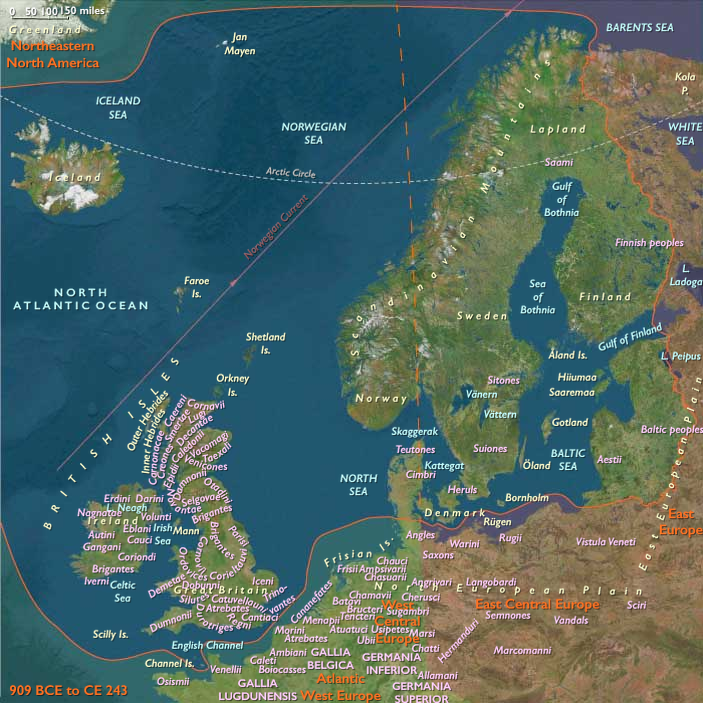
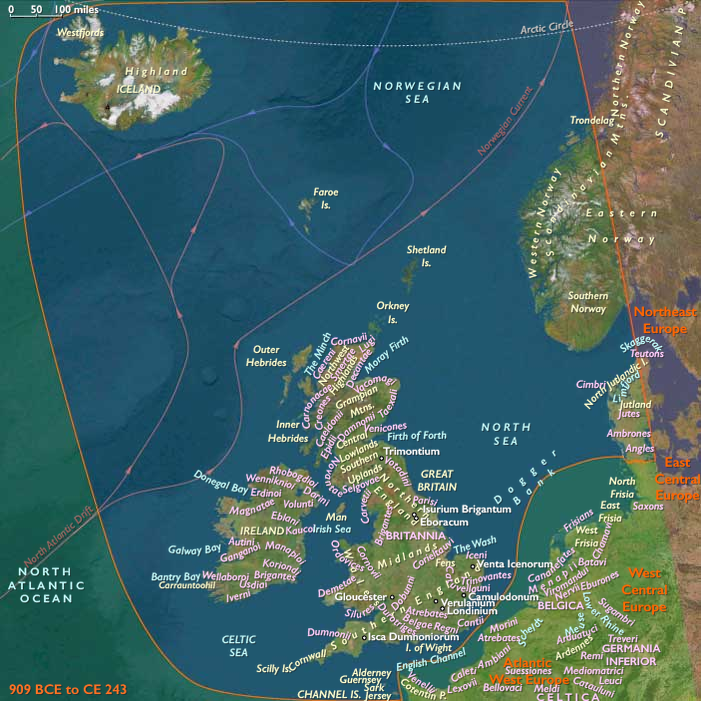
The Romans build a fort at the site of present Caernarfon, a seaport on the Menai Strait in northwestern Wales in about 80.
The Roman fort, called Segontium, is established to aid in the subjugation of the Ordovices as part of the Roman conquest of Britain.
Locations
People
Groups
Topics
- Classical antiquity
- Roman colonization
- Pre-Roman Iron Age of Northern Europe
- Roman Age Optimum
- Pax Romana
- Roman Conquest of Britain
Commodoties
Subjects
Regions
Subregions
Related Events
Filter results
Showing 10 events out of 61515 total
Nero is primarily known as a universally hated tyrant, but there is evidence that for much of his reign, he remained highly popular in the eastern provinces.
Reports that Nero had in fact survived the assassination attempts are fueled by the vague circumstances surrounding his death and several prophecies foretelling his return.
According to Cassius Dio, Terentius Maximus, a Roman also known as the Pseudo-Nero, resembles Nero in voice and appearance and, like him, sings to the lyre.
Terentius establishes a following in Asia Minor but is soon forced to flee beyond the Euphrates, taking refuge with the Parthians, where he tries to gain their support by claiming that they owe him (claiming as Nero) some requital for the return of Armenia.
Artabanus III, a rival for the crown of the Parthian Empire during the reign of Pacorus II, against whom he has revolted, both receives him and makes preparations to reinstate him to Rome.
He is executed when his true identity is revealed.
Paul’s former assistant Timothy is eventually created bishop of Ephesus, and in about 80 is martyred here when he protests orgies accompanying the worship of Artemis.
Additionally, Titus visited Pompeii once after the eruption and again the following year.
During the second visit, …
…in spring of CE 80, a fire breaks out in Rome, burning large parts of the city for three days and three nights.
Although the extent of the damage is not as disastrous as during the Great Fire of 64—crucially sparing the many districts of insulae—Cassius Dio records a long list of important public buildings that were destroyed, including Agrippa's Pantheon, the Temple of Jupiter, the Diribitorium, parts of Pompey's Theater and the Saepta Julia among others.
Once again, Titus personally compensates for the damaged regions.
According to Suetonius, a plague similarly struck during the fire.
The nature of the disease, however, or the death toll are unknown.
Meanwhile war has resumed in Britannia, where Agricola pushes further into Caledonia and manages to establish several forts there.
As a result of his actions, Titus receives the title of Imperator for the fifteenth time.
Titus’s reign also sees the rebellion led by Terentius Maximus, one of several false Neros who continue to appear throughout the 70s.
In addition, sources state that Titus discovered that his brother Domitian was plotting against him but refused to have him killed or banished.
Practice of the imperial cult is revived by Titus, though apparently it met with some difficulty as Vespasian was not deified until six months after his death.
To further honor and glorify the Flavian dynasty, foundations are laid for what will later become the Temple of Vespasian and Titus, which will bes finished by Domitian.
Construction of the Flavian Amphitheater, presently better known as the Colosseum, had begun in 70 under Vespasian and is finally completed in 80 under Titus.
In addition to providing spectacular entertainments to the Roman populace, the building is also conceived as a gigantic triumphal monument to commemorate the military achievements of the Flavians during the Jewish wars.
Adjacent to the amphitheater, within the precinct of Nero's Golden House, Titus had also ordered the construction of a new public bathhouse, which is to bear his name.
Construction of this building is hastily finished to coincide with the completion of the Flavian Amphitheater.
The Colosseum features an immense oval superstructure standing 160 feet high (49 meters) and covers an area 118 feet long (615 meters) by 510 feet wide (156 meters).
The exterior walls are of travertine, the inner walls of tufa, and the vaulting of the ramped seating area of monolithic concrete.
Seventy-six of the eighty bays function as entryways, so that circulation is easy.
The arches of its four-story outer wall are framed by superimposed orders: Roman Doric on the ground floor, Ionic above that, and Corinthian on the third level.
The fourth story, embellished with Corinthian pilasters, carries wooden masts from which an awning (“velarium”) is suspended to shield spectators from the sun.
Marble and wooden seating for up to about fifty thousand spectators surrounds an arena 86 meters by 280 feet by 175 feet (54 meters).
The arena’s floor is built of heavy wooden planks; chambers below house animals for the games, passed from there to the arena by means of special corridors and counterbalanced elevators.
The flooring can be removed and the entire area flooded for mock naval battles.

Agricola also expands Roman rule north into Caledonia (modern Scotland).
He had pushed his armies in the summer of 79 virtually unchallenged to the estuary of the river Taus and established forts here.
This is often interpreted as the Firth of Tay, but this would appear to be anomalous as it is further north than the Firths of Clyde and Forth, which Agricola will not reach until the following year.
Others suggest the Taus was the Solway Firth.
Horrea Classis (present Carpow, Scotland), situated immediately to the east of the confluence of the River Tay and River Earn, is the site of a Roman camp and fort, which is made of stone, signaling the intent to stay for an extended period.
Agricola’s legions construct a substantial fort in 80 at Trimontium (present Newstead) near Melrose.
The inaugural games last for a hundred days and are said to be extremely elaborate, including gladiatorial combat, fights between wild animals (elephants and cranes), mock naval battles for which the theater is flooded, horse races and chariot races.
During the games, wooden balls are dropped into the audience, inscribed with various prizes (clothing, gold, or even slaves), which could then be traded for the designated item.
At the closing of the games, Titus officially dedicates the amphitheater and the baths, which is to be his final recorded act as Emperor.
He sets out for the Sabine territories but falls ill at the first posting station where he dies of a fever, reportedly in the same farmhouse as his father.
Allegedly, the last words he uttered before passing away were: "I have made but one mistake".
(Cassius Dio, Roman History LXVI.26).
Titus had ruled the Roman Empire for just over two years, from the death of his father in 79 to his own on September 13, 81.
Historians have speculated on the exact nature of his death, and to which mistake Titus alluded in his final words.
Philostratus writes that he was poisoned by Domitian with a sea hare, and that his death had been foretold to him by Apollonius of Tyana.
Suetonius and Cassius Dio maintain he died of natural causes, but both accuse Domitian of having left the ailing Titus for dead.
Consequently, Dio believes Titus's mistake refers to his failure to have his brother executed when he was found to be openly plotting against him.
Titus's record among ancient historians stands as one of the most exemplary of any emperor.
All the surviving accounts from this period, many of them written by his own contemporaries, present a highly favorable view towards Titus.
His character has especially prospered in comparison with that of his brother Domitian.
Ancient authors have implicated Domitian in the death of his brother, either by directly accusing him of murder, or implying he left the ailing Titus for dead, even alleging that during his lifetime, Domitian was openly plotting against his brother.
It is difficult to assess the factual veracity of these statements given the known bias of the surviving sources.
Brotherly affection was likely at a minimum, but this was hardly surprising, considering that Domitian had barely seen Titus after the age of seven.
Whatever the nature of their relationship, Domitian seems to have displayed little sympathy when his brother lay dying, instead making for the Praetorian camp where he was proclaimed emperor.
Rome’s power brokers do not dispute Domitian’s claim to the throne, although the 30-year-old has held no important posts during the regimes of his father and his older brother.
The following day, 14 September, the Senate confirms Domitian's powers, granting tribunician power, the office of Pontifex Maximus, and the titles of Augustus, and Pater Patriae.
His first act as emperor is to deify his brother.
Agricola "crossed in the first ship" in 81, and defeated peoples unknown to the Romans until this time.
Tacitus, in Chapter 24 of Agricola, does not tell us what body of water he crossed, although most scholars believe it was the Clyde or Forth, and some translators even add the name of their preferred river to the text; however, the rest of the chapter exclusively concerns Ireland.
The text of the Agricola has been emended here to record the Romans "crossing into trackless wastes", referring to the wilds of the Galloway peninsula.
Agricola fortifies the coast facing Ireland, and Tacitus recalls that his father-in-law often claimed the island could be conquered with a single legion and auxiliaries.
He had given refuge to an exiled Irish king whom he hoped he might use as the excuse for conquest.
This conquest never happened, but some historians believe that the crossing referred to was in fact a small-scale exploratory or punitive expedition to Ireland.
Irish legend provides a striking parallel.
Tuathal Teachtmhar, a legendary High King, is said to have been exiled from Ireland as a boy, and to have returned from Britain at the head of an army to claim the throne.
The traditional date of his return is 76–80, and archaeology has found Roman or Romano-British artifacts in several sites associated with Tuathal.
The elder Consort Son becomes ill in 82, and she requests that her family bring her dodder 9cuscuta), a commonly used traditional Chinese medicine to nourish the liver and kidney.
Empress Dou seizes the dodder and falsely accuses Consort Song of using it for witchcraft.
Emperor Zhang is enraged and expels Crown Prince Qing from the palace.
He has the Consorts Song arrested and interrogated by the eunuch Cai Lun.
The Consorts Song, seeing their great danger, commit suicide by poison.
Crown Prince Qing is deposed and created the Prince of Qinghe instead; he is replaced by Prince Zhao as crown prince.
Prince Zhao, however, is friendly to his brother, and they often spend time together.
Domitian as Emperor quickly dispenses with the republican facade his father and brother had maintained during their reign.
By moving the center of government (more or less formally) to the imperial court, Domitian openly renders the Senate's powers obsolete.
In his view, the Roman Empire is to be governed as a divine monarchy with himself as the benevolent despot at its head.
In addition to exercising absolute political power, Domitian believes the Emperor's role encompasses every aspect of daily life, guiding the Roman people as a cultural and moral authority.
To usher in the new era, he embarks on ambitious economic, military and cultural programs with the intention of restoring the Empire to the splendor it had seen under the Emperor Augustus.
Despite these grand designs, Domitian is determined to govern the Empire conscientiously and scrupulously.
He becomes personally involved in all branches of the administration: edicts are issued governing the smallest details of everyday life and law, while taxation and public morals are rigidly enforced.
According to Suetonius, the imperial bureaucracy never ran more efficiently than under Domitian, whose exacting standards and suspicious nature maintained historically low corruption among provincial governors and elected officials.
Although he makes no pretense regarding the significance of the Senate under his absolute rule, those senators he deems unworthy are expelled from the Senate, and in the distribution of public offices he rarely favors family members; a policy which stands in contrast to the nepotism practiced by Vespasian and Titus.
Above all, however, Domitian values loyalty and malleability in those he assigns to strategic posts, qualities he finds more often in men of the equestrian order than in members of the Senate or his own family, whom he regards with suspicion, and promptly removes from office if they disagree with imperial policy.
The conquest of Britain continues under the command of Gnaeus Julius Agricola, who expands the Roman Empire as far as Caledonia, or modern day Scotland.
Domitian also founds a new legion in 82, the Legio I Minervia, to fight against the Chatti.
Domitian commissions the elaborate triumphal Arch of Titus, a graphic glorification of Rome’s victories in the Judean War.
In rebuilding the destroyed Capitoline Hill temple, he adds gilded tiles and gold-plated doors to a richly decorated marble structure.
Years: 80 - 80
Locations
People
Groups
Topics
- Classical antiquity
- Roman colonization
- Pre-Roman Iron Age of Northern Europe
- Roman Age Optimum
- Pax Romana
- Roman Conquest of Britain