The Roman triumvir Marcus Licinius Crassus, replacing …
Years: 54BCE - 54BCE
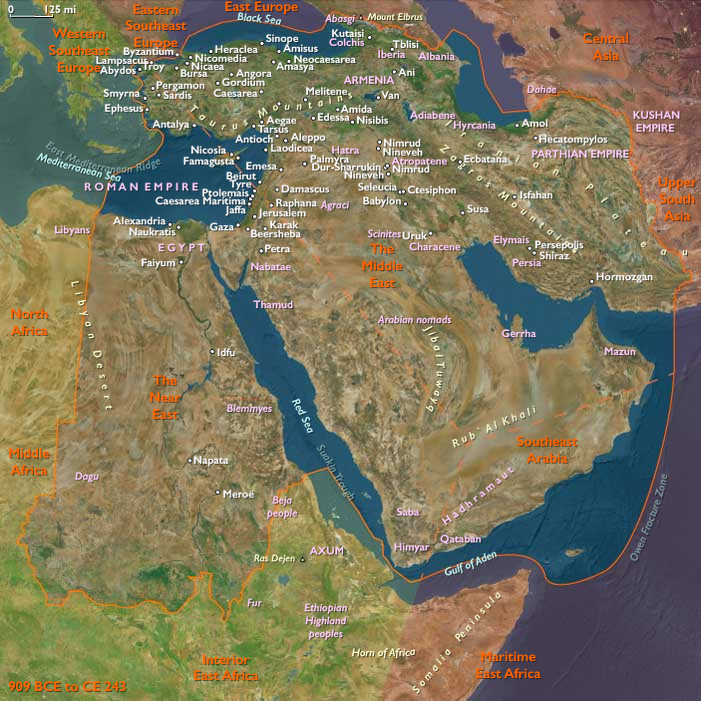
The Roman triumvir Marcus Licinius Crassus, replacing Gabinius as governor of Syria in 54, attempts to gain military glory to balance that of his partners, Pompey and Caesar, by embarking on an unwarranted invasion of Parthia, to the east.
With seven legions (about forty-four thousand men), but insufficient cavalry, Crassus invades Mesopotamia, which is defended by a Parthian noble of the Suren family (whose personal name is not known).
Locations
People
Groups
Topics
Commodoties
Subjects
Regions
Subregions
Related Events
Filter results
Showing 10 events out of 62527 total
Mithridates III flees Seleucia for Babylon, and after a long siege is taken prisoner and killed in 54 BCE by Orodes II.
Roman creditors at the moment of Ptolemy XII's restoration had demanded the return on their investments, but the Alexandrian treasury could not repay the king's debt.
Learning from previous mistakes, Ptolemy XII shifts popular resentment of tax increases from the king to a Roman, his main creditor Gaius Rabirius Postumus, whom he appoints Dioiketes (minister of finance); Rabirius is thus placed in charge of debt repayment.
Perhaps Aulus Gabinius had also put pressure on Ptolemy XII to appoint Rabirius, who now has direct access to the financial resources of Egypt but exploits the land too much.
The king has to imprison Rabirius to protect his life from the angry people, then arranges his escape to Rome, where, at the end of the year 54 BCE, he is accused under the Lex Julia de repetundis, a law of 59 BCE that restricts the number of 'gifts' that a Governor could receive during his term in a province, and also ensures that governors balanced their accounts before leaving a province.
Defended by Cicero, Rabirius is probably acquitted.
Syria has been devastated by robbers during Gabinius' absence in Egypt, and Alexander, son of Aristobulus, has again taken up arms with the object of depriving Hyrcanus II of the high-priesthood.
Gabinius with some difficulty restores order and in 54 BCE hands over the province to his successor, Marcus Licinius Crassus.
Ptolemy IX Soter had refused to give aid to the Romans in the course of their war with Pontus, but after the Roman sack of Athens in 86, the Egyptian rulers had helped rebuild the city, for which commemorative statues of them are erected.
The Odeum is rebuilt through the generosity of King Ariobarzanes of Cappadocia.
Verona-born Latin poet Gaius Valerius Catullus, while in his twenties, has written one hundred and sixteen poems, most of them to his mistress Lesbia—in reality, Clodia, sister of Cicero's archenemy, Clodius Pulcher—making a religion of his love for her by treating her as almost a divinity, someone in whose service, or servitude, a life could be well spent.
His small but spirited collection of verse, written in various meters, includes poems of infatuation, of despair, and of obscene vituperation.
He also writes erotic verse to a boy named Juventius, longer poems in the learned and allusive Greek style suggestive of Callimachus and Sappho, and occasional poems on topics ranging from the bad manners of dinner companions to the sexual excesses of Julius Caesar.
He dies in 54 at about age thirty.
The Eburones Rebellion and the Belgic Uprising (54 BCE)
In 54 BCE, Julius Caesar’s legions were still in Belgic territory, having just returned from their second expedition to Britain. Due to a severe drought, crop yields were poor, making the forced winter quartering of Roman troops an increasing burden on local Gallic communities. This tension erupted into rebellion, led by the Eburones and their allies, marking one of the most devastating setbacks for Rome in the Gallic Wars.
The Ambush and Massacre of Sabinus and Cotta’s Legion
- Only fifteen days after their arrival in winter quarters, a Roman legion and five cohorts (approx. 6,000 men), commanded by Quintus Titurius Sabinus and Lucius Aurunculeius Cotta, were attacked by the Eburones.
- The Eburones were led by their kings, Ambiorix and Cativolcus, and encouraged by Indutiomarus, the Treveri king, to resist Roman rule.
- Ambiorix tricked the Roman commanders into abandoning their fortified camp, promising them safe passage.
- As soon as the Romans left their stronghold, they were ambushed and massacred, with nearly all 6,000 men killed—one of the worst Roman defeats in Gaul.
The Spread of the Revolt: An Attack on Cicero’s Camp
-
Emboldened by his victory, Ambiorix personally rode to the Aduatuci and the Nervii, calling for a coordinated attack on another Roman outpost.
-
The Nervii agreed, rallying reinforcements from their allied tribes:
- Centrones
- Grudii
- Levaci
- Pleumoxii
- Geiduni
-
They besieged the winter camp of Quintus Tullius Cicero (the brother of the famous orator, Marcus Tullius Cicero), who was stationed in Nervian territory.
-
However, Caesar arrived in time to relieve Cicero, causing the Belgic coalition to disperse.
-
Caesar, unwilling to pursue them too far into the forests and marshes, wrote:
"Fearing to pursue them very far, because woods and morasses intervened, and also [because] he saw that they suffered no small loss in abandoning their position."
(Gallic War, V.40–V.52)
Titus Labienus’ Campaign and the Death of Indutiomarus
-
Meanwhile, Titus Labienus, one of Caesar’s most trusted generals, was wintering among the Treveri, when the rebellion spread into his territory.
-
The Treveri, under King Indutiomarus, also prepared to rise against Rome.
-
Labienus, however, acted decisively—he launched a counteroffensive, ambushed Indutiomarus, and killed him in battle.
-
With the death of Indutiomarus, the Eburones and Nervii forces withdrew, and Caesar noted that:
"This affair having been known, all the forces of the Eburones and the Nervii which had assembled, depart; and for a short time after this action, Caesar was less harassed in the government of Gaul."
(Gallic War, V.58)
Significance of the Belgic Uprising
- The annihilation of Sabinus and Cotta’s legion was one of Caesar’s worst defeats, exposing the limits of Roman control in Gaul.
- The Belgic rebellion was the most serious resistance since Vercingetorix's coalition in 52 BCE and demonstrated the widespread discontent among Rome’s Gallic subjects.
- Caesar responded with brutal reprisals, leading to the eventual destruction of the Eburones in 53 BCE.
The Eburones rebellion of 54 BCE was one of the last major challenges to Rome’s dominance in Gaul, highlighting both the ferocity of Gallic resistance and the ruthless efficiency of Roman countermeasures.
Caesar launches a more successful attack on Britain the following year, this time bringing five legions and some cavalry in five hundred ships.
Invading inland, he is continually harassed by the southern Britons under Cassivellaunus, who avoids pitched battle.
Caesar is eventually able to use his large force to impose a peace on local tribes, who surrender hostages and promise tribute.
However, poor harvests lead to widespread revolt in Gaul, which forces Caesar to leave Britain for the last time.
Declaring victory, he departs with his hostages.
Crassus has meanwhile begun his attempt to conquer the east: the Romans in 53 BCE advance on the western Arsacid vassalaries.
Orodes II in response sends his cavalry units under Surenas to combat them.
Gaius Cassius Longinus' first office is as quaestor under Crassus in 53 BCE, an office in which he proves himself to have a capable military mind.
He has traveled with Crassus to the province of Syria, and attempts to dissuade him from attacking the Parthians, suggesting that they secure a base at the Euphrates.
Ignoring Cassius, Crassu leads the army into the Battle of Carrhae, during which he also ignores Cassius' plans for strengthening the Roman line.
The result is the most famous Roman rout since the Second Punic War.
Crassus, learning that Surenas (i.e., “the Suren”) is in the desert east of the Euphrates River, leaves the cover of the river and strikes out toward Carrhae.
(Some later historians will condemn this move as rash, but, because Seleucia on the Tigris is Crassus' ultimate objective, he must at some time cross open country.)
Suddenly the Parthians are upon him, with a force of about a thousand armored knights and nearly ten thousand horse archers.
His troops, though superior in numbers, are neither acclimatized nor adapted to desert warfare.
While his son Publius launches an unsuccessful covering attack with his cavalry, the main Roman forces form a square against the encircling Parthians and attempt unsuccessfully to cover both body and head with their shields against the showers of Parthian arrows.
Surenas' provision of a corps of one thousand Arabian camels, one for every ten men, enable the Parthians to retire by sections and replenish their quivers.
Crassus, lacking provisions, is compelled by his demoralized men to negotiate but is cut down by the Parthians in the attempt.
About ten thousand Romans escape, but the rest of Crassus' men are either captured or killed.
Cassius manages to save the remnants of the army with the help of Crassus' legate, Gaius Octavius.
The army in turn tries to make Cassius its new commander, but he refuses out of loyalty to Crassus.
Crassus is killed by Parthian forces after treacherous guides lead him astray during the retreat from Carrhae, but Cassius manages to escape with five hundred and nine cavalry and meet up with the surviving legionaries.
The Parthians have dealt a stunning blow to Roman prestige in the East, and the death of Crassus is to have serious repercussions on Roman political life.
Although this feat of arms takes a severe toll on the Roman troops (Plutarch speaks of twenty thousand dead and ten thousand prisoners), and "produced a mighty echo amongst the peoples of the East," it did not cause "any decisive shift in the balance of power," that is, the Arsacid victory did not gain them territory.
For Surena, "it soon cost him his life. Probably fearing that he would constitute a threat to himself, King Orodes II had him executed."

Orodes himself invades Armenia and forces King Artavasdes, the son of Tigranes the Great, to abandon the Romans.
By the victory of Carrhae the countries east of the Euphrates are secured to the Parthians.
Plutarch relates that Orodes understood Greek very well.
After the death of Crassus, the Bacchae of Euripides is presented at Artavasdes' court, with the head of Crassus himself allegedly being used as an accessory for a scene actually including a severed head, on the order of the king.
Pompey has irresolutely veered increasingly further away from Caesar, the marriage link between the two having been broken in 54 by Julia's death.
The issue is whether there should or should not be an interval between the date at which Caesar is to resign his provincial governorships and, therewith, the command over his armies and the date at which he will enter his proposed second consulship.
If there is to be an interval, Caesar will be a private person during this time, vulnerable to attack by his enemies; if prosecuted and convicted, he will be ruined politically and might possibly lose his life.
Caesar must ensure that, until his entry on his second consulship, he shall continue to hold at least one province with the military force to guarantee his security.
This issue has already been the object of a series of political maneuvers and counter-maneuvers at Rome.
The dates on which the issue turned are all in doubt.
As had been agreed at Luca in 56, Caesar's commands have been prolonged for five years, apparently until February 28, 49, but this is not certain.
Rome’s equestrian class, who as farmers of the taxes had suffered heavy losses during the disturbances in Syria, are greatly embittered against Aulus Gabinius, and, when he appears in the Senate to give an account of his governorship, he is brought to trial on three counts, all involving a capital offense.
On the charge of maiestas (high treason) incurred by having left his province for Egypt without the consent of the senate and in defiance of the Sibylline books, he is acquitted; it is said that the judges were bribed, and even Cicero, an enemy of Gabinius, was persuaded by Pompey to say as little as he could.
On the second charge, that of repetundae (extortion during the administration of his province), with special reference to the 10,000 talents paid by Ptolemy XII for his restoration, he is found guilty, in spite of evidence offered on his behalf by Pompey and witnesses from Alexandria and the eloquence of Cicero, who has been induced to plead his cause.
Nothing but Cicero's wish to do a favor to Pompey could have induced him to take on the task; it is hinted that the half-heartedness of the defense contributed to Gabinius's condemnation.
The third charge, that of ambitus (illegalities committed during his canvass for the consulship), is consequently dropped; Gabinius goes into exile, and his property is confiscated.
In late 53 BCE, when Milo is a candidate for the consulship, and Clodius for the praetorship, the rivals collect armed bands and clash in the streets of Rome.
Some sources state that on December 6 of this year, Clodius and Milo (each accompanied by an armed escort) chance to pass each other on the Appian Way near Bovillae.
A fight erupts between members of the two groups, and Clodius dies in the ensuing mêlée.
His enraged clients build his funeral pyre in the Senate House, which ignites the building and ultimately burns it down.