
The Roman calendar is in error by …
Years: 45BCE - 45BCE
January
The Roman calendar is in error by several months.
Romans have used various lunar-solar calendars supposedly based only on observation, but in fact influenced by political considerations.
Roman military and political leader Julius Caesar had in 63 BCE been elected Pontifex Maximus, and one of his roles as such was settling the calendar.
Recognizing the need for a stable, predictable calendar, Caesar had ordered an astronomer, Sosigenes, to restructure the calendar in 46 BCE.
The year 46 BCE was given 445 days, to compensate for past errors and to bring the calendar into line with the seasons, and every common year hereafter is to have 365 days.
Every fourth year, starting with 45 BCE, is to be designated a leap year of 366 days, during which February, which commonly has twenty-eight days, is extended by one day. (This Julian Calendar will subsequently be modified by Pope Gregory XIII in 1582 into the modern Gregorian calendar).
The Julian calendar begins on January 1, 45 BCE.
Caesar’s complete overhaul of the old Roman calendar will prove to be one of his most longlasting and influential reforms.
Locations
People
- Augustus
- Cleopatra VII
- Julius Caesar
- Marcus Aemilius Lepidus (triumvir)
- Marcus Junius Brutus the Younger
- Ptolemy XIV
Groups
Topics
- Classical antiquity
- Roman Age Optimum
- Roman Republic, Crisis of the
- Roman-Parthian War of 55-36 BCE
- Roman Civil War, Great, or Caesar's Civil War
Commodoties
Subjects
- Commerce
- Symbols
- Writing
- Engineering
- Environment
- Labor and Service
- Conflict
- Faith
- Government
- Custom and Law
- Technology
Regions
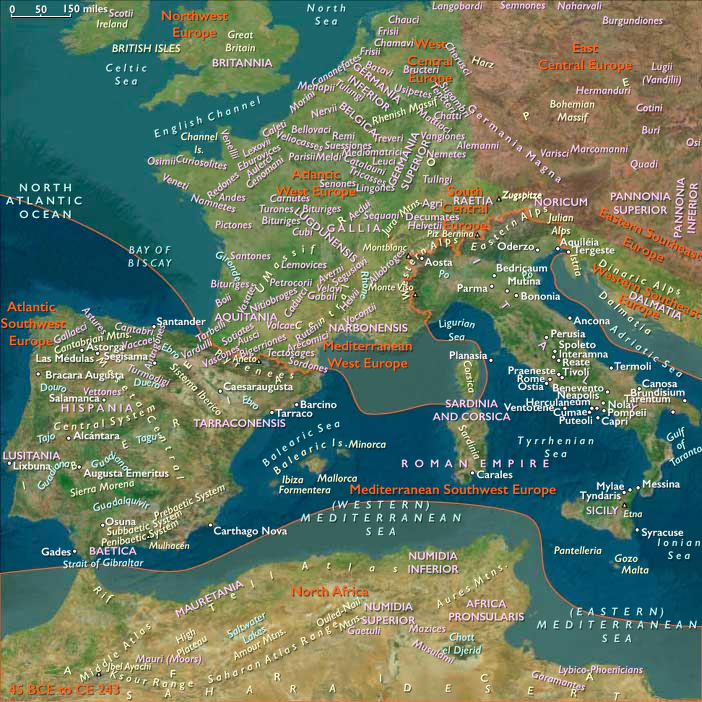
Subregions
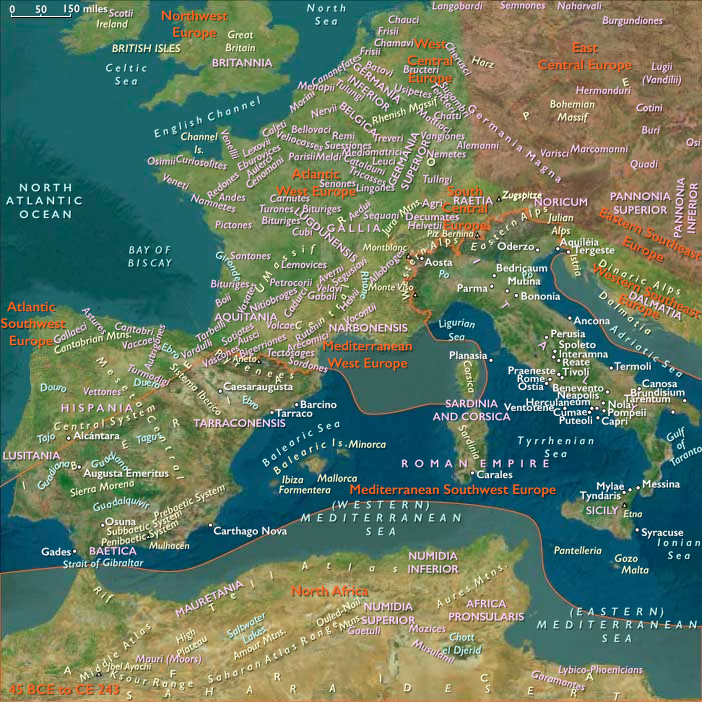
Years: 45BCE - 45BCE
January
Locations
People
- Augustus
- Cleopatra VII
- Julius Caesar
- Marcus Aemilius Lepidus (triumvir)
- Marcus Junius Brutus the Younger
- Ptolemy XIV
Groups
Topics
- Classical antiquity
- Roman Age Optimum
- Roman Republic, Crisis of the
- Roman-Parthian War of 55-36 BCE
- Roman Civil War, Great, or Caesar's Civil War
Commodoties
Subjects
- Commerce
- Symbols
- Writing
- Engineering
- Environment
- Labor and Service
- Conflict
- Faith
- Government
- Custom and Law
- Technology
Regions
Subregions