The Roman Aqua Marcia, constructed entirely of …
Years: 144BCE - 144BCE
The Roman Aqua Marcia, constructed entirely of stone in 144 BCE by the praetor Quintus Marcius Rex, for whom it is named, is the first long, high-level aqueduct. (It still functions today as one of the major water sources to the modern city of Rome.)
Locations
Groups
Topics
Commodoties
Subjects
Regions
Subregions
Related Events
Filter results
Showing 10 events out of 63097 total
Mithridates takes Babylon from the Seleucids in 144 BCE.
The young king Ptolemy VII is executed in 144 BCE, following his mother's marriage to his uncle, who then takes the throne as "Ptolemy VIII Euergetes II", the name deliberately recalling his ancestor Ptolemy III Euergetes, and has himself proclaimed as pharaoh.
He has meanwhile taken his revenge on the intellectuals of Alexandria who had opposed him, engaging in mass purges and expulsions that include Aristarchus of Samothrace and Apollodorus, leaving Alexandria a changed city.
In 145 BCE, "he expelled all intellectuals: philologists, philosophers, professors of geometry, musicians, painters, schoolteachers, physicians and others, with the result that these brought 'education to Greeks and barbarians elsewhere,' as mentioned by an author who may have been one of the king's victims" (Menecles of Barca, FGrHist 270 F 9).
Die Fragmente der griechischen Historiker, commonly abbreviated FGrHist or FGrH (Fragments of the Greek Historians), is a collection by Felix Jacoby of the works of those ancient Greek historians whose works have been lost, but of which we have citations, extracts or summaries.
It is mainly founded on Karl Wilhelm Ludwig Müller's previous Fragmenta Historicorum Graecorum (1841–1870).
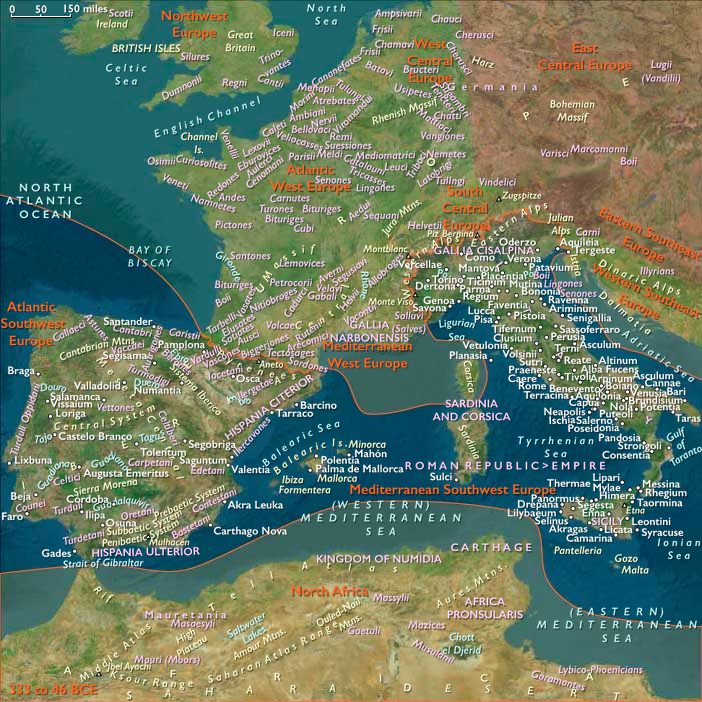
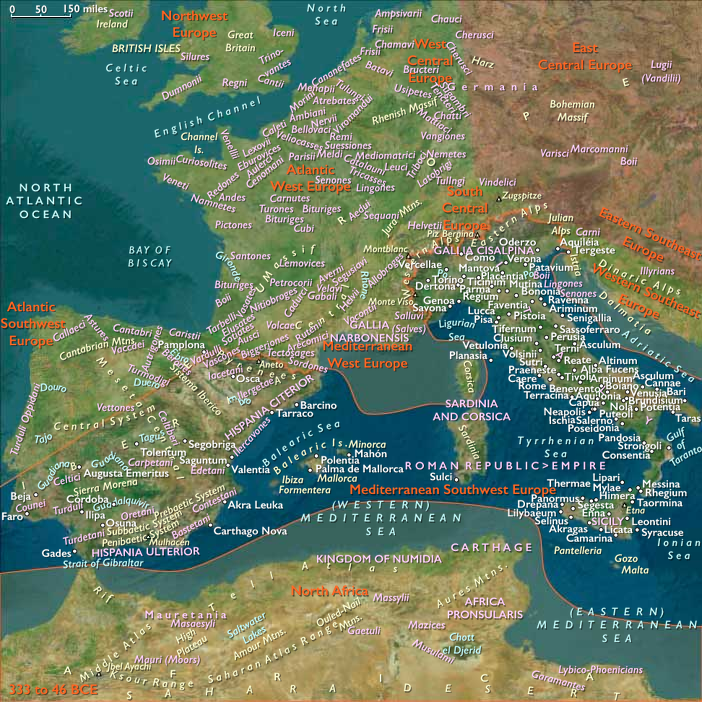
Metellus Macedonicus leads his legions in defeating many of the Celtiberian tribes in 144, but the Lusitanians fight on.
The Romans lose most of their reinforcements in Ossuma (near modern Córdoba).
Jonathan captures Ashkelon, which had submitted voluntarily, and …
…Gaza, which had not.
The Jewish forces under the High Priest Jonathan have behaved too boldly for the comfort of the Syrian regent Diodotus, who in 143 leads an army to Judea and invites Jonathan to Scythopolis for a friendly conference, persuading him to dismiss his army of forty thousand men and promising to give him Ptolemais and other fortresses.
Jonathan falls into the trap, taking with him to Ptolemais one thousand men, all of whom are slain; he himself is taken prisoner.
Fabius risks combat again and is totally defeated near what is today the city of Béja in Alentejo.
This defeat gives the Lusitanians access to territory in what is today a part of Spain, modern Granada and Murcia.
Viriathus meanwhile forms a league against Rome with several Celtiberian tribes.
Diodotus, intending to cow the Jews, is about to enter Judea when he is confronted by Jonathan’s brother, Simon, ready for battle.
Simon, who has quietly and loyally served under his other brothers, all now dead, is a man of character and prudence as well as a born leader.
Diodotus, avoiding an engagement, demands one hundred talents and Jonathan's two sons as hostages, in return for which he promises to liberate Jonathan.
Although Simon does not trust Diodotus Tryphon, he complies with the request in order that he might not be accused of the death of his brother.
However, Diodotus, angry that Simon has everywhere blocked his way and that he can accomplish nothing, executes Jonathan; nothing is known of his two captive sons.
The Hasmonean revolt, waged by the orthodox Jews of southern Syria against Seleucid rule over Judah, has been largely successful.
Simon secures from Diodotus, in the name of the general’s ward, Antiochus VI, exemption from taxation for the Jews and the right to issue his own coins.
The Jews pass a decree in Simon's honor, granting the right of permanent incumbency to Simon and to his successors, until "an accredited prophet" should arise.
It is thus during Simon's reign that the rule of the priest-prince will be transformed into a secular hereditary rule.
Polybius, a witness to the the final reduction of Carthage, had returned to Greece shortly after the destruction of Corinth in the same year and made use of his Roman connections to lighten the conditions here; entrusted with the difficult task of organizing the new form of government in the Greek cities, in this office he has gained for himself the highest recognition.
As the geographer Pausanias states, Achaean gratitude found expression in the erection of statues in his honor at Tegea, Pallantium, Mantineia, Lycosura—where the inscription declared that “Greece would never have come to grief, had she obeyed Polybius in all things, and having come to grief, she found succor through him alone”—and Megalopolis, where it was recorded that “he had roamed over all the earth and sea, had been the ally of the Romans, and had quenched their wrath against Greece.”
He seems to have spent the succeeding years in Rome, engaged on the completion of his historical work, and occasionally undertaking long journeys through the Mediterranean countries in the interest of his history, more particularly with a view to obtaining firsthand knowledge of historical sites.
It also appears that he sought out and interviewed war veterans in order to clarify details of the events he was writing about, and was given access to archival material for the same purpose.
In his major historical work, containing forty books (of which the first five are extant, in addition to large fragments of the remaining volumes) Polybius presents the facts and causes of Rome's rapid rise to world dominion from 221 to 168, with an introduction describing Roman history from 264 to 220 and a conclusion, related in Books XXX–XXXIX, summarizing the recent events from 168 to 146.
Polybius probably conceived his revision after 146, having by this date completed his narrative down to the end of the Second Punic War.
At least Books I–VI seem to have been published by about 150; there is no information as to when the rest of the work, including the revised plan in Book III, appeared.
A rationalist who rejects religious superstitions, he emphasizes the causes, circumstances, and consequences of events, and the inevitability of change.
The didactic historian expresses his conviction that the Romans prevailed over their opponents because of a superior constitution and military organization.