The rightful Chalukya ruler ascends the throne …
Years: 604 - 615
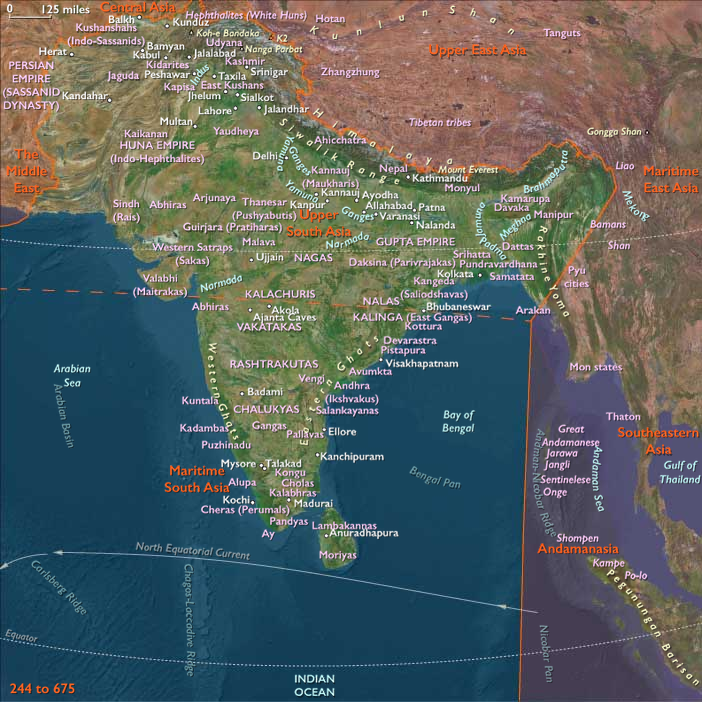
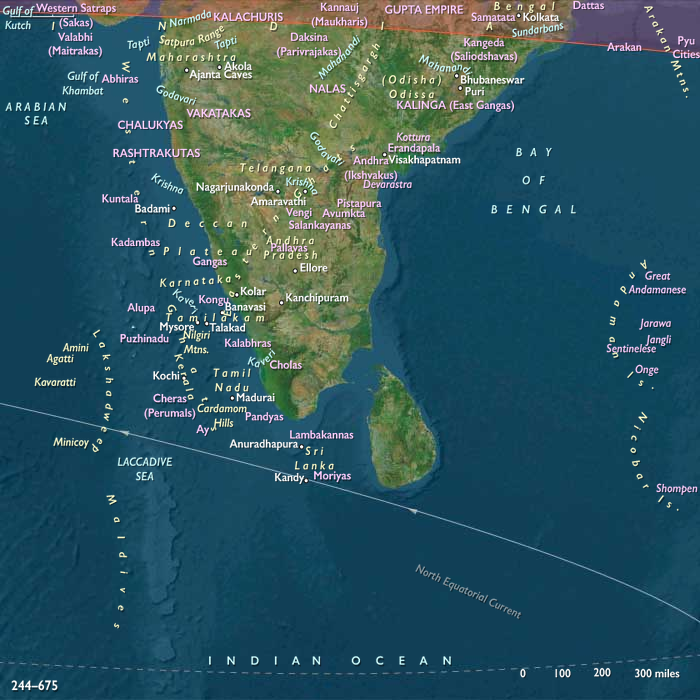
The rightful Chalukya ruler ascends the throne as Pulakesi II in 610 following a long and bloody fratricidal war against his usurping uncle, Mangalesha.
Assuming control of Chalukya domains much enlarged during the reign of his treacherous uncle, Pulakesi focuses on consolidating his kingdom.
Intent on controlling India’s northwest coast, he gains parts of Gujarat and Malawa with the voluntary submission to his overlordship of the Latas, the Malvas, and the Gujaras.
Pulakesin exterminates the Kadambas in western Deccan, retaining the Alupas and Gangas as vassals.
Locations
People
Groups
Topics
Commodoties
Subjects
Regions
Subregions
Related Events
Filter results
Showing 10 events out of 57091 total
Emperor Yang of Sui launches his first of three campaigns against Goguryeo in 613.
Yang Xuangan, an official of China’s Sui Dynasty, mindful that Emperor Yang is apprehensive of his father, the powerful official Yang Su, rebels near the eastern capital, Luoyang, but is soon defeated.
He orders his brother Yang Jishan to kill him, so as to not fall into Emperor Yang's hands.
East Central Europe (604–615 CE): Increasing Avar Power, Strengthening of Bohemia and Moravia, and Expanding Slavic Influence
Between 604 and 615 CE, East Central Europe—encompassing Poland, Czechia, Slovakia, Hungary, and those portions of Germany and Austria lying east of 10°E and north of a line stretching from roughly 48.2°N at 10°E southeastward to the Austro-Slovenian border near 46.7°N, 15.4°E—continued to witness significant geopolitical shifts. The Avar Khaganate further solidified its dominant position, intensifying both military campaigns and diplomatic maneuvers, particularly towards the Byzantine frontier and the developing West Slavic entities. Meanwhile, early state structures in Bohemia and Moravia became increasingly organized and culturally distinct, firmly establishing these territories as pivotal regional entities. Bavarian diplomatic and trade interactions continued to provide critical connections between Frankish, Slavic, and Avar spheres, reinforcing the region's economic importance.
Political and Military Developments
Intensified Avar Military Pressure
-
Under strong central leadership, the Avar Khaganate increased military and diplomatic activities, conducting frequent raids and exerting pressure over surrounding regions, including Moravian, Bohemian, and Bavarian territories.
-
Avar military actions, particularly toward Byzantine territories in the Balkans, indirectly influenced regional stability in East Central Europe, prompting defensive coalitions and stronger political consolidation among neighboring entities.
Consolidation of Bohemian and Moravian Leadership
-
Both Bohemia and Moravia solidified tribal leadership and political hierarchies, organizing increasingly effective defenses and governance structures to counter the threat posed by Avar incursions.
-
Early political entities began clearly emerging, laying firm foundations for future medieval duchies, characterized by centralized leadership, fortified settlements, and regional alliances.
Bavarian Diplomatic and Economic Influence
-
Bavaria (Baiuvarii) continued to mediate diplomatically and economically between the Frankish West, Avar East, and emerging Slavic powers. This pivotal role bolstered Bavarian economic strength and diplomatic prominence.
Economic and Technological Developments
Growth of Regional Trade
-
Trade networks through Bavaria, Bohemia, and Moravia flourished, connecting Avar-controlled territories, Byzantine markets, and Frankish lands. Trade goods included agricultural products, ironwork, luxury items, textiles, and regional craft products.
Development of Defensive Infrastructure
-
Under increased Avar pressure, Bohemian and Moravian communities significantly strengthened fortifications, hillforts, and defensive settlements, reflecting growing political organization, technological capability, and centralized leadership.
Cultural and Artistic Developments
Further Cultural Differentiation in Bohemia and Moravia
-
Distinct West Slavic cultural identities continued to solidify, clearly expressed in pottery, jewelry styles, burial rituals, and settlement architecture, distinguishing Bohemian and Moravian traditions from those of neighboring Slavic groups.
Avar Artistic and Cultural Influence
-
The Avar Khaganate further disseminated Central Asian artistic styles throughout East Central Europe, notably influencing regional metalworking, jewelry, weaponry, and ceramics, leaving a lasting cultural imprint.
Settlement and Urban Development
Fortified Bohemian and Moravian Centers
-
Bohemia and Moravia experienced substantial growth in fortified settlements, reflecting increased political centralization and social organization essential for early medieval state formation.
Continuity of Avar-Controlled Settlements
-
Avar-controlled urban centers—such as Augusta Vindelicorum (Augsburg), Vindobona, and Aquincum—remained essential administrative, military, and commercial hubs, benefiting from stable governance and extensive trade connections.
Social and Religious Developments
Emergence of Stable Hierarchies in Bohemia and Moravia
-
Early Bohemian and Moravian societies developed stable hierarchical structures centered around tribal chieftains and warrior elites, laying crucial foundations for future political organization and social cohesion.
Avar Socio-Political Stability
-
The Avar social structure, emphasizing centralized authority and military hierarchy, provided ongoing regional stability, strengthening their dominance across extensive territories.
Long-Term Consequences and Historical Significance
The era 604–615 CE marked another critical juncture for East Central Europe, defined by increased Avar dominance, the continued consolidation of Bohemian and Moravian leadership, and growing Bavarian diplomatic and economic influence. These developments significantly shaped the region's geopolitical framework, laying lasting foundations for medieval states and defining cultural identities. The patterns established during this period influenced future interactions among Avars, Bavarians, and emerging Slavic powers, deeply affecting East Central Europe's historical trajectory.
The Slavic tribes in Bohemia and along the Elbe throw off the Avar yoke around 610.
Eastern Southeast Europe (604–615 CE): Major Demographic and Cultural Realignments
Settlement and Migration Patterns
Avar-Slavic Penetration and Settlement
Between 604 and 615 CE, Eastern Southeast Europe experienced substantial demographic and geopolitical shifts due to the combined forces of the Avars and Slavs breaching the Danube frontier. Their occupation of extensive territories drastically altered the configuration of Balkan populations, resulting in profound and enduring demographic transformations.
Isolation of Dacia
For the first time since Emperor Trajan's conquest, Dacia found itself cut off from the Roman world, marking a significant geopolitical shift. This isolation redefined regional interactions and hastened local adaptations to the new socio-political landscape.
Indigenous Population Displacement
The invasions caused significant displacement among the region's indigenous populations, particularly affecting Illyrian and Greek communities. Many relocated their settlements to more defensible, higher ground or fled the Balkans entirely, with a notable exodus to areas such as Calabria in southern Italy.
Political and Military Developments
Defensive Challenges and Reorganization
Faced with the penetrating forces, the Eastern Roman Empire struggled to effectively repulse or assimilate these newcomers. Consequently, defensive strategies underwent significant re-evaluation, focusing on safeguarding key areas and managing an increasingly fragmented regional landscape.
Shift in Regional Dominance
The success of the Avars and their Slavic allies significantly altered regional power dynamics. This shift necessitated ongoing military vigilance and continuous adaptations to imperial defensive and diplomatic strategies.
Economic and Technological Developments
Economic Disruption and Adaptation
The invasions and resultant demographic shifts caused considerable disruption to local economies, particularly affecting agricultural productivity and trade networks. Nonetheless, local communities and imperial structures gradually adapted, striving to restore economic stability under challenging circumstances.
Infrastructure and Defensive Reinforcements
Continuous attention was given to infrastructure improvements, notably fortifications and defensive measures. These reinforced defenses played a crucial role in managing persistent security threats and maintaining administrative and logistical functions.
Cultural and Artistic Developments
Cultural Slavicization and Stability
The extensive Slavic settlements introduced a more stable culture, substantially influencing and reshaping the existing Roman social order. While the Slavs retained their language, significant cultural blending occurred, creating a unique and lasting socio-cultural synthesis within the region.
Intellectual and Cultural Resilience
Despite upheaval, intellectual and educational institutions persisted in their roles of preserving classical and theological knowledge, adapting to the new social conditions and continuing their scholarly activities.
Social and Religious Developments
Governance Under Strain
Imperial and local administrative structures faced considerable challenges managing the extensive demographic and social transformations. Administrative strategies focused on adaptive governance, aimed at maintaining societal order and community resilience amidst significant upheavals.
Continuing Role of Christianity
Christianity maintained its significant societal presence, providing moral cohesion and community support throughout the period of instability. Religious institutions continued to function as key elements in preserving social unity and communal identity.
Long-Term Consequences and Historical Significance
The era from 604 to 615 CE marked a pivotal turning point for Eastern Southeast Europe, characterized by dramatic demographic shifts, extensive population movements, and significant cultural transformations. These developments deeply influenced the region’s historical trajectory, setting the stage for lasting socio-political realignments.

Various Slavic tribes move into the devastated Balkans.
Much of the indigenous population of the Balkans, that of Greece included, relocate their settlements to higher, more secure regions or flee the peninsula altogether, especially to Calabria at the southern tip of Italy.
The Slavs bring a more stable culture and substantially slavicize the existing Roman social system.
They retain their own language.
The configuration of Balkan populations alters drastically when allied Avars and Slavs break through the Danube frontier of the Roman Empire and occupy much of the Illyrian-populated areas of the Balkan Peninsula.
Dacia is cut off from the Roman world for the first time since Trajan's conquest.
The Middle East: 604–615 CE
Escalation of the Byzantine–Sassanian Conflict
Rise of Khosrau II and Renewed Warfare
This era witnesses the dramatic escalation of the conflict between the Byzantine Empire and the Sassanian Empire, fueled by the ambitions of Persian king Khosrau II (Parviz). After the murder of Emperor Maurice in 602, Khosrau, under the pretext of avenging Maurice—his former ally and patron—initiates hostilities against the Byzantines. Beginning in 603, Khosrau's armies launch sweeping invasions into Byzantine territories, swiftly capturing major cities such as Dara and Amida in Mesopotamia.
Persian Advances in the Levant
The Persian forces rapidly expand their control into the Levant, securing key strategic locations and cities, including parts of Armenia and Syria. This territorial expansion severely weakens Byzantine influence and defense lines, significantly altering the regional balance of power. These victories mark the onset of a brutal and prolonged confrontation known historically as the final and most devastating phase of the Byzantine–Sassanian wars.
Impact on Regional Stability
The aggressive Persian campaigns profoundly disrupt regional stability, exacerbating existing economic hardships and social dislocation across affected areas. The conquest and subsequent occupation by Persian forces lead to increased tensions and hardships among local populations, reshaping political loyalties and setting the stage for further conflicts and shifts in regional power dynamics in subsequent decades.
This period, therefore, stands as a critical juncture, underscoring the fragility of imperial authority and foreshadowing greater turmoil in the Middle East.
The Middle East: 604–615 CE
Escalation of the Byzantine–Sassanian Conflict
Rise of Khosrau II and Renewed Warfare
This era witnesses the dramatic escalation of the conflict between the Byzantine Empire and the Sassanian Empire, fueled by the ambitions of Persian king Khosrau II (Parviz). After the murder of Emperor Maurice in 602, Khosrau, under the pretext of avenging Maurice—his former ally and patron—initiates hostilities against the Byzantines. Beginning in 603, Khosrau's armies launch sweeping invasions into Byzantine territories, swiftly capturing major cities such as Dara and Amida in Mesopotamia.
Persian Advances in the Levant
The Persian forces rapidly expand their control into the Levant, securing key strategic locations and cities, including parts of Armenia and Syria. This territorial expansion severely weakens Byzantine influence and defense lines, significantly altering the regional balance of power. These victories mark the onset of a brutal and prolonged confrontation known historically as the final and most devastating phase of the Byzantine–Sassanian wars.
Impact on Regional Stability
The aggressive Persian campaigns profoundly disrupt regional stability, exacerbating existing economic hardships and social dislocation across affected areas. The conquest and subsequent occupation by Persian forces lead to increased tensions and hardships among local populations, reshaping political loyalties and setting the stage for further conflicts and shifts in regional power dynamics in subsequent decades.
This period, therefore, stands as a critical juncture, underscoring the fragility of imperial authority and foreshadowing greater turmoil in the Middle East.
A Jewish insurrection against the East Roman Empire across the Levant comes to the aid of Sassanid Persia during the Byzantine–Sassanid War of 602–628.
The revolt begins with the Battle of Antioch in 613 and culminates with the conquest of Jerusalem in 614 by Persian and Jewish forces and the establishment of Jewish autonomy.