
The Rhine and Danube have been threatened …
Years: 356 - 356
The Rhine and Danube have been threatened frequently during the years that Constantius has been occupied fighting Shapur in Mesopotamia, because the troops had been withdrawn from there and sent to the East.
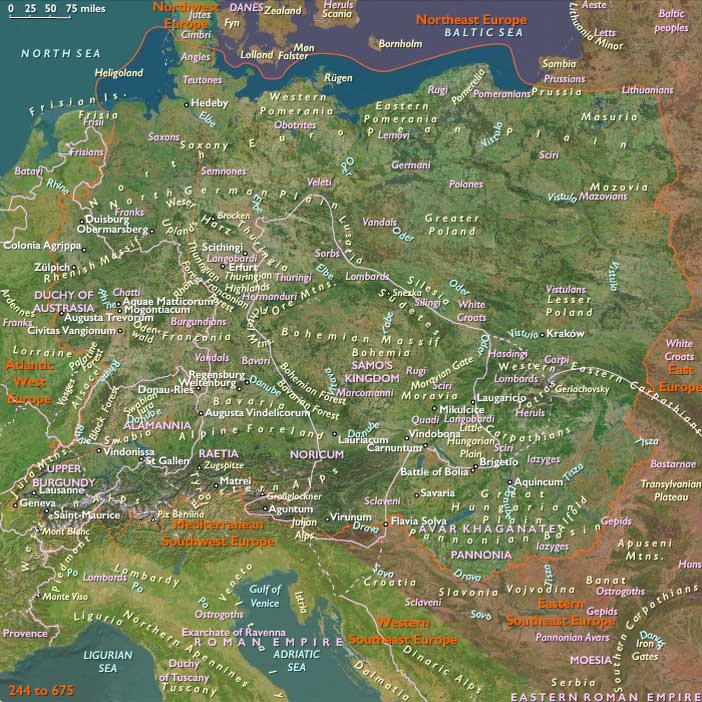
Constantius, moreover, had made a mistake in sending Chnodomar, the Alamannic king, against Magnentius in 351, for his tribes invade Raetia in 356.
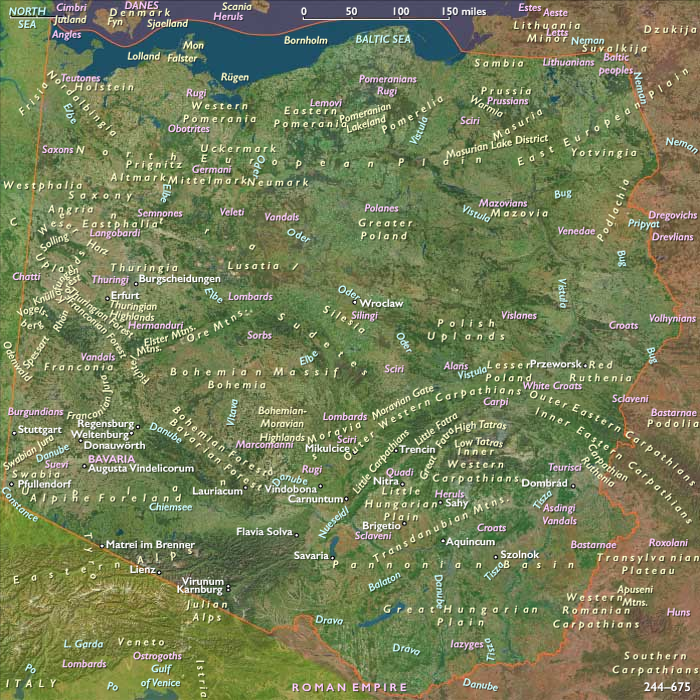
Raetia had formed part of the diocese of the vicarius Italiae under Diocletian, and had been subdivided into Raetia prima, with a praeses at Curia Raetorum (Chur) and Raetia secunda, with a praeses at Augusta Vindelicorum (Augsburg), the former corresponding to the old Raetia, the latter to Vindelicia.
The boundary between them is not clearly defined, but may be stated generally as a line drawn eastwards from the lacus Brigantinus (Lake Constance) to the Oenus (River Inn).
Locations
People
Groups
- Raetia (Roman province)
- Alamanni (Germanic tribal alliance)
- Italy, Diocese of
- Roman Empire: Constantinian dynasty (Constantinople)
- Italy, Praetorian prefecture of
Topics
Commodoties
Subjects
Regions
Subregions
Related Events
Filter results
Showing 10 events out of 59752 total
Wang Duo is executed in 356 after offending Dong, who had then advised Fu Jiàn that a high level official needed to be executed in accordance with astrological signs.
Because Fu Sheng is blind in one eye and apparently apprehensive that people would be making fun at him or be contemptuous of him due to this disability, he orders that words such as "missing," "lacking," "slanted," "less," and "without" not be used.
He also engages in heavy drinking, and he often either ignores officials' petitions altogether or makes irrational decisions on them in the middle of his stupor, allowing his attendants to make random decisions on his behalf.
For example, Xin Lao is killed in 356 by an arrow Fu Sheng launches during the middle of a feast after Fu Sheng had become displeased that he, as the master of ceremony, was not getting everyone drunk.
Fu Sheng also carries out cruel punishment—in addition to frequent executions, he also likes to cruelly treat animals—including throwing them into boiling water or skinning them alive; the latter punishment he sometimes applies to humans.
When his uncle Qiang Ping, Empress Dowager Qiang's brother, tries to correct his ways in 356, he breaks Qiang Ping's skull by hitting him with a hammer him, then executes him, causing Empress Dowager Qiang to die in sorrow and fear.
Also in 356, Fu Sheng's brother Fu Liu, the Prince of Jin, is able to persuade the Former Liang regent Zhang Guan to have the young Former Liang ruler Zhang Xuanjing become a vassal.
Roman authorities make an attempt on February 8, 356, to arrest Athanasius on the accusation of supporting the late usurper Magnentius.
Athanasius eludes them, fleeing to the desert to hide among the monks of Mount Nitria.
Aëtius of Antioch goes to Alexandria with his Cappadocian protégé Eunomius in order to advocate Arianism, but he is banished by Constantius.
Constantius, who is primarily interested in religious affairs, publishes a decree in 356 ordering the closure of all pagan temples throughout the Empire and bans the veneration of non-Christian images.
His interventions have created a “caesaro-papism” that is unfavorable to the church, for after the Battle of Mursa the emperor had become violently Arian.
The Christological problem has moved to the forefront.
As sole ruler after 353, Constantius tries to create religious unity in the empire under Arian Christianity.
Under his leadership, the Nicene party (orthodox Christians) is largely crushed.
The extreme Arians now declare that the Son was “unlike” (anomoios) the Father.
Constantius twice (339, 356) exiles Athanasius, the influential orthodox bishop of Alexandria, but the religious unity he seeks is destined to be short-lived.
Hilary of Poitiers: Defender of Nicene Christianity and Opponent of Arianism (c. 300–368 CE)
Hilary of Poitiers, born in Poitiers at the end of the 3rd century CE, was a highly educated pagan aristocrat who, after extensive study of the Old and New Testament, converted to Christianity, along with his wife and daughter (traditionally named Saint Abra). His deep learning, including a rare knowledge of Greek for a Western Christian of the time, would make him one of the most influential theologians of the 4th century CE, particularly in the fight against Arianism.
1. Hilary Becomes Bishop of Poitiers (c. 353 CE)
- Around 353 CE, the citizens of Poitiers, impressed by his wisdom and character, unanimously elected him bishop, despite the fact that he was still married (clerical celibacy was not universally required at this time).
- His tenure came at a critical moment when Arianism was spreading rapidly in the Western Church, largely due to the support of Emperor Constantius II.
- Recognizing the threat to Nicene Christianity, Hilary became one of the leading defenders of the doctrine of the Trinity.
2. Hilary’s Opposition to Arianism and Imperial Persecution
- One of Hilary’s first actions as bishop was to organize the excommunication of key Arian leaders, including:
- Saturninus, the Arian bishop of Arles.
- Ursacius and Valens, two of the most influential Arian theologians and imperial supporters.
- Around 355 CE, he wrote a letter to Emperor Constantius II, known as Ad Constantium Augustum liber primus, denouncing the emperor’s role in persecuting Nicene Christians.
- Instead of achieving reconciliation, his defiance led to his exile.
3. Exile to Phrygia and Writings on the Trinity (356–360 CE)
- At the Synod of Béziers (356 CE), called by Constantius II to settle the Arian controversy, Hilary was condemned and exiled to Phrygia (modern-day Turkey), along with Rhodanus, bishop of Toulouse.
- During his nearly four years in exile, Hilary used the time to write extensively, producing:
- De Trinitate – A detailed theological work defending the doctrine of the Holy Trinity, refuting Arian Christology.
- De Synodis – A historical account of the Arian controversy, attempting to clarify the theological positions of different factions.
- Hymns – He is one of the first Latin hymn writers, using poetry to convey orthodox doctrine.
4. Legacy: Defender of Orthodoxy and Later Recognition as a Church Father
- Eventually, Hilary was recalled from exile and continued his fight against Arianism until his death around 368 CE.
- His writings and theological contributions significantly influenced later Church doctrine, earning him the title “Athanasius of the West” for his staunch defense of Nicene Christianity.
- He was later recognized as a Doctor of the Church, and his legacy as a defender of Trinitarian orthodoxy remains influential in Christian theology.
Hilary’s intellectual depth, theological rigor, and resistance to imperial interference in Church matters made him one of the most important figures in the Arian controversy, securing his place as one of the great Church Fathers of Late Antiquity.
Julian’s Winter Encampment at Sens and the Alamanni Siege (356/357 CE)
During his Gallic campaigns, Julian, Caesar of the West, chose Senones (modern Sens, France) near Paris as his winter base for 356/357 CE. To spread the burden of quartering his army, he stationed most of his troops in different towns, with the main force at Reims under the command of Marcellus.
However, this decision left Julian vulnerable, and when the Alamanni learned of his reduced escort, they launched a siege against Sens, forcing Julian into a month-long defensive struggle.
1. The Siege of Sens (356 CE)
- A large Alamannic force surrounded Sens, trapping Julian inside the city with only a small contingent of troops.
- The Romans successfully held out for about a month, resisting repeated assaults.
- However, Julian was too heavily outnumbered to sally forth or pursue the Alamanni when they finally withdrew.
2. The Failure of Marcellus to Assist Julian
- While besieged, Julian expected reinforcements from his commander at Reims, Marcellus, the magister equitum (Master of Horse).
- Marcellus failed to send aid, despite having a substantial force at his disposal.
- Ammianus Marcellinus, a contemporary historian, condemned Marcellus' inaction as cowardice, highlighting his failure to support Julian during a critical moment.
3. Marcellus is Dismissed and Replaced by Severus
- Upon hearing of Marcellus' failure, Emperor Constantius II dismissed him as magister equitum, replacing him with Severus, a trusted and experienced officer.
- Severus was known for being more compatible with Julian, strengthening command cohesion.
4. Consequences and Significance of the Event
- The successful defense of Sens further boosted Julian’s reputation as a capable and resilient leader.
- Marcellus' dismissal demonstrated Constantius' confidence in Julian, despite growing tensions between the two rulers.
- The incident exposed weaknesses in Roman command coordination, highlighting the challenges of defending the empire from Germanic incursions.
Though the siege of Sens was a defensive victory, it foreshadowed Julian’s growing autonomy and eventual break with Constantius, leading to his rise as sole emperor in 361 CE.
Julian's Daunting Task in Gaul: The Collapse of the Rhine Frontier and His First Campaign (355–356 CE)
When Julian was sent to Gaul in 355 CE as Caesar, he inherited an incredibly dire situation. The civil war between Constantius II and Magnentius (350–353 CE) had devastated northern Gaul, and the Rhine frontier had largely collapsed, leaving the province at the mercy of Germanic invasions.
1. The Dire State of Roman Gaul
-
The defensive line of the Rhine had disintegrated, with many key Roman strongholds now in German hands.
-
According to Ammianus Marcellinus, the following cities had fallen to the Alamanni or the Franks:
- Moguntiacum (Mainz)
- Borbetomagus (Worms)
- Nemetae Vangionum (Speyer)
- Tabernae (Saverne)
- Saliso (Brumath)
- Argentorate (Strasbourg)
-
Only Colonia Agrippina (Cologne) remained as a major Roman stronghold, along with three minor positions:
- A single tower near Cologne.
- Forts at Rigodunum (Remagen) and Confluentes (Koblenz).
-
Large barbarian war bands were roaming northeastern Gaul, pillaging as far as the Seine River, with no organized Roman resistance.
-
The Roman limitanei (border defense forces) had been decimated, and those that survived had abandoned the frontier to garrison Gaul’s interior cities.
2. Political Intrigue: A Mission Designed to Fail?
- At Constantius II’s court in Milan, many cynically whispered that Julian had been given an impossible task, meant to remove him as a potential rival.
- Julian was a scholar, not a career soldier, and had no previous military experience, making him an unlikely savior of Gaul.
- Yet, against all expectations, he would soon prove himself to be a brilliant military leader.
3. Julian’s Arrival and the Fall of Cologne (355–356 CE)
-
Julian was provided with only a small escort, consisting of:
- 200 scholares (imperial bodyguard cavalry).
- A regiment of cataphractarii (heavily armored cavalry).
- Some mounted archers.
- In total: just 360 men, a pitiful force given the scale of the crisis.
-
While en route from Milan, he received the catastrophic news that Cologne, Rome’s largest military stronghold on the Rhine, had fallen to the Franks.
-
He spent the winter of 355/356 at Vienna (modern Vienne, France), not far from Lugdunum (Lyon), preparing for his first campaign in 356 CE.
4. The 356 CE Campaign: Julian’s First Steps in Warfare
- Julian’s first objective was to link up with the main Roman field army (comitatus) in Gaul, which had wintered in Remi (Reims) under Marcellus, the magister equitum (Master of Horse).
- This involved a dangerous march through enemy-infested territory, with Alamanni raiding bands larger than Julian’s escort, skilled in ambush tactics.
First Successes: Early Engagements in 356 CE
- Augustodunum (Autun):
- Julian surprised and drove off a large barbarian force besieging the city.
- The Morvan Wilderness:
- He defeated a Germanic raiding band, demonstrating his tactical ability in the field.
Despite his lack of military experience, Julian quickly proved himself capable and decisive, setting the stage for his later victories in Gaul.
5. Conclusion: Julian’s Unexpected Rise as a Military Leader
- Tasked with an almost impossible mission, Julian inherited a broken province, abandoned by the Roman military.
- While his initial army was small, his first successes in 356 CE demonstrated his brilliance as a general.
- His leadership in Gaul would continue to grow, culminating in a major victory at Argentorate (Strasbourg) in 357 CE, where he would break the Alamanni threat and begin restoring Roman control in Gaul.
Despite skepticism from Constantius’ court, Julian’s early victories proved that he was far more than a mere scholar—he was a capable and resourceful commander who would later challenge Constantius himself for control of the empire.
Julian's Bold March to Alsace and the Ambush at Decem Pagi (356 CE)
After linking up with his main army at Reims in 356 CE, Julian demonstrated his characteristic boldness by deciding, in consultation with his senior commanders, to directly confront the Alamanni threat at its source. Instead of adopting a defensive strategy, he planned to march into Alsace and restore Roman control over the region, which had largely fallen under Alamannic domination following the collapse of the Rhine frontier.
However, this aggressive maneuver nearly ended in disaster when Julian’s army was ambushed by the Alamanninear Decem Pagi (modern Dieuze, France).
1. The Ambush at Decem Pagi
- As Julian’s army advanced through dense mist, two rearguard legions lost contact with the rest of the column.
- A large Germanic war band seized the opportunity to launch a sudden and devastating assault on the isolated Roman units.
- The two legions suffered heavy casualties, nearly being wiped out before Julian's main force could react.
2. The Roman Counterattack: Auxilia Palatina to the Rescue
- The uproar of the battle was heard by Roman auxilia palatina regiments, elite light infantry units that rushed to the scene.
- These highly mobile troops launched a counterattack, breaking the momentum of the Alamanni and rescuing the trapped legions.
- Julian quickly reorganized his column, avoiding further pursuit and ensuring that his march to Alsace continued.
3. Significance of the Battle
- The ambush at Decem Pagi revealed the tactical skill and coordination of the Alamanni, demonstrating their ability to exploit Roman weaknesses.
- Julian’s decisive response and the discipline of his auxilia palatina prevented a total disaster, solidifying his leadership under pressure.
- The battle underscored the dangers of campaigning in enemy-held territory, as Roman forces had to adapt to guerrilla-style warfare in Germanic lands.
4. Julian’s Campaign Continues
- Despite this near-defeat, Julian pressed forward into Alsace, determined to break the power of the Alamanni.
- His bold strategy would soon culminate in a major Roman victory at the Battle of Argentorate (Strasbourg) in 357 CE, a decisive engagement that would restore Roman dominance in Gaul.
The ambush at Decem Pagi was one of Julian’s earliest military trials, and his ability to survive and recover from near catastrophe only further proved that he was not just a scholar-emperor, but a capable and determined military leader.
Julian's Campaign in Alsace and the Decision to Recover Cologne (356 CE)
After his near-disaster at Decem Pagi (Dieuze), Julian continued his campaign, advancing toward Brotomagus (modern Brumath, Alsace). Along the way, his army routed another Germanic war band in open battle, further demonstrating his ability to regain control of northeastern Gaul. However, after assessing the strategic situation in Alsace, Julian realized that his forces were insufficient to fully defeat the Alamanni on their own.
Rather than risking a decisive battle against numerically superior Alamanni forces, Julian made a calculated decision: he shifted his focus from offensive operations in Alsace to the recovery of Cologne, a crucial Roman stronghold on the Rhine, which had fallen to the Franks earlier that year.
1. Julian’s Assessment of the Situation in Alsace
- While he had won victories against smaller raiding bands, the main Alamanni forces remained intact.
- His army was still relatively small, and he lacked the reinforcements needed to secure the region permanently.
- Securing Cologne, a key Roman city and military base, was a more achievable objective and would allow him to better stabilize northern Gaul.
2. The Strategic Importance of Cologne
- Cologne (Colonia Agrippina) was Rome’s largest and most important city on the Rhine, serving as a military and administrative center for Germania Inferior.
- Its fall to the Franks earlier in 356 had dealt a serious blow to Roman prestige and left the Rhine frontier dangerously exposed.
- Retaking the city would restore Roman control over the region and demonstrate that Julian could defend Roman territory.
3. Julian’s Decision: A Tactical Shift
- Recognizing that Alsace could not be held without reinforcements, Julian pivoted to recovering Cologne, a more vital and achievable goal.
- His strategy reflected his pragmatic approach to warfare, balancing offensive action with defensive priorities.
- By focusing on Cologne, he aimed to consolidate control over northern Gaul before reengaging the Alamanni in a larger campaign.
4. The Path to the Battle of Argentorate (357 CE)
- Julian’s decision to secure Cologne first would strengthen his position for the following year’s campaign.
- In 357 CE, he would return to Alsace and achieve a major victory at the Battle of Argentorate (Strasbourg), decisively defeating the Alamanni king Chnodomar.
- This campaign was part of a broader strategy to systematically reclaim Roman control over the Rhine frontier.
Conclusion: A Calculated Strategic Move
Julian’s choice to prioritize the recovery of Cologne over engaging the Alamanni in Alsace was a wise tactical decision that demonstrated his military prudence and strategic foresight. Rather than overextending his forces, he secured a key stronghold first, setting the stage for his later victories that would restore Roman dominance in Gaul.
Julian leads his army from Metz via Treviri (Trier) to Roman-held Koblenz and thence along the Rhine to Cologne.
Entering the ruined city unopposed, Julian's men are set to work to rebuild the city walls.
Julian then concludes a peace treaty with the Franks.
This has the important result of removing half the opposition from the equation and allowing Julian to focus his resources on dealing with the Alamanni.
The former Jin general Yao Xiang, who, after rebelling against Jin in 354, had intended to establish his independent state, attacks Former Qin's northern territory in 357; the Former Qin generals Deng Qiang and Fu Huangmei, the Prince of Guangping, fight back and capture and execute him.
Fu Sheng, still respectful of Yao Xiang and his father Yao Yizhong, whose casket Yao had carried with his army, buries both with honors.
However, not only does he not reward Fu Huangmei but further insults him, leading Fu Huangmei to plot an unsuccessful assassination against him, resulting in Fu Huangmei's death.
Yu Zun is executed in 357 along with his sons and grandsons after Fu Sheng dreams of a large fish in Chinese) eating calamus palm.
Later in 357, Fu Sheng becomes suspicious of his cousins Fu Jiān, the Prince of Donghai, and Fu Fa, the Prince of Qinghe, and considers killing them.
His ladies in waiting leak the news to Fu Jiān, who immediately leads his private army to attack the palace.
The imperial guards, who already resent Fu Sheng's ferocity, surrender without resisting.
Fu Jiān captures Fu Sheng, who is still in a drunken stupor, and has him deposed and then executed.
Fu Jiān now takes the throne.
Years: 356 - 356
Locations
People
Groups
- Raetia (Roman province)
- Alamanni (Germanic tribal alliance)
- Italy, Diocese of
- Roman Empire: Constantinian dynasty (Constantinople)
- Italy, Praetorian prefecture of
