The return of Andrew II of Hungary …
Years: 1228 - 1228
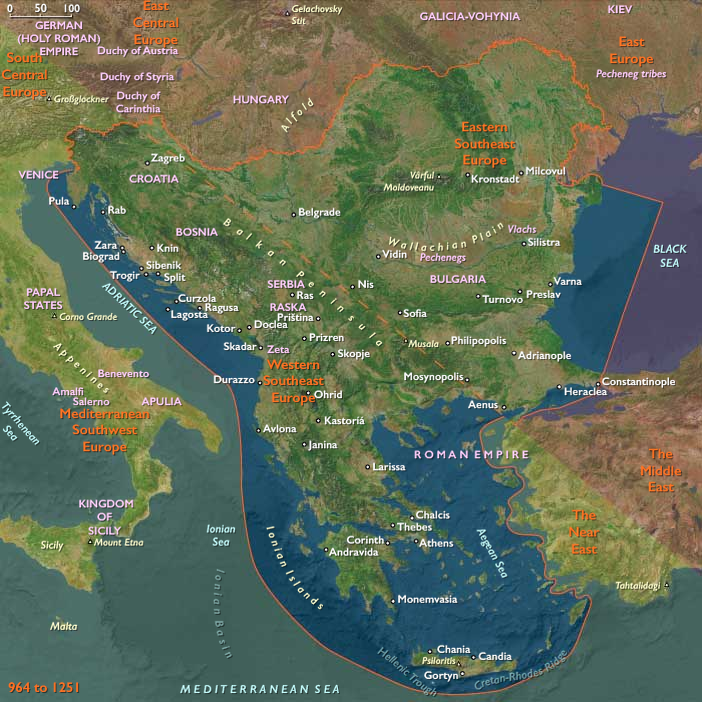
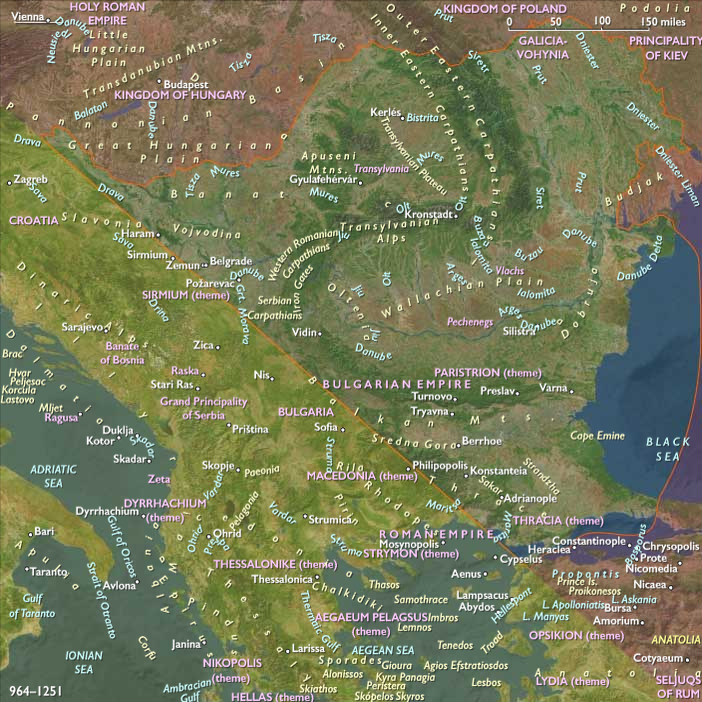
The return of Andrew II of Hungary from the Fifth Crusade in 1218 had provided Ivan Asen II an opportunity to establish a marriage alliance and to obtain (probably in 1221) the return of the disputed territories of Belgrade on the Danube as the dowry of Princess Anna Maria of Hungary.
Ivan had also made an alliance with Theodore Komnenos Doukas of Epirus to his south, although the latter had expanded his control over various Bulgarian-inhabited territories, including Ohrid.
The alliance had been cemented with the marriage of Ivan Asen II's daughter to Theodore's brother Manuel.
After the death of Robert of Courtenay in 1228, the barons in Constantinople consider Ivan Asen II as a possible choice of regent or guardian of the minor Baldwin II.
By this time, Theodore of Epirus had reconquered Thessalonica from the Latin Empire in 1224, had had himself crowned emperor there by the autocephalous archbishop of Ohrid, had taken Adrianople, and is poised to strike at Constantinople itself.
Locations
People
Groups
- Hungary, Kingdom of
- Christians, Roman Catholic
- Christians, Eastern Orthodox
- Bulgarian Empire (Second), or Empire of Vlachs and Bulgars
- Latin Empire of Constantinople (“Romania”)
- Nicaea, Empire of
- Epirus, Despotate of
Topics
Commodoties
Subjects
Regions
Subregions
Related Events
Filter results
Showing 10 events out of 47082 total
The Kangi famine of 1231-1232, possibly the worst famine in Japan's history, is caused by unusually cold, damp weather related to world wide volcanic activity.
Snow falls in central Japan in the summer of 1230.
In 1231, in one estate in central Japan about twenty percent of cultivators die in less than a month.
Law and order breaks down; the widespread banditry even affects relations with Goryeo when hungry residents of Kyushu raided the neighboring Korean peninsula for food.
The famine also leads to numerous quarrels between warrior landlords and urban proprietors, with many estates unable to pay taxes or organize labor gangs.
When harvests are inadequate, warriors had pressured and abused the hapless cultivators, driving them from their fields.
Both the Kyoto and Kamakura governments take steps to make more grain available to commoners, but with only modest results.
A family faced with starvation might choose to sell children or other relatives in return for grain, at the same time ensuring sufficient food for the sellers and the person to be sold.
This behavior has been going on illegally for centuries, but its official authorization from 1231 to 1239 demonstrates the severity of the Kangi famine.
The policy helps to distribute famine victims to people who can feed them, but also tears apart more families.
Moreover, all those sold become members of a servile class, dwelling in small lean-tos or perhaps a room in their new master’s house.
The new policy save lives but creates many dependent, broken, and poor families.
The result is a lower fertility rate, making recovery from the famine even more difficult.
One consequence of the famine is the considerable expansion of the servile class, which is to remain a significant proportion of Japanese society for the next four centuries. (Farris, William Wayne. Japan To 1600: A Social and Economic History. University of Hawai'i Press, 2009)
The Bulgar State centered in lower Volga and Kama is the center of the fur trade in Eurasia throughout most of its history.
Before the Mongol conquest, Russians of Novgorod and Vladimir repeatedly loot and attack the area, thereby weakening the Bulgar state's economy and military power.
The latter had ambushed the Mongols in late 1223 or in 1224.
Several subsequent clashes occur between 1229–1234, and the Mongol Empire conquers the Bulgars in 1236.
The Mongol invasion of Rus' had been heralded by the Battle of the Kalka River in 1223 between Subutai's reconnaissance unit and the combined force of several Rus' princes.
After fifteen years of peace, it is followed by Batu Khan's full-scale invasion during 1237 to 1240.
The invasion, facilitated by the breakup of Kievan Rus' in the twelfth century, has incalculable ramifications for the history of Eastern Europe, including the division of the East Slavic people into three separate nations and the rise of the Grand Duchy of Moscow.
Northeast Europe (1228–1239 CE): Continued Crusader Expansion and Baltic Resistance
Introduction
Between 1228 and 1239 CE, Northeast Europe experienced continued territorial expansion by Danish and German crusaders, ongoing Swedish colonization efforts, and persistent resistance by Baltic tribes. The political and cultural landscapes of the region were further reshaped as foreign powers deepened their authority, intensifying local conflicts and embedding Christianity across conquered lands.
Danish Estonia and Livonian Consolidation
The territorial organization established by earlier conquests solidified during this era. In Danish Estonia, with its capital at Reval (Tallinn)—founded after the Danish conquest of Lyndanisse in 1219—the Danish crown further entrenched its rule through fortified strongholds, notably the strategic fortress Castrum Danorum at Toompea Hill. Danish authority solidified as local administration and ecclesiastical structures were firmly established.
Simultaneously, the Livonian Confederation, under German crusader and clerical administration, expanded control over the southern Baltic territories, encompassing modern-day Latvia and southern Estonia. German crusaders fortified their positions, especially through the strongholds in Riga, consolidating political, military, and ecclesiastical dominance.
The Teutonic Order and Prussian Conquests
The arrival and rapid territorial expansion of the Teutonic Knights marked a significant development during this period. These powerful German crusaders intensified their conquest of pagan territories further south in Prussia, systematically subjugating local tribes. Their military dominance reshaped the political structure of the southeastern Baltic and initiated widespread cultural and religious transformation, increasingly interconnecting Prussia with Livonian and Danish territories.
Continued Swedish Expansion in Finland
Sweden further advanced its territorial and religious ambitions in southern Finland during this period, establishing additional fortified settlements and expanding Christian missionary activities. Swedish colonization deepened, entrenching cultural and political divisions between the Finnic populations in Finland and their Baltic kinsmen, particularly the Estonians under Danish and German domination.
Baltic Resistance and Major Uprisings
Baltic tribes maintained robust resistance against Danish and German crusader forces. Significant rebellions occurred during this period, notably among the Estonians and Curonians, whose defiance compelled continuous military responses from the crusaders. The tribes developed increasingly organized defensive strategies and alliances, highlighting their sustained determination to preserve independence and cultural traditions despite heavy pressures.
Economic Expansion and Urban Growth
Economic prosperity continued to expand in the key Baltic cities established by the crusaders. Reval (Tallinn) and Riga rapidly developed into vital commercial hubs, linking Northeast Europe with broader European trade networks. Traditional economic centers, including Visby on Gotland, thrived as critical nodes of maritime commerce, enhancing regional wealth and urbanization.
Ecclesiastical Influence and Cultural Integration
Ecclesiastical institutions further extended their authority across Northeast Europe, systematically embedding Christianity in conquered territories. Clerical leaders and monastic communities, particularly the Cistercians and the Teutonic Order, facilitated widespread cultural integration through missionary efforts, education, legal reform, and local administration. The establishment of dioceses in newly conquered areas, particularly in Livonia and Prussia, deepened Christian cultural dominance.
Legacy of the Era
The period 1228–1239 CE critically influenced the future of Northeast Europe. The consolidation of Danish and German control, Swedish colonization in Finland, persistent Baltic resistance, and rapid ecclesiastical expansion laid lasting foundations. This era established enduring political boundaries, cultural divisions, and social structures that continued to shape the historical development of Northeast Europe for centuries.
East Central Europe (1228–1239 CE): Mongol Threat Emerges, Hungarian Aristocratic Tensions, Bohemian Stability under Wenceslaus I, and Polish Unity Efforts under Henry I
Between 1228 and 1239 CE, East Central Europe—including modern-day Poland, Czechia, Slovakia, Hungary, and eastern parts of Germany and Austria east of 10°E and north of the defined southeastern boundary—entered a critical era of growing external threats, internal aristocratic struggles, and further consolidation of regional identities. The looming threat of the Mongol Empire began to influence regional dynamics profoundly, Hungarian politics saw intensified tensions between Andrew II and powerful aristocrats, Bohemia remained stable under Wenceslaus I, Poland saw renewed unity efforts under Silesian Duke Henry I the Bearded, and Austria’s Babenberg dynasty maintained steady governance. Collectively, these developments significantly impacted regional political stability, defense strategies, and cultural landscapes.
Political and Military Developments
Emergence of the Mongol Threat
-
By the late 1220s and into the 1230s, news of the Mongol invasions into Russia and Eastern Europe caused growing anxiety among regional rulers. Hungary and Poland especially began preparations for potential Mongol attacks, marking a significant shift toward defensive policies and military organization.
Hungarian Aristocratic Struggles under Andrew II and Béla IV
-
King Andrew II (r. 1205–1235) continued to face significant aristocratic challenges, intensified by the rights granted to the nobility under the Golden Bull of 1222. His final years were marked by increased internal tensions, weakening royal central authority.
-
His successor, Béla IV (r. 1235–1270), sought to restore royal power and consolidate central authority, though faced immediate opposition and considerable aristocratic resistance, complicating Hungary’s internal political situation amid growing external threats.
Stability in Bohemia under Wenceslaus I
-
Wenceslaus I Přemysl (r. 1230–1253) succeeded Ottokar I, providing continued political stability, territorial security, and cultural flourishing. His reign consolidated royal authority, strengthened administrative reforms, and maintained Bohemia’s prominent position within the Holy Roman Empire.
-
Prague’s political and cultural prestige notably increased, further solidifying Bohemia’s regional influence.
Polish Unity Efforts under Henry I the Bearded
-
In Poland, Henry I the Bearded of Silesia (r. 1201–1238) intensified his efforts to reunify fragmented Polish territories. His strategic alliances and political diplomacy gradually consolidated greater parts of Poland under Silesian leadership, significantly elevating Silesia’s regional prominence.
-
Henry’s governance laid essential groundwork for future efforts toward broader Polish unification and stability.
Continued Austrian Stability under Frederick II the Quarrelsome
-
Austria under Duke Frederick II the Quarrelsome (r. 1230–1246) of the Babenberg dynasty maintained political stability and territorial integrity. Despite his contentious personality, Frederick preserved Austria’s status as a significant regional power within the Holy Roman Empire, contributing to sustained economic and cultural development.
Imperial Influence under Frederick II
-
Emperor Frederick II (r. 1212–1250) continued to influence East Central Europe significantly. His diplomacy, military campaigns, and administrative strategies shaped political alliances and governance structures, particularly impacting Bohemia, Austria, and neighboring regions.
Economic and Technological Developments
Regional Economic Prosperity Amid Growing Uncertainty
-
Despite rising external threats, East Central Europe maintained economic prosperity through active trade networks connecting Baltic, Mediterranean, Byzantine, and Western European markets. Urban centers like Prague, Vienna, Kraków, Wrocław, Esztergom, and Buda continued to flourish commercially.
Agricultural Productivity and Technological Advances
-
Agricultural productivity further increased through widespread adoption of advanced farming techniques, improved metal plows, crop rotation, and livestock management, enabling significant population growth and supporting urbanization and regional economic stability.
Cultural and Artistic Developments
Bohemian Cultural Flourishing under Wenceslaus I
-
Under Wenceslaus I, Bohemia—particularly Prague—saw extensive cultural patronage, including ecclesiastical architecture, manuscript production, and artistic endeavors. This period significantly elevated Prague’s cultural prestige and intellectual influence within Central Europe.
Hungarian Cultural Continuity amid Internal Tensions
-
Despite internal political tensions, Hungary maintained robust cultural and ecclesiastical activity. Manuscript illumination, ecclesiastical architecture, and scholarly pursuits continued, supported by religious institutions and aristocratic patrons.
Silesian Cultural and Scholarly Activity under Henry the Bearded
-
Henry I’s patronage significantly enhanced Silesian cultural vitality, supporting monasteries, scholarly institutions, manuscript production, and urban development. These efforts reinforced Silesia’s prominence within fragmented Poland and across East Central Europe.
Settlement and Urban Development
Urban Fortifications and Expansion amid Mongol Threat
-
Growing awareness of Mongol threats encouraged fortification improvements and urban defensive strategies across Hungary, Poland, and neighboring regions. Major cities enhanced their defensive walls, towers, and military infrastructure, notably in Hungary and Poland.
Bohemian Urban Stability and Expansion under Wenceslaus I
-
Prague and other Bohemian urban centers maintained growth and development, benefiting from stable royal governance, infrastructural improvements, and flourishing commerce. Prague’s prominence as a regional cultural, economic, and political hub was further reinforced.
Austrian Urban Prosperity and Territorial Cohesion
-
Austrian towns, particularly Vienna, continued prospering economically and administratively under Frederick II the Quarrelsome. Urban fortifications and infrastructure developed substantially, bolstering Austria’s stability and regional influence.
Social and Religious Developments
Expansion and Strengthening of Ecclesiastical Institutions
-
Ecclesiastical institutions continued to expand their influence, significantly shaping governance, education, and cultural identity. Monasteries, bishoprics, and religious orders reinforced societal cohesion and intellectual development.
Aristocratic Power and Governance
-
Aristocratic authority strongly influenced regional governance. In Hungary, aristocratic tensions heightened, limiting royal authority. Conversely, Bohemia, Austria, and Silesia saw stable aristocratic support for strong dynastic governance, highlighting varied aristocratic roles across the region.
Long-Term Consequences and Historical Significance
The era 1228–1239 CE critically shaped East Central Europe’s medieval trajectory. The emergence of the Mongol threat profoundly influenced regional defense strategies. Hungary faced significant aristocratic struggles under Andrew II and Béla IV, complicating internal governance amid external threats. Bohemia’s stability under Wenceslaus I provided vital regional continuity, while Henry the Bearded’s efforts enhanced Polish unity and Silesian prominence. Austria under Frederick II the Quarrelsome maintained political stability and economic growth. Collectively, these developments laid crucial foundations for the significant challenges and transformations characterizing the subsequent decades, particularly the imminent Mongol invasions that would dramatically reshape the region.
The territory of the Constantinople-based Latin Empire is substantially reduced by invasions by the Greeks of Epirus and Nicaea and by the Bulgarians.
Eastern Southeast Europe (1228–1239 CE): Territorial Realignments and Regional Rivalries
Settlement and Migration Patterns
Shrinking Latin Influence
The territory of the Constantinople-based Latin Empire was substantially reduced during this era, as aggressive invasions by the Greeks of the Despotate of Epirus and the Empire of Nicaea, coupled with military pressures from the expanding Second Bulgarian Empire, eroded Latin control. This caused notable demographic shifts, with Latin settlers either integrating into local populations or retreating to fortified enclaves.
Bulgarian Territorial Consolidation
Under the leadership of Tsar Ivan Asen II, the Second Bulgarian Empire continued to expand and consolidate its hold on the Balkans, significantly shaping regional demographics and reinforcing Bulgarian cultural and administrative influence across newly acquired territories.
Emergence of Greek Successor States
The Empire of Nicaea and the Despotate of Epirus successfully reclaimed numerous Byzantine territories from Latin control. The consolidation of these Greek successor states led to population movements as Greek populations resettled reclaimed territories, bolstering their demographic and cultural cohesion.
Economic and Technological Developments
Localized Economic Strength
Economic activities increasingly localized as centralized Latin power weakened. Bulgaria, Epirus, and Nicaea each strengthened internal trade networks and local artisanal production, boosting regional economies and reducing reliance on broader imperial commerce.
Defensive Innovations
Amidst frequent conflicts, fortifications throughout the region were expanded and strengthened. Notably, urban centers under Bulgarian and Greek control received significant fortification upgrades, reflecting the heightened need for defense against both internal revolts and external invasions.
Cultural and Artistic Developments
Revival of Byzantine Traditions
With the resurgence of Greek successor states, Byzantine cultural traditions flourished anew. Artistic expressions, including religious iconography and architecture, strongly revived traditional Byzantine styles, particularly within the Empire of Nicaea and the Despotate of Epirus.
Bulgarian Cultural Flourishing
Under Ivan Asen II, the Second Bulgarian Empire experienced a cultural renaissance. Architectural developments, manuscript illumination, and religious arts saw notable advancements, reflecting both Byzantine influence and distinct Bulgarian cultural identity.
Social and Religious Developments
Orthodox Ecclesiastical Reassertion
The resurgence of Greek states bolstered Eastern Orthodoxy, diminishing the influence of Latin ecclesiastical structures imposed by the crusaders. Orthodox patriarchates and bishoprics regained prominence in reclaimed territories, reinforcing religious and social cohesion.
Bulgarian Ecclesiastical Independence
The Bulgarian Orthodox Church continued to assert its independence and authority, significantly shaping social and political structures within the expanding Bulgarian territories. Ivan Asen II notably supported ecclesiastical autonomy, reinforcing Bulgaria's national and religious identity.
Political Fragmentation and Regional Rivalries
Decline of the Latin Empire
The Latin Empire's authority continued to diminish significantly, weakened by continuous territorial losses and internal divisions. Its rulers struggled to maintain effective control, rendering it increasingly vulnerable to the resurgent Greek states and Bulgarian expansion.
Rise of Greek and Bulgarian Dominance
This period marked the definitive ascendance of the Empire of Nicaea, Despotate of Epirus, and the Second Bulgarian Empire as dominant regional powers. Their territorial gains significantly reshaped political dynamics, intensifying rivalries and alliances that defined subsequent regional politics.
Long-Term Consequences and Historical Significance
The period from 1228 to 1239 CE profoundly reshaped Eastern Southeast Europe, characterized by significant territorial realignments, the decline of Latin rule, and the strengthened positions of Greek and Bulgarian powers. These changes significantly influenced the region's historical trajectory, laying the groundwork for renewed Byzantine revival efforts and intensified national and religious identities.

The expansionist Mongols disrupt the entire northern Near East.
Marching west to war from a center near Azerbaijan, they systematically conquer Syria, Syrian Mesopotamia, and eastern Anatolia.
The Mongols attack the Christian kingdoms of Armenia and Georgia in 1235-36 to keep their communication lines open for a European offensive planned for the coming year.
The Mongols shatter Georgian unity and, in 1239, ravage the Armenian capital.
The Zengids, based in Mosul, Iraq, have sent troops to the Omani coast in the 1220s and 1230s.
The Nabhanid dynasty continues to control Oman's interior, but Turkic Oguz (Ghuzz), Persians, and others variously possess the coastal flank of the mountains.
Genghis Khan's vast Eurasian empire falls to pieces after his death in 1227.
In Afghanistan, some local chiefs successfully establish independent principalities, and others acknowledge the suzerainty of Mongol princes.
The Gitagouinda, written in the vernacular by the poet-saint Jayadeva around 1230, is one of a number of major works associated with the bhakti Hindu revival.
Years: 1228 - 1228
Locations
People
Groups
- Hungary, Kingdom of
- Christians, Roman Catholic
- Christians, Eastern Orthodox
- Bulgarian Empire (Second), or Empire of Vlachs and Bulgars
- Latin Empire of Constantinople (“Romania”)
- Nicaea, Empire of
- Epirus, Despotate of