The Anglo-Portuguese Alliance …
Years: 1384 - 1395
The Anglo-Portuguese Alliance and the Treaty of Windsor (1386–1387)
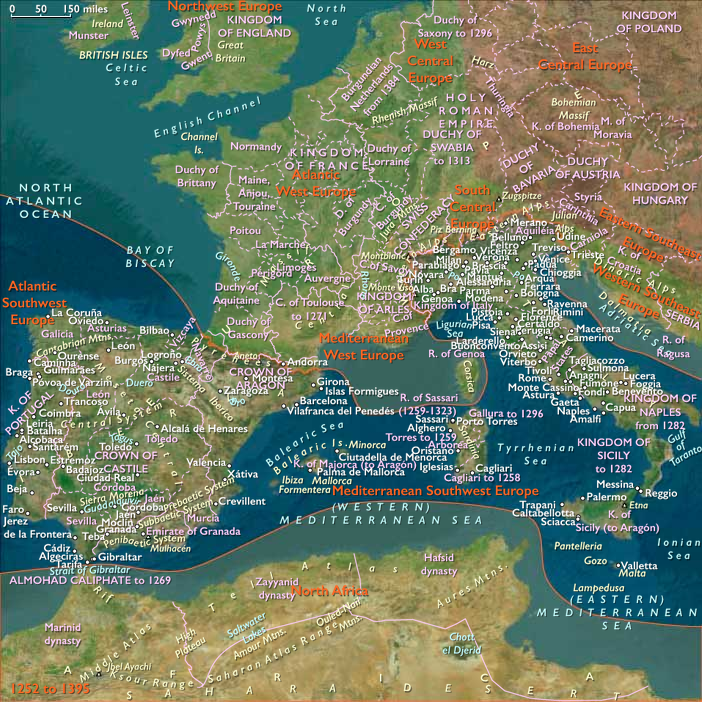
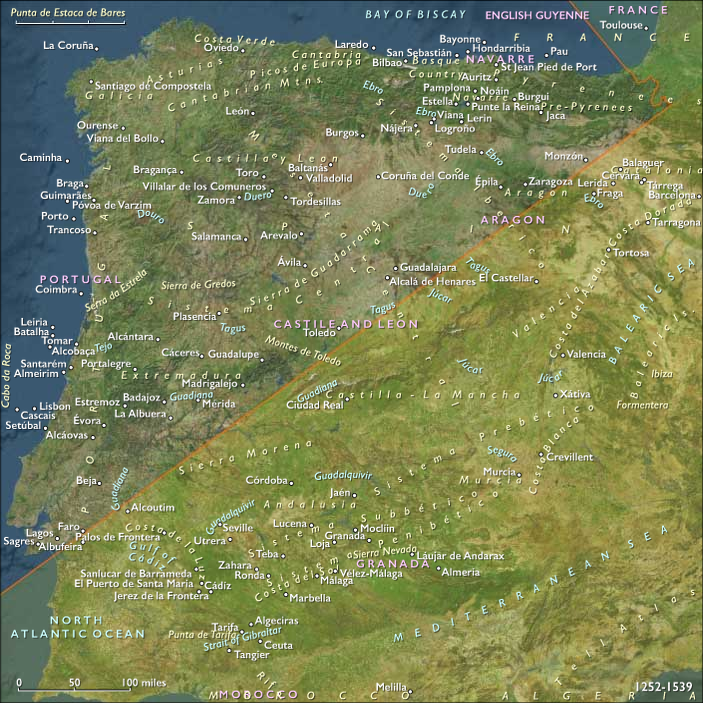
English support for the House of Avis during Portugal’s crisis of succession in the 1380s laid the foundation for a long-lasting alliance between Portugal and England, shaping Portuguese foreign policy for the next five centuries.
The Treaty of Windsor (May 1386)
In May 1386, the Treaty of Windsor formally confirmed the Anglo-Portuguese alliance, which had been forged through English aid at the Battle of Aljubarrota (1385). The treaty established a "pact of perpetual friendship", guaranteeing mutual military and commercial cooperation between the two kingdoms. It remains one of the oldest standing alliances in history.
John of Gaunt’s Castilian Campaign (1387)
In 1387, John of Gaunt, Duke of Lancaster, son of Edward III of England and father of Henry IV, launched an expeditionary campaign in Galicia, seeking to press his claim to the Castilian throne with Portuguese support.
- Despite his military presence, Gaunt failed to gain the support of the Castilian nobility, who remained loyal to the rival claimant, King John I of Castile.
- Unable to secure his objective, Gaunt negotiated a settlement and returned to England with a cash compensation, effectively ending his campaign.
Although the Castilian venture did not succeed, the Anglo-Portuguese alliance endured, providing Portugal with a powerful ally in its struggles against Castile and securing key commercial and military advantages for centuries to come.
Locations
People
Groups
- Portuguese people
- Castillian people
- Christians, Roman Catholic
- English people
- Portugal, Burgundian (Alfonsine) Kingdom of
- England, (Plantagenet, Angevin) Kingdom of
- Castile, Crown of
Topics
Commodoties
Subjects
Regions
Subregions
Related Events
Filter results
Showing 10 events out of 43629 total
The Forty Years' War begins in 1385 between the Burmese Kingdom of Ava and the Mon Kingdom of Hanthawaddy Pegu fought primarily in today's Lower Burma and also in Upper Burma, the Shan States and Rakhine State.
A truce of 1391 will stay in effect until 1404.
Yoshimitsu allows the constables, who had had limited powers during the Kamakura period, to become strong regional rulers, later called daimyo (from dai, great, and mydden, named lands). In time a balance of power evolved between the shogun and the daimyo; the three most prominent daimyo families rotate as deputies to the shogun at Kyoto.
Yoshimitsu is finally successful in reunifying the Northern and Southern courts in 1392, but, despite his promise of greater balance between the imperial lines, the Northern line will maintain control over the throne hereafter.
The line of shoguns gradually weakens after Yoshimitsu and increasingly loses power to the daimyo and other regional strongmen.
The shogun's decisions about imperial succession become meaningless, and the daimyo back their own candidates.
In time, the Ashikaga family has its own succession problems, resulting finally in the Onin War (1467-77), which leaves Kyoto devastated and effectively ends the national authority of the bakufu.
The power vacuum that ensues launches a century of anarchy.
One of Yi Song-gye's first acts is to carry out a sweeping land reform long advocated by literati reformers.
After a national cadastral survey, all old land registers are destroyed.
Except for estates doled out to loyalists called "merit subjects," Yi declares all other land to be owned by the state, thus undercutting Buddhist temples (which hold sizable tracts of farmland) and locally powerful clans—both of which had exacted high rents from peasants, leading to social distress in the late Goryeo period.
These reforms also greatly enhance the taxation revenue of the central government.
Tokhtamysh, khan of the Golden Horde, battles the Turco-Mongol warlord and conqueror Timur, in the areas of the Caucasus mountains, Turkistan and southern Russia in the 1380s and early 1390s.
The war between the two Turkic rulers plays a key role in the decline of the Turkic power in southern Russia.
The Expulsion of Jews from France and Their Eastward Migration
By the late 14th century, the Kingdom of France enacted a final expulsion of its Jewish population, following a series of earlier bans and expulsions that had been periodically reversed or reimposed throughout the Middle Ages. This forced many Jewish communities to seek refuge in the German states, where life remained difficult and precarious due to persistent legal restrictions and social discrimination.
Jewish Expulsions from France
- The expulsion of 1306 by Philip IV (the Fair) was one of the most significant, but some Jews were later allowed to return under Louis X and subsequent rulers.
- Another mass expulsion in 1322 under Charles IV further reduced Jewish communities in France.
- The final expulsion, enacted by Charles VI in 1394, permanently removed Jewish populations from the kingdom, preventing any large-scale return for centuries.
Difficult Conditions in the German States
Many exiled French Jews sought refuge in the Holy Roman Empire, particularly in the German states. However, they faced severe restrictions:
- They were barred from land ownership, preventing them from engaging in agriculture.
- They were excluded from the craft and trade guilds, limiting their ability to enter most skilled professions.
- Frequent persecutions and expulsions, often following accusations of ritual crimes or financial exploitation, created an unstable existence, with many communities forced to relocate repeatedly.
Migration into Poland: A New Opportunity
As conditions in the German states remained uncertain, many Jews moved eastward into Poland, where King Casimir III (r. 1333–1370) had extended legal protections and privileges to Jewish communities. Poland’s lack of a strong urban middle class meant that Jewish merchants, bankers, and artisans played an essential role in the economy, providing financial and commercial expertise.
This migration contributed to the growth of Jewish communities in Poland, which would eventually develop into one of the largest and most vibrant Jewish populations in Europe, playing a central role in commerce, finance, and cultural life for centuries to come.
East Europe (1384–1395 CE): Final Stages of Mongol Dominance and Muscovite Ascendancy
Political and Military Developments
Collapse of Golden Horde Authority
From 1384 to 1395 CE, the Golden Horde experienced near-total collapse in central authority, with internal fragmentation and succession crises leaving power increasingly decentralized. This collapse opened substantial political opportunities for local principalities.
Muscovy's Firm Establishment as a Regional Power
Moscow emerged decisively as the dominant political and military power in East Europe, expanding its territories significantly and solidifying centralized rule. Muscovite rulers further enhanced governance structures and diplomatic capabilities.
By the end of the 13th century, the Grand Principality of Vladimir-Suzdal had fragmented into over a dozen appanages. Moscow and Tver emerged as the two leading principalities, competing fiercely for the grand princely throne. From 1331, the prince of Moscow also held the title of Grand Prince of Vladimir, with a brief interruption from 1359 to 1363, when the throne passed temporarily to Nizhny Novgorod. In 1389, the grand principality became a family possession of the prince of Moscow, uniting the two thrones and forming a critical territorial and political foundation for the future Russian state.
Ethnic Integration and Cooperative Governance
Ethnic groups such as the Mari, Mordvins, Udmurts, Komi, and Vepsians continued their integration into Muscovite society, enhancing demographic diversity and administrative cohesion within the growing state.
Economic and Technological Developments
Economic Strengthening and Independence
Regional economies, particularly in Moscow, Novgorod, and Tver, achieved greater economic independence and prosperity through thriving internal trade and continued engagement in Eurasian commerce.
Military Technological Advancements
Further improvements in military strategies, siege tactics, and fortifications bolstered Muscovy's defensive and offensive capabilities, solidifying its position as a formidable regional power.
Cultural and Artistic Developments
Rich Cultural Fusion and Innovation
Continued cultural synthesis created a vibrant artistic landscape blending Rus', Mongol, and diverse ethnic influences. Architecture, religious iconography, and decorative arts reached notable levels of innovation and distinctiveness.
Continued Literary and Scholarly Activity
Chroniclers and intellectuals remained actively engaged in documenting historical narratives, cultural developments, and religious traditions, reinforcing regional identity and intellectual continuity.
Settlement Patterns and Urban Development
Sustained Urban Growth and Prosperity
Cities, particularly Moscow, maintained robust demographic growth and economic vitality. Urban development and infrastructure improvements supported increasingly sophisticated commercial and administrative functions.
Reinforcement of Urban Defense Systems
Advanced fortifications continued to evolve, enhancing strategic defense capabilities and protecting urban centers from potential internal and external threats.
Social and Religious Developments
Integration and Complexity in Social Structures
Societal structures further adapted to integrate diverse ethnic communities, enriching administrative and aristocratic frameworks. Social complexity increased, reflecting the diverse composition of the expanding Muscovite state.
Orthodox Church as Cultural Pillar
The Orthodox Church maintained its influential role, guiding cultural traditions, educational initiatives, and community cohesion. Its centrality remained vital in shaping regional identity and maintaining social stability.
Long-Term Consequences and Historical Significance
The period from 1384 to 1395 CE marked the definitive end of centralized Mongol control and the robust ascendance of Muscovy as the primary regional power. These developments significantly shaped future trajectories, laying the foundations for a unified Russian state and richly diverse cultural identity.
...handing Belz as a fief to the Duke of Mazovia.
Northeast Europe (1384–1395 CE): Formation of New Alliances, Territorial Consolidation, and Diplomatic Shifts
Between 1384 and 1395 CE, Northeast Europe underwent substantial geopolitical realignments, marked by the establishment of significant new unions and alliances, territorial stabilization, and economic recovery. The period saw critical developments including the early stages leading to the formation of the Kalmar Union, strengthened integration between Lithuania and Poland, and sustained control by the Teutonic Order in Estonia and Prussia.
Early Formation of the Kalmar Union
Following the death of King Olaf II in 1387, diplomatic efforts intensified among the kingdoms of Denmark, Norway, and Sweden, driven by shared economic interests, regional security concerns, and efforts to minimize dynastic instability. Margaret I, acting as regent and ruler of Denmark and Norway, skillfully advanced diplomatic negotiations and set in motion critical groundwork that would culminate in the formal establishment of the Kalmar Union in 1397. The gradual diplomatic initiatives during this era helped unite the Scandinavian kingdoms under a single crown, fundamentally altering the region’s political landscape.
Lithuanian-Polish Strategic Alliance
Concurrently, a pivotal event reshaped the eastern part of Northeast Europe. The marriage of Lithuanian Grand Duke Jogaila (later Władysław II Jagiełło) to Queen Jadwiga of Poland in 1386 created a significant personal union between the Grand Duchy of Lithuania and the Kingdom of Poland. This strategic alliance significantly strengthened both realms, enhancing their capacity to counterbalance the influence of neighboring powers, notably the Teutonic Order, and reshaped regional power dynamics, bringing greater geopolitical stability and integration in Eastern Europe.
Continued Stability Under Teutonic Governance
The Teutonic Order sustained its stable governance over territories such as Estonia and Prussia. The Order solidified administrative structures and fortified critical strategic points, including Reval (Tallinn) with its fortifications on Toompea Hill, and major urban centers like Königsberg. These actions enhanced the Order’s defensive posture, maintained economic vitality, and reinforced their regional influence.
Swedish Integration of Finland
During this period, Sweden deepened administrative, military, and ecclesiastical control over southern Finland, reinforcing political cohesion and cultural integration. Enhanced fortifications and strengthened governance frameworks ensured robust defensive capabilities, contributing significantly to regional stability and solidifying Finland’s alignment with broader Swedish geopolitical strategies.
Livonian Confederation’s Stability and Prosperity
The Livonian Confederation, administered from the trading city of Riga, continued to flourish economically and diplomatically. Effective internal governance, reinforced trade networks, and strategic diplomacy allowed the Confederation to successfully navigate complex regional politics, ensuring sustained autonomy and economic prosperity.
Economic Recovery and Urban Resilience
Urban centers including Reval (Tallinn), Riga, Königsberg, and Visby on Gotland enjoyed ongoing economic resurgence, driven by robust maritime commerce, enhanced trade networks, and merchant activity. These cities emerged as resilient economic hubs, significantly contributing to regional economic stability and broader recovery efforts.
Ecclesiastical Influence and Cultural Continuity
Ecclesiastical institutions, notably the Teutonic Order and influential regional bishoprics, played critical roles in fostering education, cultural continuity, and social stability. They sustained Latin Christian traditions, providing essential social services and education, thus reinforcing regional cohesion during an era of significant geopolitical realignment.
Strategic Diplomatic Realignments
Diplomatic interactions intensified among regional powers, including the emerging Scandinavian alliances, the Lithuanian-Polish union, the Teutonic Order, and the Livonian Confederation. Carefully balanced diplomatic initiatives ensured peaceful coexistence, managed regional rivalries, and facilitated cooperative efforts, significantly influencing Northeast Europe's political dynamics.
Legacy of the Era
The era from 1384 to 1395 CE significantly reshaped Northeast Europe through the formation of crucial strategic alliances and unions, territorial stabilization, and economic resurgence. These developments established enduring geopolitical structures, influenced future political alignments, territorial boundaries, and cultural identities, and laid essential groundwork for subsequent historical progress across the region.

The Arrival of the Rom in Europe (14th Century)
The Rom, a landless, wandering people of north-central Indian origin, entered Europe in the 14th century, bringing with them a distinct language (Romany) and a unique cultural identity. Their language, Romany, retains a Sanskrit-based structure with loanwords from various lands they passed through, reflecting their long migratory history.
Origins and Migration
Modern scholarship suggests that the Rom may have originated from a multiethnic military group formed in northwestern India to resist Islamic invasions. Over time, they migrated westward, likely moving through Persia, Armenia, and the Byzantine Empire before reaching the Balkans and Western Europe.
Economic and Social Exclusion
Upon their arrival in Europe, the Rom found themselves marginalized by local societies.
- They rejected agriculture and other settled occupations, instead specializing in trades that avoided direct competition with local populations.
- Excluded from craft and trade guilds, they earned their livelihood as:
- Entertainers and musicians
- Magicians and fortune tellers
- Blacksmiths and coppersmiths
- Horse traders and animal handlers
Religious and Social Stigma
The Roman Catholic Church forbade association with Rom fortunetellers, reinforcing their status as outsiders.
- Their mystical reputation, nomadic lifestyle, and distinct customs fueled mistrust and discrimination.
- In England, they were erroneously believed to have come from Egypt, leading to the colloquial term "Gypsies", which would become widespread.
Long-Term Influence and Legacy
Despite centuries of marginalization and persecution, the Rom contributed to European culture, particularly in music, metalworking, and horse trading. Their oral traditions and artistic expressions shaped aspects of folk music and performance arts in various countries.
Their 14th-century arrival in Europe marked the beginning of a complex and often fraught relationship with European societies, one that continues to evolve today.
Both the Kingdom of Poland and Kievan Rus had fought in the tenth century for the possession of Chelm Land, of which Chelm is the most important town, and after several subsequent conflicts, in about 1240 King Daniel of Galicia had made Chełm capital of an Orthodox Diocese, which resulted in the rapid development of the town.
Following the Mongol invasion of Rus', which weakened the Ruthenian states, the Grand Duchy of Lithuania, a new power in Eastern Europe, had occupied Chełm.
Polish King Casimir III had annexed the town, together with Belz, Red Ruthenia and Podolia, in 1340.
The Land of Chełm was initially united with the Land of Belz, but in 1387 King Wladyslaw Jagiello directly annexes Chelm to the Polish Crown, while …
Years: 1384 - 1395
Locations
People
Groups
- Portuguese people
- Castillian people
- Christians, Roman Catholic
- English people
- Portugal, Burgundian (Alfonsine) Kingdom of
- England, (Plantagenet, Angevin) Kingdom of
- Castile, Crown of