
The Legacy of Charles V: A Model …
Years: 1372 - 1383
The Legacy of Charles V: A Model of Kingship and Its Decline
The reign of King Charles V of France (r. 1364–1380) left a lasting impression on posterity, as his conception of governance became an ideal that later courtiers wished his successors would emulate. His rule combined pragmatism, intellectual refinement, and political acumen, stabilizing the kingdom after the disasters of the Hundred Years’ War and the internal turmoil of the Jacquerie (1358) and the Étienne Marcel Revolt (1357–1358).
Charles V in Political Thought and Biography
Much of what we know about Charles V’s personal and political life comes from Christine de Pizan’s biography, commissioned in 1404 by Philip the Bold, Duke of Burgundy. Pizan’s work not only preserves intimate details of the king’s rule, but also serves as a moral guide for his successors. Drawing on the political philosophy of Nicole Oresme, who translated Aristotle’s moral works into French, and Giles of Rome, the biography presents Charles as a model ruler, embodying the wisdom and piety that his heirs were expected to follow.
A similar didactic portrayal appears in Philippe de Mézières’ allegorical Songe du Vieil Pèlerin (The Old Pilgrim’s Dream), written for Charles’ son, the future Charles VI. Mézières urges the dauphin to emulate his father’s piety and reformist zeal, though history would prove that Charles VI did not live up to this ideal.
The Royal Library and the Intellectual Kingship of Charles V
Among Charles V’s greatest achievements was his vast royal library, housed in his expanded Louvre, which symbolized both the magnificence of the monarchy and his belief in governance for the common good. Containing over 1,200 volumes, the library was described in detail by the 19th-century historian Léopold Delisle.
- Charles prioritized works in French so that his counselors and officials could access them, reinforcing royal authority through knowledge.
- The most significant translations commissioned for the library were those of Nicole Oresme, who produced the first full French translations of Aristotle’s Politics, Ethics, and Economics.
- The Politics and Economics served as manuals for government, while the Ethics advised the king on how to be a virtuous ruler.
- Other notable works included:
- Songe du Vergier, an anonymous legal treatise inspired by the debates between Philip IV’s jurists and Pope Boniface VIII.
- The translations of Raoul de Presles, which included St. Augustine’s City of God.
- The 1377 edition of the Grandes Chroniques de France, edited to emphasize the vassalage of Edward III, reinforcing the Valois claim to French sovereignty over English-occupied lands.
Charles' kingship placed great emphasis on both royal ceremony and political theory, seeking to embody the ideals of St. Louis (Louis IX), Charlemagne, and Clovis, as depicted in his Coronation Book of 1364, now housed in the British Library.
The Builder King: Architecture and Urban Fortifications
Charles was also a builder king, commissioning or rebuilding several significant fortifications and palaces in the late 14th-century style, including:
- The Bastille, initially constructed as a fortress to defend Paris.
- The Château du Louvre, expanded as both a residence and a stronghold.
- The Château de Vincennes, a royal residence and military stronghold.
- The Château de Saint-Germain-en-Laye, a model later widely imitated by the nobility.
These constructions reflected Charles' strategic foresight, reinforcing France’s urban defenses while also displaying royal prestige.
The Fragility of Charles V’s Achievements
While his reign marked a recovery from the devastation of Brétigny (1360), Charles’ successes ultimately proved ephemeral.
- His brothers, who dominated the regency council after his death, quarreled among themselves, weakening central authority.
- His son, Charles VI, neglected governance in favor of courtly entertainments, and after his descent into madness in 1392, his uncles resumed control, leading to factional rivalries.
- By 1419, the kingdom was divided between Armagnac and Burgundian factions, while Henry V of England was conquering northern France, culminating in the Treaty of Troyes (1420), which nearly extinguished Valois rule.
Thus, the hard-won victories of Charles V were squandered by his successors, plunging France into renewed crisis.
Locations
People
- Charles V of France
- Charles VI of France
- Edward III of England
- Nicole Oresme
- Philip the Bold
- Philippe de Mézières
Groups
Topics
Commodoties
Subjects
Regions
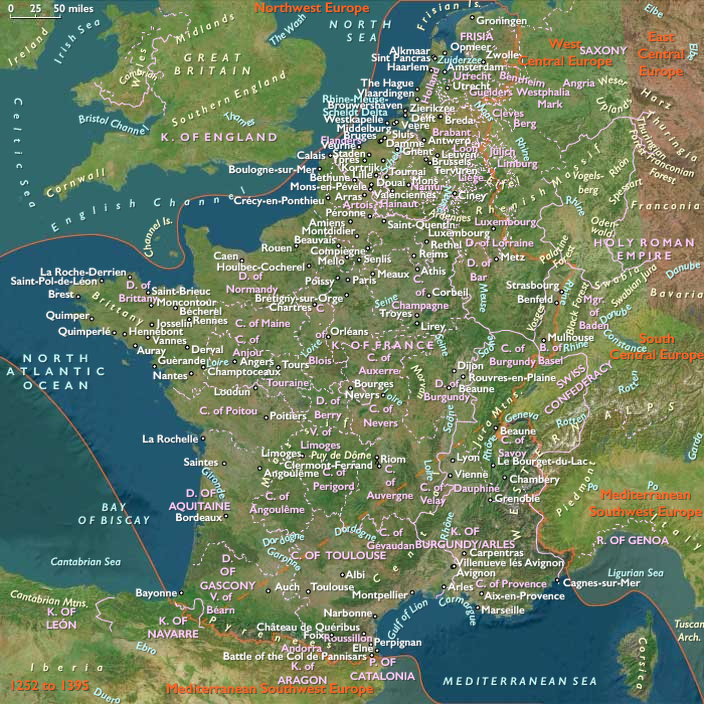
Subregions
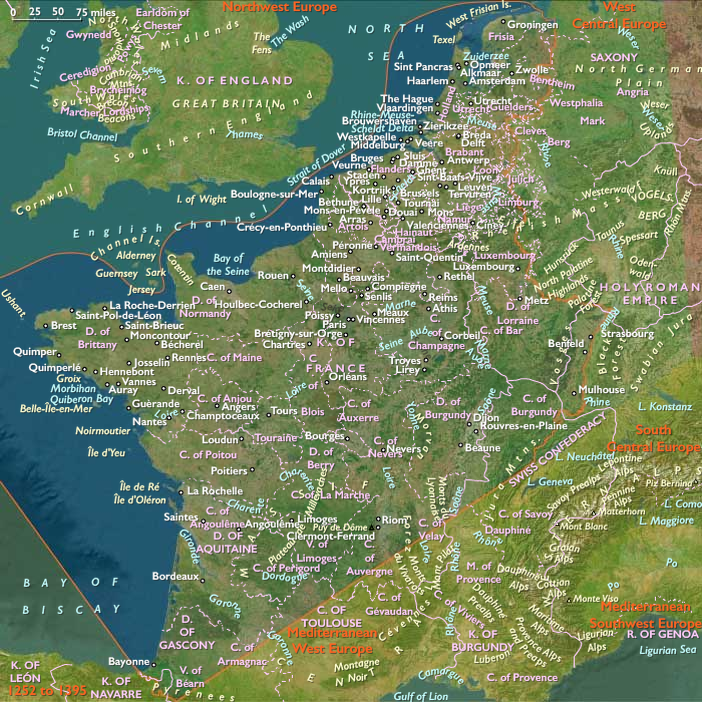
Related Events
Showing 10 events out of 43832 total
Years: 1372 - 1383
Locations
People
- Charles V of France
- Charles VI of France
- Edward III of England
- Nicole Oresme
- Philip the Bold
- Philippe de Mézières
Groups
Topics
Commodoties
Subjects
Regions
Subregions