
Filters:
The efforts of liberal-minded congressional representatives to …
Years: 1816 - 1827
The efforts of liberal-minded congressional representatives to subject the military more fully to civilian courts are seen by the latter as an affront,and much of the clergy resents legislation designed to curb church influence, such as measures closing small convents and promoting secular education.
Bolivar, as a committed freethinker, does not oppose the objectives of these first anticlerical measures, and as one who supports total abolition of slavery, he definitely opposes the campaign of slaveholders to water down the free-birth law passed by the Congress of Cucuta in 1821, but he feels that many of the reforms adopted are premature, thus needlessly promoting unrest, and he assigns part of the blame to Vice President Santander, a man who had dropped out of law study to fight for independence but as chief executive surrounds himself with ardent young lawyers as helpers and advisers.
What the country needs, in Bolivar's view, is a stronger executive, a less assertive legislature, and a partial rollback of overhasty reforms.
He also hopes to see some form of a new constitution that he has drafted for Bolivia adopted in the Republic of Colombia.
Its central feature is a president serving for life and appointing his successor.
Some other features are highly liberal, but what attracts attention is the call for a life-term president, who in the Colombian case will obviously be himself.
Bolivar journeys back from Peru to Colombia in September-November 1826.
He finds little real support for introducing his constitutional panacea, but he solves the Venezuelan rebellion by meeting with General Paéz in Venezuela in January 1827 and pardoning him, as well as by promising to call a convention to reform the existing constitution in some way.
This September Bolivar returns to Bogota and resumes the presidency of Colombia.
Bolivar, as a committed freethinker, does not oppose the objectives of these first anticlerical measures, and as one who supports total abolition of slavery, he definitely opposes the campaign of slaveholders to water down the free-birth law passed by the Congress of Cucuta in 1821, but he feels that many of the reforms adopted are premature, thus needlessly promoting unrest, and he assigns part of the blame to Vice President Santander, a man who had dropped out of law study to fight for independence but as chief executive surrounds himself with ardent young lawyers as helpers and advisers.
What the country needs, in Bolivar's view, is a stronger executive, a less assertive legislature, and a partial rollback of overhasty reforms.
He also hopes to see some form of a new constitution that he has drafted for Bolivia adopted in the Republic of Colombia.
Its central feature is a president serving for life and appointing his successor.
Some other features are highly liberal, but what attracts attention is the call for a life-term president, who in the Colombian case will obviously be himself.
Bolivar journeys back from Peru to Colombia in September-November 1826.
He finds little real support for introducing his constitutional panacea, but he solves the Venezuelan rebellion by meeting with General Paéz in Venezuela in January 1827 and pardoning him, as well as by promising to call a convention to reform the existing constitution in some way.
This September Bolivar returns to Bogota and resumes the presidency of Colombia.
Locations
People
Groups
- Tairona
- Christians, Roman Catholic
- Muisca (Amerind tribe)
- Spaniards (Latins)
- Venezuela Province
- New Granada, United Provinces of
- Colombia, Republic of (Gran Colombia)
- Peru, Republic of
- Bolivia, Republic of
Topics
- Colonization of the Americas, Spanish
- Bolivian War of Independence
- Colombian War of Independence
- Bolivar's War
- Bolívar's campaign to liberate New Granada
- Peruvian War of Independence
- Ayacucho, Battle of
Commodoties
Subjects
Regions
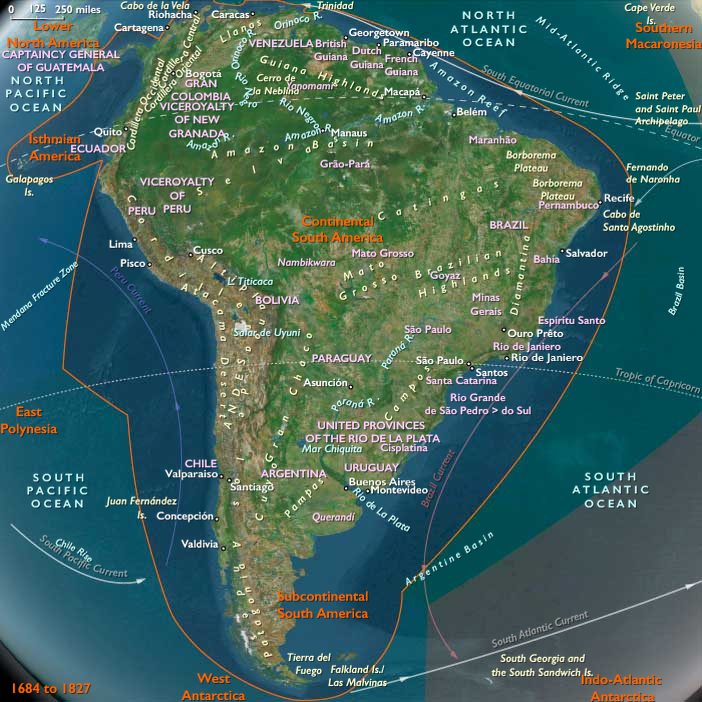
Subregions
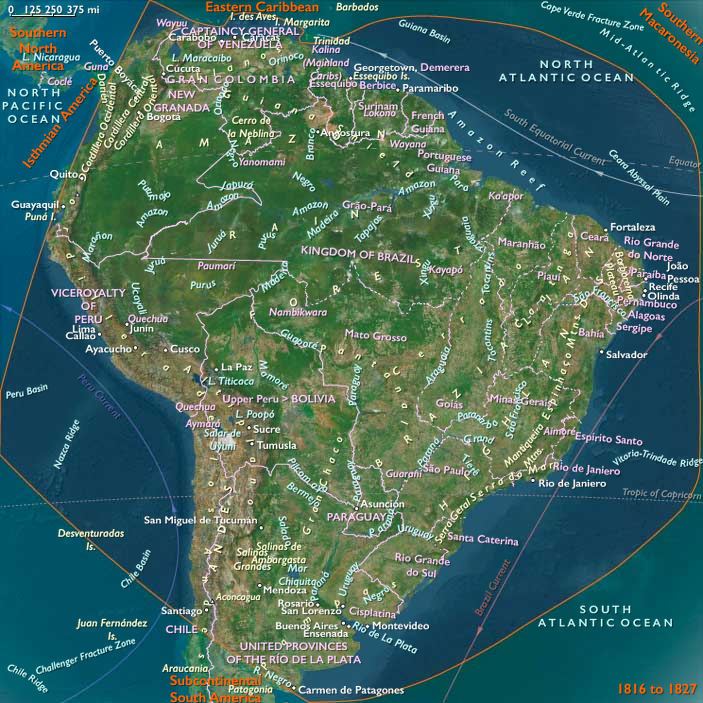
Years: 1816 - 1827
Locations
People
Groups
- Tairona
- Christians, Roman Catholic
- Muisca (Amerind tribe)
- Spaniards (Latins)
- Venezuela Province
- New Granada, United Provinces of
- Colombia, Republic of (Gran Colombia)
- Peru, Republic of
- Bolivia, Republic of
Topics
- Colonization of the Americas, Spanish
- Bolivian War of Independence
- Colombian War of Independence
- Bolivar's War
- Bolívar's campaign to liberate New Granada
- Peruvian War of Independence
- Ayacucho, Battle of
Commodoties
Subjects
Regions
Subregions