The religio-political Muslim Brotherhood (Arabic: Al-ikhwan Al-muslimun …
Years: 1928 - 1928
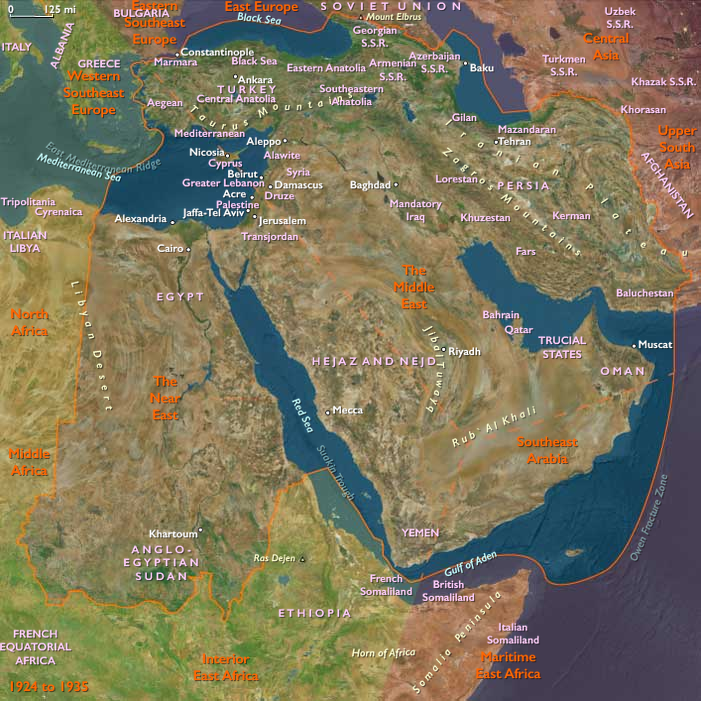
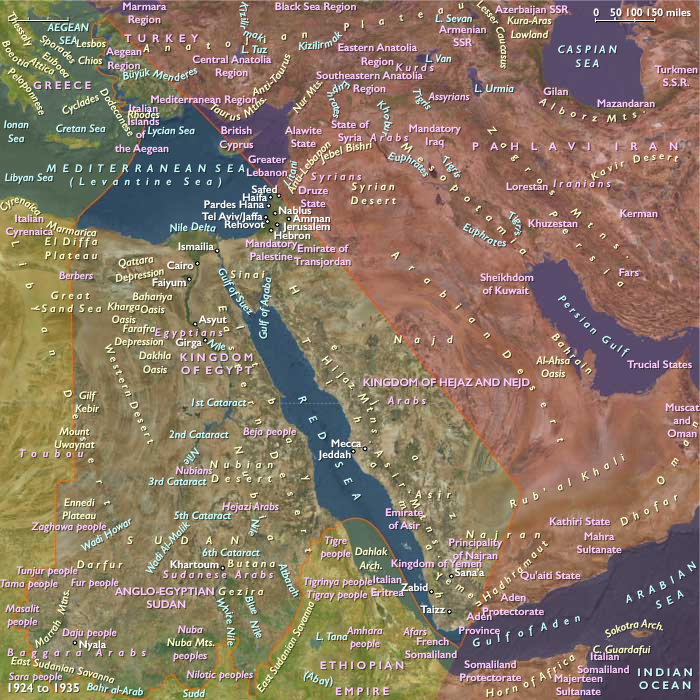
The religio-political Muslim Brotherhood (Arabic: Al-ikhwan Al-muslimun), founded in 1928 at Isma'iliyah, Egypt, by Hassan al-Banna', advocates a return to the Qur'an and the Hadith as guidelines for a healthy, modern Islamic society.
The brotherhood will spread rapidly throughout Egypt, Sudan, Syria, Palestine, Lebanon, and North Africa.
Locations
People
Groups
Topics
Subjects
Regions
Subregions
Related Events
Filter results
Showing 10 events out of 6720 total
The epidemic of encephalitis lethargica that began in 1919 -- or perhaps as early as 1915 -- had wound down by 1927 and ends definitively in 1928, having claimed an attributed 500,000 deaths and 1,000,000 cases of neurological impairment, which affects males more than females.
First described by the neurologist Constantin von Economo (1876-1931) in 1917, EL attacks the brain, leaving some victims in a statue-like condition, speechless and motionless.
An atypical form of encephalitis, also known as "sleepy sickness" or as "sleeping sickness" (though different from the sleeping sickness transmitted by the tsetse fly), EL is a devastating illness that has swept the world in the 1920s; it now vanishes as quickly as it had appeared.
One theory holds encephalitis lethargica as the explanation for the symptoms of the afflicted in New England during the 1600's, which ultimately resulted in the Salem Witch Trials.
The symptoms --characterized by increasing languor, apathy, and drowsiness, passing into lethargy -- are consistent.
(No recurrence of the epidemic has since been reported, though isolated cases continue to occur.)
The Soviet Union selects Birobidzhan (also called Birobidjan), in the basin of the middle Amur River in far eastern Russia, to become a national home for the Jews and as a buffer zone against China.
Most of its 14,200 square miles are uninhabitable due to floods.
On March 28, 1928, the Presidium of the General Executive Committee of the USSR passes the decree "On the attaching for Komzet of free territory near the Amur River in the Far East for settlement of the working Jews."
The decree means that there is "a possibility of establishment of a Jewish administrative territorial unit on the territory of the called region".
According to Joseph Stalin's national policy, each of the national groups that form the Soviet Union are to receive a territory in which to pursue cultural autonomy in a socialist framework.
In this sense, the decree is also a response to two supposed threats to the Soviet state: Judaism, which runs counter to official state policy of atheism; and Zionism, the creation of the modern State of Israel, which counters Soviet views of nationalism.
The idea is to create a new "Soviet Zion", where a proletarian Jewish culture could be developed.
Yiddish, rather than Hebrew, would be the national language, and a new socialist literature and arts would replace religion as the primary expression of culture.
Stalin's theory on the National Question holds that a group could only be a nation if they had a territory, and since there is no Jewish territory, per se, the Jews are not a nation and do not have national rights.
Jewish Communists argue that the way to solve this ideological dilemma is by creating a Jewish territory, hence the ideological motivation for the Jewish Autonomous Oblast.
Politically, it is also considered desirable to create a Soviet Jewish homeland as an ideological alternative to Zionism and the theory put forward by Socialist Zionists such as Ber Borochov that the Jewish Question could be resolved by creating a Jewish territory in Palestine.
Thus Birobidzhan is important for propaganda purposes as an argument against Zionism, which is a rival ideology to Marxism among left-wing Jews.
Another important goal of the Birobidzhan project is to increase settlement in the remote Soviet Far East, especially along the vulnerable border with China.
In 1928, there is virtually no settlement in the area, while Jews have deep roots in the western half of the Soviet Union, in Ukraine, Belarus and Russia proper.
There had initially been proposals to create a Jewish Soviet Republic in the Crimea or in part of Ukraine but these had been rejected because of fears of antagonizing non-Jews in those regions.

In the 1920s, the Liberal Party, although previously dominant in New Zealand party politics, seemed in serious long-term decline, and its organization had decayed to the point of collapse.
The United Party has emerged from a faction of the decaying Liberal Party known as "the National Party" (not directly related to the modern National Party, although it may have inspired the name).
George Forbes, a Liberal Party leader, leads the faction.
In 1927, Forbes had joined with Bill Veitch (who leads another faction of the Liberals, but who had once been involved with the labor movement) and with Albert Davy (a well-known and highly successful organizer for the Reform Party, the traditional opponent of the Liberals).
They had hoped that the United Party would draw support not only from former Liberals, but from moderates on either the right or left of the Liberals.
The new organization had adopted the name "the United Party".
This reflects in shortened form the name of the "United New Zealand Political Organisation", which Davy had used after he had left Reform.
Forbes and Veitch both contested the leadership, but eventually, Joseph Ward won the position.
Although Ward, a former Liberal Prime Minister in 1906 - 1912, does not enjoy the best of health, Davy backs him as a compromise candidate .In the 1928 elections, the new United Party performs surprisingly well, winning twenty-seven seats.
The Reform Party also has twenty-seven seats, the Labour Party has nineteen, the Country Party has one, and independents hold six.
The United Party forms a government with the backing of the Labour Party, and Ward becomes Prime Minister again.
The United Party represents an unexpected resurgence of the Liberals, and some historians consider it nothing more than the Liberal Party under a new name.
Falling export demand and commodity prices has placed massive downward pressures on wages, particularly in industries such as coal mining.
Due to falling prices, bosses are unable to pay the wages that workers want.
The result is a series of crippling strikes in many sectors of the Australian economy in the late 1920s.
Chiang is named Generalissimo of all Chinese forces and Chairman of the National Government, a post he will hold until 1932.
His party enjoys popular support; however, there are still "surrendered" warlords who are autonomous within their own regions.
Finally, the warlord capital of Beijing is taken in June 1928 and in December the Manchurian warlord Zhang Xueliang pledges allegiance to Chiang's government.
Chiang Kai-shek aligns the warlords under the Nanking government, controlled by a KMT now purged of Communists.
According to Sun Yat-sen's plans, the Kuomintang is to rebuild China in three steps: military rule, political tutelage, and constitutional rule.
The ultimate goal of the Kuomintang revolution is democratic rule, which is not feasible in China's fragmented state.
Since the Kuomintang has completed the first step of the revolution through its seizure of power in 1928, Chiang's rule thus begins the period of political tutelage under the guidance of the Kuomintang, to prepare China for the final transition to constitutional democracy.
During this period, many features of a modern, functional Chinese state will emerge and develop.
Now that Chiang has nominally reunified China against the expanding Japanese presence, the US stations Marines and ground troops throughout the country.
Around the time of the Great War, Zhang Zuolin had established himself as a hugely powerful warlord with influence over most of Manchuria.
He is determined to keep his Manchu army under his control and to keep Manchuria free of foreign influence.
The Japanese had tried to kill him in 1916 by throwing a bomb under his carriage, but failed; they finally succeed on June 2, 1928, when a bomb explodes under his seven-carriage train a few miles from Mukden station.
…-28, however, the Ikhwan destroy an Iraqi force that had violated a neutral zone established by Great Britain and Ibn Sa'ud between Iraq and Arabia.
The British bomb Nejd in retaliation.
Ibn Sa'ud convenes a congress in October 1928 that deposes Ibn Humayd, Faysal ad-Dawish, and Ibn Hithlayn, the leaders of the Ikhwan revolt.
Before the year ends, ad-Dawish, Sultan ibn Bijad, and other leaders of the Ikhwan, accusing Ibn Sa'ud of betraying the cause for which they had fought and opposing the taxes levied upon their followers, resume their defiance of the king's authority.
The rebels seek to stop the centralization of power in the hands of the king and maintain the purity of Wahhabi practices against the innovations advocated by Ibn Sa'ud.
Amanollah, following a 1927 tour of Europe and Turkey—which had seen modernization and secularization under Ataturk— introduces several reforms intended to modernize the country.
Some of these, such as the abolition of the traditional Muslim veil for women and the opening of a number of coeducational schools, quickly alienate many conservative tribal and religious leaders.
The weakness of the army under Amanollah further jeopardizes his position.
The national flag becomes in September a horizontal tricolor of black, red, and green; the golden device in the center is a rising sun over snowcapped mountains, surmounted by a five-pointed star and surrounded by a wreath.
Civil war erupts in November 1928, and Habibullah Kalakani, a Tajik folk hero-or brigand-popularly known as Baccheh Saqow (Bacha Saqqao; "Son of a Water Carrier"), occupies Kabul.
Liapchev’s government during 1927–28 has secured League of Nations stabilization loans to assist in repatriating Bulgarian refugees in the Kingdom of the Serbs, Croats, and Slovenes.
Under the Macedonian prime minister, IMRO also has much more latitude; this means that political assassinations and terrorism continue unabated.
IMRO raids into Yugoslavia end Bulgarian rapprochement with that country, and the Macedonians demand preferential economic treatment under Liapchev.
Compared with the preceding years, however, the late 1920s bring relative political stability to Bulgaria.
Liapchev leads a conservative majority in the subranie and has the confidence of Boris.
The press is relatively free, and educational and judicial institutions function independently of the government.
Industrial and agricultural output finally exceeds prewar levels, and foreign investment increases.
But even after substantial reduction, Bulgaria's reparations payments are 20 percent of her budget in 1928, and the return to the gold standard this year weakens the economy one year before the onset of world depression.
Deputies from Croatia and Bosnia and Herzegovina soon leave the Skupstina, demanding a federal state.
The political instability of the interwar years is often attributed to the Serb-Croat conflict, …