
The reign of Vologases I of Parthia, …
Years: 64 - 75
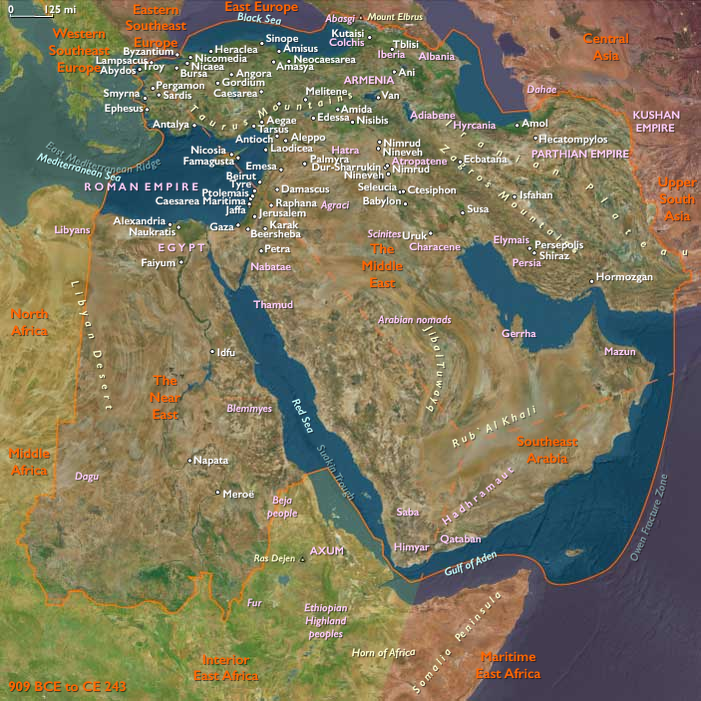
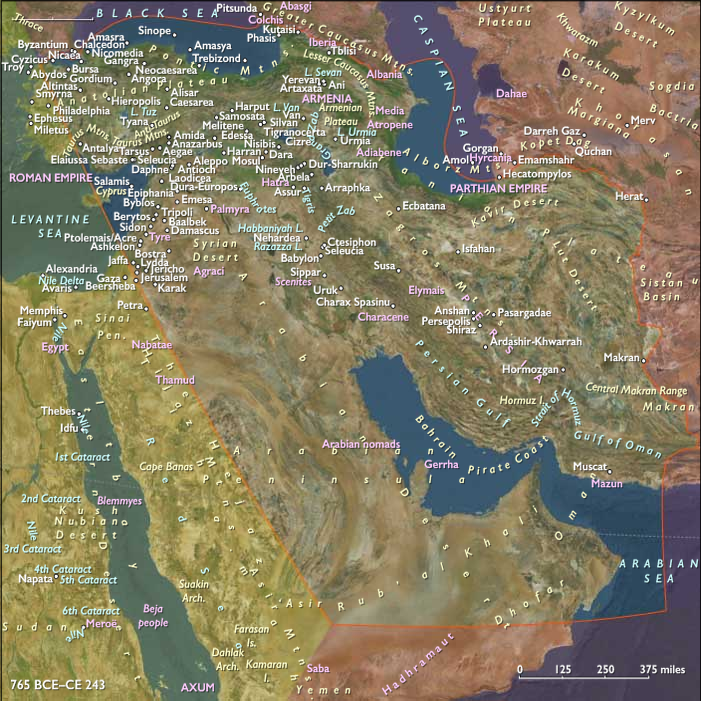
The reign of Vologases I of Parthia, ruler of the Parthian Empire, is marked by a decided reaction against Hellenism.
He is influential in reverting Hellenization by returning to Iranian customs and traditions of the Achamenids’ time.
He reverts the Greek names of Iranian cities to Iranian names.
According to Zoroastrian texts, Vologases ordered the collection of the ancient Avestan texts.
On some of his coins a fire temple can be seen; this tradition will continue for several hundred years to the end of the Sassanian dynasty.
He builds cities, including Vologesocerta (Balashkert or Balashgerd or Balashkard, literally Balash built it) in the neighborhood of Ctesiphon, with the intention of drawing to this new town the inhabitants of Seleucia on the Tigris.
Another town founded by him is Vologesias on a canal of the Euphrates, south of Babylon (near Hirah).
Vologases has good relations with Vespasian, to whom he offers an army of forty thousand archers in the war against Vitellius.
Soon afterwards the Alans, a great nomadic tribe beyond the Caucasus, invade Media and Armenia; Vologases applies in vain for help to Vespasian.
It appears that the Persian losses in the east also cannot be repaired; Hyrcania remains an independent kingdom.
Locations
People
Groups
- Iranian peoples
- Zoroastrians
- Hyrcania
- Greeks, Hellenistic
- Parthian Empire
- Alans (Sarmatian tribal grouping)
- Armenia, Kingdom of Greater
- Roman Empire (Rome): Julio-Claudian dynasty
Topics
- Classical antiquity
- Portraits, Classical
- Roman art
- Pax Romana
- Year of the Four Emperors, or Roman Civil War of 68-69
Commodoties
Subjects
Regions
Subregions
Related Events
Showing 10 events out of 61680 total
Years: 64 - 75
Locations
People
Groups
- Iranian peoples
- Zoroastrians
- Hyrcania
- Greeks, Hellenistic
- Parthian Empire
- Alans (Sarmatian tribal grouping)
- Armenia, Kingdom of Greater
- Roman Empire (Rome): Julio-Claudian dynasty
Topics
- Classical antiquity
- Portraits, Classical
- Roman art
- Pax Romana
- Year of the Four Emperors, or Roman Civil War of 68-69
Commodoties
Subjects
Regions
Subregions