
The Angevin Empire and the Capetian Rivalry …
Years: 1108 - 1251
The Angevin Empire and the Capetian Rivalry (1137–1189)
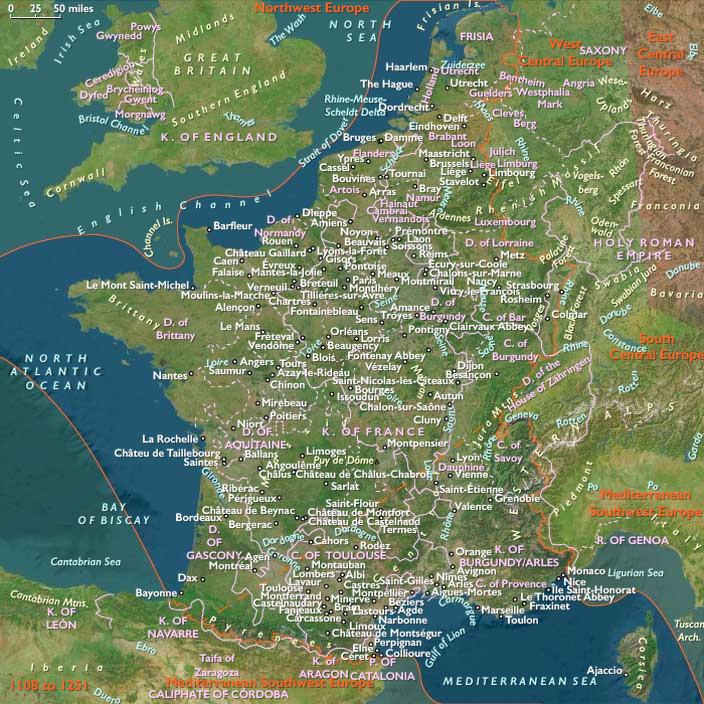
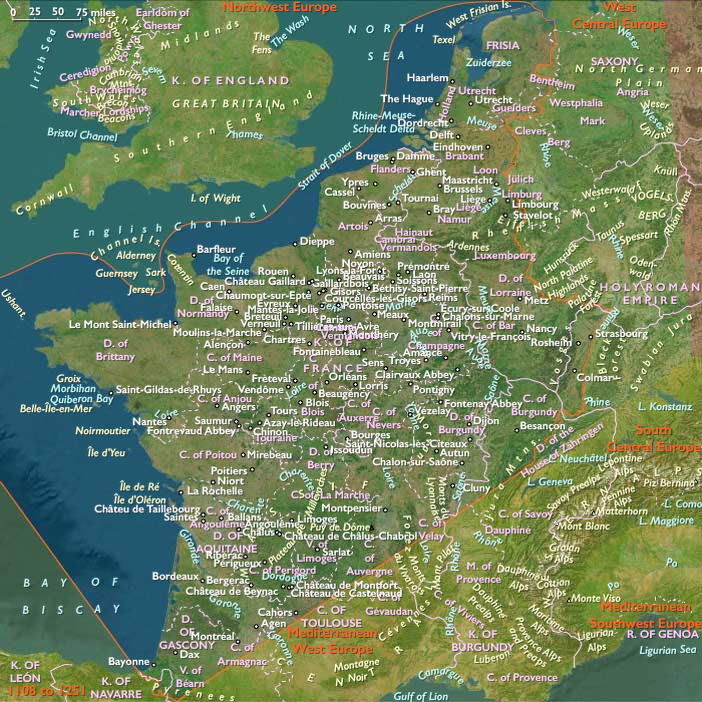
The marriage of Louis VII and Eleanor of Aquitaine initially seemed to bolster Capetian influence in Atlantic West Europe, as the vast territories of Aquitaine, Poitou, and Gascony fell under the French crown. However, the union was fraught with tensions, as Eleanor’s independent nature and close ties to her homeland clashed with Louis' pious and restrained character. Their marriage ended in annulment in 1152, allowing Eleanor to marry Henry Plantagenet, the soon-to-be Henry II of England. This union created the Angevin Empire, a vast territorial network spanning from England to Normandy, Anjou, and Aquitaine, posing a direct threat to Capetian authority.
Under Henry II (r. 1154–1189), the Angevin Empire became the dominant power in Western Europe. His legal reforms, administrative restructuring, and military campaigns reinforced his control over Atlantic West Europe, particularly in Brittany, Maine, and Poitou. However, Henry's ambitions clashed with both his sons and the Papacy. The assassination of Thomas Becket, Archbishop of Canterbury, in 1170 weakened Henry's standing with the Church, while internal rebellions among his sons—Richard the Lionheart, John Lackland, and Geoffrey of Brittany—destabilized the realm.
Despite these struggles, the Angevin presence in Atlantic West Europe remained formidable, setting the stage for continued conflict with the Capetians.
People
- Eleanor of Aquitaine
- Geoffrey II, Duke of Brittany
- Henry II of England
- John of England
- Louis VI of France
- Louis VII of France
- Philip I of France
- Richard I of England
- Thomas Becket
Groups
- Anjou, County of
- Normandy, Duchy of
- Brittanny, Duchy of
- French people (Latins)
- Aquitaine, (Angevin) Duchy of
- France, (Capetian) Kingdom of
- Christians, Roman Catholic
- England, (Norman) Kingdom of
Topics
Commodoties
Subjects
Regions
Subregions
Related Events
Showing 10 events out of 37 total
Years: 1108 - 1251
People
- Eleanor of Aquitaine
- Geoffrey II, Duke of Brittany
- Henry II of England
- John of England
- Louis VI of France
- Louis VII of France
- Philip I of France
- Richard I of England
- Thomas Becket
Groups
- Anjou, County of
- Normandy, Duchy of
- Brittanny, Duchy of
- French people (Latins)
- Aquitaine, (Angevin) Duchy of
- France, (Capetian) Kingdom of
- Christians, Roman Catholic
- England, (Norman) Kingdom of
Topics
Commodoties
Subjects
Regions
Subregions